
Revolutionizing Additive Manufacturing: Overcoming Design Challenges with Automation
The rapid evolution of additive manufacturing (AM), commonly known as 3D printing, promises unparalleled innovation and customization across numerous industries. However, a significant hurdle often slows down its widespread adoption: the intricate and time-consuming process of designing custom 3D-printable parts. Whether it’s specialized jigs, precision fixtures, or product-specific tooling, the creation of these essential components traditionally demands manual modeling by highly experienced CAD (Computer-Aided Design) users. This reliance on expert-level manual input not only makes the design phase exceptionally time-consuming but also creates a significant bottleneck in additive manufacturing workflows, severely limiting scalability and efficiency.
This manual design paradigm poses formidable challenges for companies striving to leverage the full potential of 3D printing. Each unique part, even with minor variations, often necessitates a new design cycle, stretching development timelines and escalating costs. The complexity of optimizing designs for additive manufacturing – considering factors like material properties, build orientation, support structures, and post-processing – further complicates the process. This complexity often translates into a steep learning curve for new users, perpetuating the reliance on a small pool of seasoned CAD specialists. Consequently, the promise of agile, on-demand manufacturing often remains partially unfulfilled due to these inherent design limitations.
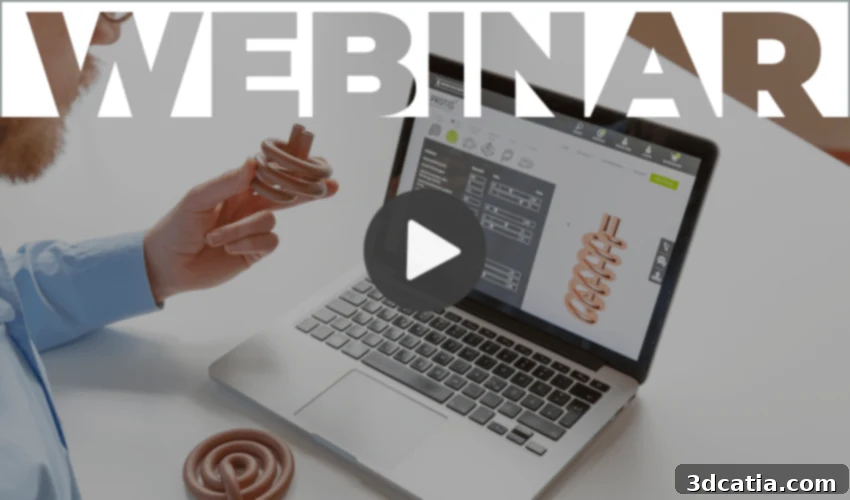
Recognizing these critical roadblocks, the industry is increasingly turning towards innovative solutions that democratize design and streamline workflows. Our recent webinar, titled “Overcoming Key AM Design Challenges in Critical Industries,” specifically addressed this pressing issue, exploring how design automation can transform the additive manufacturing landscape. We had the privilege of being joined by trinckle, a pioneering company dedicated to translating complex expert design knowledge into intuitive, automated, and user-friendly software tools. This collaboration highlighted how cutting-edge technology is making sophisticated design accessible to a wider audience, thereby unlocking greater potential within additive manufacturing.
During the webinar, our esteemed speakers delved deep into how trinckle’s revolutionary software empowers engineering teams to generate designs for complex 3D-printable parts in mere minutes, drastically reducing the reliance on advanced CAD skills. This paradigm shift accelerates product development cycles, making additive manufacturing far more accessible to organizations of all sizes and across various sectors. By removing the traditional design bottleneck, companies can unlock unprecedented 3D printing potential, fostering innovation and significantly boosting operational efficiency. For those who missed the live event, the full replay is available below, offering invaluable insights into the future of AM design.
The Power of Design Automation in Additive Manufacturing
Design automation is not merely about speeding up existing processes; it represents a fundamental shift in how custom parts are conceived and produced. By embedding expert design rules and knowledge into a software platform, trinckle’s solutions allow users to define parameters and requirements, then automatically generate optimized designs. This approach ensures design consistency, reduces human error, and allows for rapid iteration. Imagine being able to create a dozen variations of a jig for a new product in less time than it traditionally takes to design a single one manually. This capability is particularly transformative for applications requiring mass customization or a high volume of unique but structurally similar parts.
Industries from automotive and aerospace to medical and consumer goods stand to benefit immensely from these advancements. For instance, in automotive manufacturing, custom fixtures are crucial for assembly and quality control. With design automation, these tools can be rapidly designed, 3D printed, and deployed, significantly cutting lead times and costs. Similarly, in the medical field, patient-specific implants or surgical guides can be generated quickly and accurately, enhancing personalized medicine. The core benefit lies in democratizing access to complex design capabilities, moving beyond the traditional bottleneck where only a few specialists could unlock AM’s true potential. This empowers more engineers and designers to innovate directly, without extensive training in highly specialized CAD software or deep expertise in generative design algorithms.
Meet Our Expert Speakers
Ole von Seelen is a prominent figure in the additive manufacturing industry, bringing over a decade of profound experience to the table. His extensive background is marked by a deep expertise in design automation and a nuanced understanding of the practical challenges frequently encountered by AM teams. Ole has collaborated closely with a roster of industry giants, including Ford, Audi Sport, Deutsche Bahn, and Schmalz. In these partnerships, he has been instrumental in helping these leading companies navigate complex design bottlenecks, streamline their additive manufacturing workflows, and integrate digital manufacturing solutions seamlessly into their operations. His unique insight into real-world applications and his ability to translate theoretical knowledge into tangible, impactful solutions solidify his reputation as a trusted partner for organizations pushing the boundaries of digital manufacturing and seeking to optimize their 3D printing capabilities.
Koushik Sriram possesses an impressive blend of academic rigor and practical industry experience. With a strong foundation in aerospace engineering, Koushik brings a critical perspective to additive manufacturing, augmented by more than four years of dedicated experience in the field. His expertise extends deeply into mechanical design, providing him with a hands-on understanding of the daily hurdles engineers face when designing for 3D printing. Koushik is passionately driven by the desire to solve these complex problems, constantly striving to make advanced design tools more intuitive and accessible. His work focuses on empowering engineers across various industries to fully exploit the potential of additive manufacturing without being constrained by the steep learning curves typically associated with sophisticated design software. His contributions are vital in bridging the gap between advanced technology and user-friendly applications.
Madeleine Prior serves as the English Content Specialist at 3Dnatives, widely recognized as the leading international online media platform dedicated to 3D printing and additive manufacturing. As an integral member of the 3Dnatives team, Madeleine is responsible for curating and defining the content that reaches its extensive English-speaking audience. Her role involves meticulously tracking the latest developments within the additive manufacturing sector and translating complex industry news and its implications into accessible and engaging articles for readers. Through her efforts, 3Dnatives continues to be a vital source of information, keeping professionals and enthusiasts alike informed about the cutting-edge innovations, technological breakthroughs, and market trends shaping the future of 3D printing globally.
The Future is Automated: Embracing Smart Design for AM
The journey towards fully realizing the potential of industrial additive manufacturing hinges significantly on embracing smart design methodologies. Design automation, as demonstrated by trinckle’s innovative software, is not merely a convenience but a strategic imperative for businesses aiming to stay competitive. It shifts the focus from repetitive, manual design tasks to higher-value activities such as process optimization, material research, and strategic application development. This allows engineers to dedicate more time to innovation and less to the minutiae of traditional CAD, fostering an environment of accelerated development and continuous improvement.
Moreover, automated design solutions facilitate greater consistency and reliability in 3D printed parts. By standardizing design rules and incorporating validation checks, the software minimizes errors and ensures that parts are consistently optimized for the specific additive manufacturing process. This predictability is crucial for critical industries where part performance and safety are paramount. As additive manufacturing continues to mature and integrate further into mainstream production, the ability to rapidly and reliably design custom parts will become a non-negotiable requirement for efficiency, cost-effectiveness, and sustained innovation.
We invite you to experience these transformative insights by watching the full webinar replay. Discover how design automation can unlock new possibilities for your additive manufacturing initiatives, making complex design accessible and efficient. The future of 3D printing is intelligent, automated, and incredibly promising.
For further details and to gain a deeper understanding of these concepts, we encourage you to watch the full replay of the webinar. We are keen to hear your thoughts! What specific design challenges in AM do you believe software can best help to overcome within your industry? Share your insights and join the conversation in a comment below, or connect with us on our LinkedIn, Facebook, and Twitter pages! Don’t miss out on the latest 3D printing news and innovations – sign up for our free weekly Newsletter here, delivered straight to your inbox. You can also explore a wealth of informative videos and content on our YouTube channel.