
Alumide 3D Printing: The Ultimate Guide to This Polyamide-Aluminum Composite for Advanced Manufacturing
In the rapidly evolving world of additive manufacturing, material selection is paramount to achieving desired part performance and aesthetics. Engineers and designers often face a critical choice between the robust mechanical properties of metals and the design flexibility and lighter weight of polymers. What if there was a material that beautifully bridged this gap, offering the best of both worlds? Enter Alumide – a remarkable composite powder specifically engineered for 3D printing. This innovative material combines the inherent strength and pliability of polyamide (commonly known as nylon) with the distinct metallic appearance and enhanced stiffness of aluminum powder. As its name suggests, Alumide is a fusion of these two key components, creating a unique option for a wide array of industrial and consumer applications. Compatible with selective laser sintering (SLS) technology, Alumide empowers users to create intricate designs that harness nylon’s renowned versatility while benefiting from aluminum’s characteristic brilliance. If you’re looking to delve deeper into this fascinating powder material and its extensive utility in modern additive manufacturing, this comprehensive guide will walk you through everything you need to know.
Understanding the Unique Properties of Alumide in 3D Printing
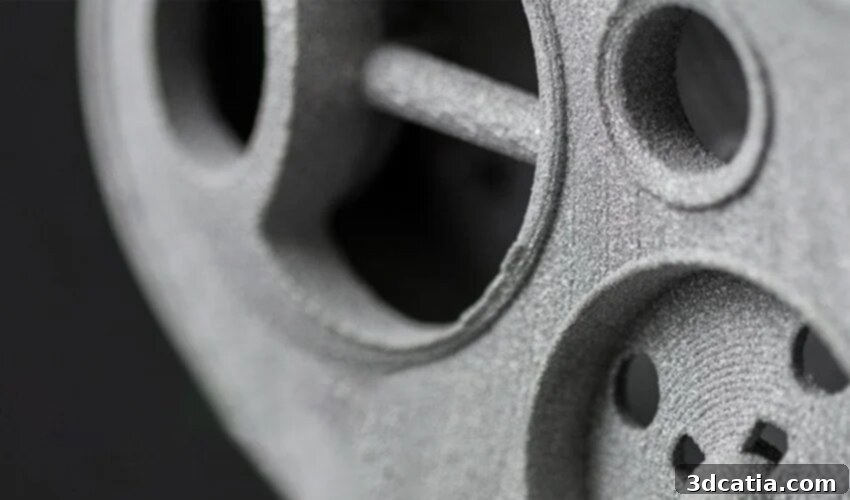
Alumide stands out as a high-performance powder material, deriving its name directly from its primary constituents: aluminum and polyamide. The composite typically comprises a significant proportion of polyamide, forming the structural backbone, with a smaller, yet crucial, percentage of fine aluminum powder dispersed throughout. This precise composition is what gives Alumide its distinctive characteristics. While the polyamide component provides excellent ductility and impact resistance, the introduction of aluminum powder imbues the material with a sophisticated matte, metallic surface finish and a subtle, appealing sheen, elevating the aesthetic quality of printed parts. However, it’s important to note that the metallic particles also contribute to a slightly increased brittleness compared to pure nylon, meaning that while it’s strong, it might be less flexible than unadulterated polyamide. Engineers and designers must factor this into their material selection process.
Beyond its visual appeal, Alumide offers a compelling set of mechanical and thermal properties that make it a superior choice for many advanced 3D printing applications. It is considerably stiffer and more rigid than many other commonly used polymer 3D printing materials, including standard nylons. This enhanced stiffness is a direct result of the aluminum content, which acts as a reinforcing agent within the polymer matrix. Furthermore, Alumide exhibits superior thermal resistance; it can withstand significantly higher temperatures without deforming or undergoing structural changes. This is a crucial advantage over conventional thermoplastics like PLA or ABS, which are prone to melting or softening at elevated temperatures, thereby limiting their application in environments requiring thermal stability. The material’s inherent porosity also plays a role in its post-processing capabilities and overall part behavior, which can be advantageous for specific functional requirements such as lightweighting or allowing for certain types of infiltration.
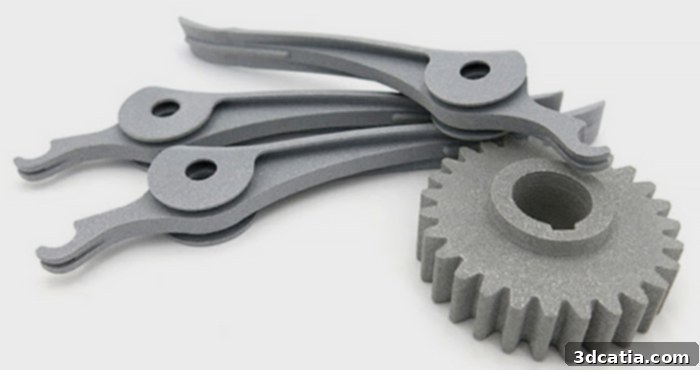
Photo Credits: Sculpteo
The manufacturing process for Alumide parts primarily utilizes Selective Laser Sintering (SLS) technology, a powder bed fusion method. This compatibility with SLS is a major benefit, as it leverages an established and highly capable additive manufacturing technique. The process begins with the 3D printer depositing a thin, uniform layer of Alumide powder onto the build platform. A powerful laser then precisely scans and sinters (fuses) specific areas of this powder layer, according to the digital 3D model. After the first layer is complete, the build platform moves down slightly, and a new layer of powder is spread over the previous one. This process is repeated successively, layer by layer, until the entire object is progressively built. A key advantage of SLS, and therefore of Alumide 3D printing, is that the unsintered powder surrounding the part acts as a natural support structure, eliminating the need for additional, dedicated support materials. This allows for the creation of incredibly complex geometries, intricate internal features, and interlocking parts without the constraints often found in other 3D printing methods. Depending on their size and design, multiple parts can often be nested and produced simultaneously within a single build job, maximizing efficiency and reducing per-part cost, especially for batch production.
Once the sintering process is complete and the build chamber has cooled, the printed parts are embedded within a block of unsintered powder. This block is then carefully removed from the printer, and a crucial manual post-processing phase begins. Trained operators meticulously excavate the parts from the powder bed, carefully brushing and blasting away any loose, unsintered material. This cleaning process reveals the finished Alumide components, which are then ready for further finishing work if required. The ability to reclaim and reuse the majority of the unsintered powder also contributes to the cost-effectiveness and sustainability of Alumide SLS printing, making it an attractive option for both prototyping and end-use part production.
Key Design Guidelines for Optimal Alumide 3D Printing Results
To truly harness the full potential of Alumide in 3D printing, careful attention to design specifications is essential. Adhering to specific guidelines ensures the structural integrity, dimensional accuracy, and aesthetic quality of the final printed models. One of the most critical considerations is wall thickness. For robust and durable parts, the minimum thickness between opposing surfaces must be at least 1 mm. Walls thinner than this threshold are susceptible to weakening during the printing process and can lead to fragile models that are prone to breakage, especially during post-processing or under stress in application. Optimal designs often feature slightly thicker walls in critical areas to enhance overall part strength.
Dimensional constraints also play a significant role. While SLS technology offers a generous build volume, the maximum practical dimensions for Alumide parts can vary. Typically, for models requiring a natural finish, maximum dimensions can reach approximately 650 x 330 x 560 mm. However, if the parts are intended for subsequent tinting or dyeing, which can introduce additional processing steps and potential material absorption, the recommended maximum dimensions are usually smaller, around 270 x 150 x 150 mm. These differences are often related to uniform post-processing and avoiding excessive material usage or potential issues during dyeing large components. Understanding these limitations upfront can save significant time and resources during the design and manufacturing phases.
Alumide’s versatility extends to the production of intricate assemblies and interconnected components. When designing parts that require movement or interaction, such as hinges or interlocking mechanisms, precise spacing is crucial. The minimum spacing between moving parts must be at least 0.4 mm. This clearance ensures that components do not fuse together during the sintering process and allows for proper articulation and freedom of movement once printed. Insufficient spacing will lead to fused or non-functional parts, necessitating redesign and reprinting.
Another important design consideration stems from the thermal dynamics of the SLS process itself. During sintering, parts are exposed to high temperatures, which can induce thermal stresses and lead to warpage, particularly in large, flat surfaces. Therefore, it’s generally best to avoid designing expansive, unsupported flat areas. Incorporating structural ribs, gentle curves, or strategic chamfers can help mitigate these risks, distributing stress and promoting even cooling. Similarly, creating designs with holes or channels for powder removal in hollow sections is vital, as trapped unsintered powder can add unnecessary weight and potentially compromise part integrity or functionality. By meticulously taking these design factors into account, engineers can significantly improve the quality, durability, and functional performance of their 3D printed Alumide models, optimizing them for their intended applications.
Broad Range of Main Applications for Alumide
Alumide is often regarded as an ideal material not only for experienced users but also for beginners in 3D printing, primarily due to the inherent advantages of SLS technology. It rarely requires dedicated support structures, as the unsintered powder provides excellent support for overhangs and complex geometries. This drastically simplifies the design process, reduces material waste, and allows users to create far more complex and organic shapes compared to many other additive manufacturing techniques. Functionally, Alumide is a strong and rigid material, yet it retains a certain degree of inherent flexibility and impact absorption from its polyamide base. This balance enables parts to absorb small shocks and withstand a fair amount of pressure without immediate failure, making it suitable for functional components in demanding environments.
The aesthetic versatility of Alumide is another significant advantage. Parts 3D printed with Alumide can be left with their natural matte, gray finish, which showcases the subtle metallic flecks of the aluminum. For applications requiring different visual effects, various color finishes can be achieved through post-processing techniques such as dyeing. Despite its naturally porous and slightly grainy texture, which is characteristic of powder bed fusion processes, the material responds well to further surface treatments. Alumide can be meticulously polished to achieve a smoother, more refined surface, or even varnished to provide a protective layer and a more optimal surface finish for specific functional or aesthetic requirements. This wide range of finishing options makes Alumide a highly adaptable material for diverse product categories.

Alumide parts can be post-treated to obtain colored results (Photo Credits: Oceanz).
Thanks to its unique combination of mechanical, thermal, and aesthetic properties, Alumide 3D printing is exceptionally well-suited for a broad spectrum of applications across numerous industries. It is predominantly chosen for creating rigid, robust parts with a distinctive metallic appearance, offering a cost-effective alternative to actual metal components where weight or specific mechanical properties are not critical. This includes the production of specialized tools and components for various manufacturing processes, such as prototyping for injection molding inserts, jigs, and fixtures that require both precision and durability. Its ability to create non-removable assemblies in a single print further enhances its utility for complex functional prototypes or end-use parts.
Alumide excels in rapid prototyping of technical parts, where quick iteration and functional testing are paramount. Its material characteristics allow for the production of functional prototypes that closely mimic the behavior of final production parts, facilitating design validation and accelerating product development cycles. Furthermore, it is an excellent choice for creating metallic-looking presentation models, architectural scale models, or consumer product mock-ups where visual appeal and structural integrity are crucial. If your project demands models that require more rigidity than standard polyamide or a striking metallic aesthetic without the cost and weight of actual metal, Alumide is often the optimal material solution. As such, its versatility allows for adoption in a wide variety of industries, ranging from bespoke jewelry and fashion accessories, where its unique finish is highly valued, to the automotive sector for interior components or testing fixtures, and even in consumer goods for durable and aesthetically pleasing enclosures or parts. Its balanced properties make it an indispensable material in the advanced manufacturing toolkit.
Have you explored the possibilities of 3D printing with Alumide for your projects? We’d love to hear about your experiences and see your creations! Share your insights and comments with us below, or join the conversation on our LinkedIn and Facebook pages. Stay ahead of the curve with the latest innovations in additive manufacturing by signing up for our free weekly Newsletter here, delivered directly to your inbox. You can also discover a wealth of educational and informative videos on our YouTube channel, showcasing the exciting world of 3D printing.