
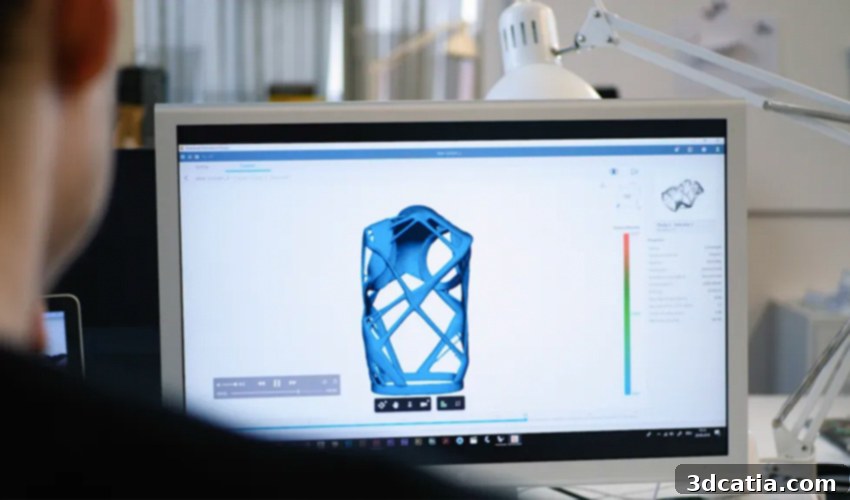
Top Topology Optimization Software for Additive Manufacturing & 3D Printing
Topology optimization is a revolutionary design methodology that systematically reduces a part to its most efficient possible geometry. This advanced process leverages sophisticated computer-based calculations to refine an initial design concept, minimizing material usage without compromising performance or structural integrity. The resulting material savings translate directly into significant cost reductions, environmental benefits, and often superior product functionality. Given these compelling advantages, topology optimization is rapidly gaining traction across numerous industries, consequently fueling a surging demand for specialized software solutions.
According to a comprehensive report by Market Research Intellect, the global market for structural topology optimization software is projected to achieve a staggering USD 21.02 billion valuation by 2031. This growth is anticipated to occur at an impressive compound annual growth rate (CAGR) of 11.09% between 2024 and 2031. This robust market trend clearly indicates a vibrant landscape where innovative topology optimization solutions are continuously emerging and evolving. Specifically, its synergy with additive manufacturing (AM) — commonly known as 3D printing — has unlocked unprecedented design freedom, making it an indispensable tool for engineers and designers. But what are the leading topology optimization software solutions available today, particularly those tailored for the unique requirements of additive manufacturing?
3DXpert
Originally a flagship product of 3D Systems, 3DXpert became part of the Oqton brand in 2022, following 3D Systems’ acquisition of Oqton in 2021. Oqton now operates as an independent software subsidiary, further strengthening its focus on integrated manufacturing solutions. 3DXpert stands out as a comprehensive, all-in-one additive manufacturing 3D software designed to streamline and optimize the entire AM workflow, from initial design conceptualization right through to final print preparation. Its primary objective is to prevent costly errors and inefficiencies by consolidating all critical AM processes within a single, unified software environment.
Key functionalities integrated into 3DXpert include Design for Additive Manufacturing (DfAM), detailed print preparation, advanced simulation capabilities, and rigorous inspection tools. Beyond these core features, 3DXpert offers a specialized suite of design tools essential for modern manufacturing. These tools facilitate lightweighting, surface texturing, and critical printability modifications. Specific capabilities encompass powerful topology optimization algorithms, efficient meshing tools, diverse texturing options, and implicit modeling for complex geometries. This robust software is particularly well-suited for demanding industrial projects across a wide array of sectors, earning recognition for its ability to introduce significant automation and accelerate manufacturing processes.
Ameba Topology Optimization Software From XIE Technologies
Ameba, developed by XIE Technologies, distinguishes itself as an advanced yet remarkably user-friendly topology optimization tool. Its design philosophy emphasizes ease of use and intuitive functionality, making sophisticated optimization techniques accessible to a broader range of engineers and designers. The software is built upon the innovative Bi-directional Evolutionary Structural Optimization (BESO) technology, a method pioneered by the renowned Prof. Yi-Min (Mike) Xie.
Ameba seamlessly integrates with Rhino-Grasshopper, leveraging this powerful combination for both efficient 3D modeling and comprehensive post-processing of optimized designs. A standout feature of Ameba is its capability to analyze finite element models and perform topology optimization with impressive speed, thanks to its utilization of cloud computing resources. This allows users to tackle complex problems and iterate through design variations much faster than traditional desktop-bound solutions. Furthermore, Ameba comes equipped with numerous computational libraries and readily available open-source files, providing users with extensive flexibility to manipulate and process data during both preprocessing and post-processing stages.
Its high extension capability ensures seamless integration with various external software applications, establishing Ameba as a highly versatile and adaptable tool for advanced design and engineering workflows. This interoperability makes it a valuable asset for designers seeking to incorporate robust optimization into diverse projects, enhancing efficiency and innovation.
Altair Engineering and its Range of Software for Topology Optimization
Altair Engineering is a leading global technology company renowned for its extensive portfolio of software and cloud solutions, specifically catering to simulation, high-performance computing (HPC), and data analytics. Within its vast software ecosystem, Altair offers several sophisticated 3D modeling and simulation solutions, with a strong emphasis on tools specifically engineered for additive manufacturing and advanced design optimization.
A prime example is Altair® HyperWorks®, a comprehensive and integrated design and simulation platform. HyperWorks natively incorporates topology optimization capabilities by enabling deep analysis of structural integrity, durability, dynamic performance, weight reduction, strength optimization, and overall material efficiency. Within this powerful platform, specific topology optimization tools like OptiStruct play a pivotal role. OptiStruct provides a wide array of structural optimization methods, including topology, topography, size, and shape optimization, offering a complete range of functions useful across traditional manufacturing processes, with composite materials, and crucially, for additive manufacturing.
Further demonstrating its commitment to innovation, Altair has developed Altair Inspire, a powerful suite of programs designed to accelerate simulation-driven design. A particularly notable tool within this suite is Altair® Inspire™ Print3D. This specialized software offers specific functionalities tailored to optimize material usage in specific additive manufacturing processes, such as Powder Bed Fusion and Binder Jetting, helping users achieve lighter, stronger, and more cost-effective parts. In addition to these, Altair’s offerings include specialized tools for mold manufacturing, metal and polymer extrusion, and many other advanced engineering applications, making it a holistic solution provider for complex design challenges.
Ansys Additive Suite
The Ansys Additive Suite is a robust and highly integrated software solution meticulously designed for the complexities of metal additive manufacturing. Its core mission is to empower designers, engineers, and analysts by preventing manufacturing failures and ensuring that resultant parts consistently meet rigorous design specifications and performance criteria. The suite delivers essential insights and tools that span the entire additive manufacturing workflow, from initial topology optimization through to final design validation and print simulation.
Among its advanced features, Ansys Additive Suite provides sophisticated capabilities for STL file manipulation, comprehensive structural and thermal analysis, and precise simulation of various additive processes. This includes detailed modeling of powder laser melting (such as DMLS and SLM), Directed Energy Deposition (DED), and metal sintering processes. These simulations are crucial for predicting part distortion, residual stresses, and other manufacturing challenges, allowing for proactive adjustments before physical production. Complementing the suite’s capabilities, Ansys Discovery, a pioneering simulation-based design tool that uniquely combines instant physical simulation with advanced modeling functionalities, remains available to further support and accelerate additive manufacturing projects, enabling rapid exploration of design ideas and immediate feedback on their performance.
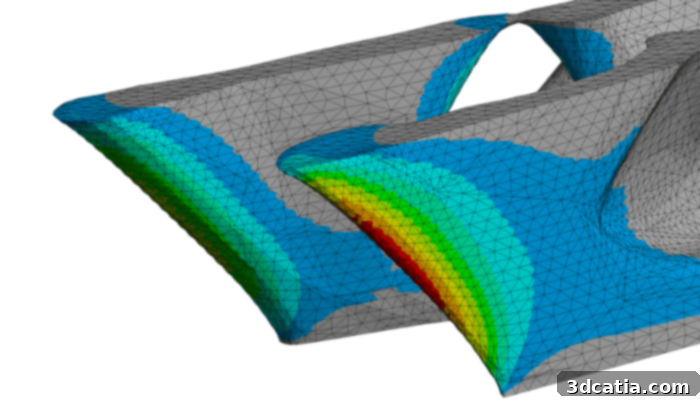
Photo Credits: Ansys
Cognitive Design
Cognitive Design is an innovative software solution developed by the French company Cognitive Design Systems. This powerful platform offers a broad spectrum of functionalities aimed at optimizing designs, regardless of their inherent complexity or specific application. By adopting a highly simulation-driven approach, CAD designers can effectively identify the most advantageous strategies for significantly reducing the weight of their 3D models while simultaneously exploring and generating entirely novel and organic shapes. The software’s capabilities extend to intelligently integrating various structural elements, such as ribs, intricate lattice structures, or optimizing infill patterns to achieve desired performance characteristics.
A key advantage of Cognitive Design is its ability to allow users to implement these complex geometric optimizations semi-automatically. This semi-automated approach provides an optimal balance, offering greater flexibility and creative control to the designer while substantially reducing the iterative design times typically associated with manual optimization. Furthermore, Cognitive Design is equipped to generate models specifically prepared for 3D printing. Crucially, it can identify potential manufacturing faults and issues at this early stage, proactively alerting users to concerns such as insufficient wall thickness, suboptimal part positioning on the build tray, or other factors that could compromise print quality or success. In essence, Cognitive Design transcends mere topology optimization, functioning as a holistic solution that significantly streamlines the entire product development and additive manufacturing production process.
COMSOL Multiphysics®
COMSOL Multiphysics® is a highly versatile and comprehensive software platform widely utilized for advanced topology optimization, specifically engineered to enhance and refine the designs of 3D printed parts. This sophisticated software employs cutting-edge numerical methods and provides a rich set of tools for both multiphysics and single-physics modeling. A key strength is the seamless integration of these modeling capabilities, allowing engineers to simulate complex real-world phenomena where multiple physical effects interact, all within a unified environment.
The intuitive interface of COMSOL Multiphysics® facilitates efficient and straightforward management of the entire design and optimization workflow, from initial setup to result analysis. To further augment its optimization prowess, the software offers a dedicated add-on module known as The Optimization Module. This powerful extension provides additional specialized tools for a variety of optimization tasks, including parameter estimation, shape optimization, and crucially, topology optimization. Practical examples of The Optimization Module’s extensive capabilities are readily available, showcasing its application in diverse engineering challenges. These examples include demonstrations of topological optimization for a hook, aimed at achieving superior material and weight distribution, as well as the design optimization of a coil to maximize magnetic flux density, illustrating its utility in electromagnetic applications. Finally, the software ensures flexibility by offering two distinct user interfaces tailored for both shape and parameter optimization, catering to different user preferences and project requirements.
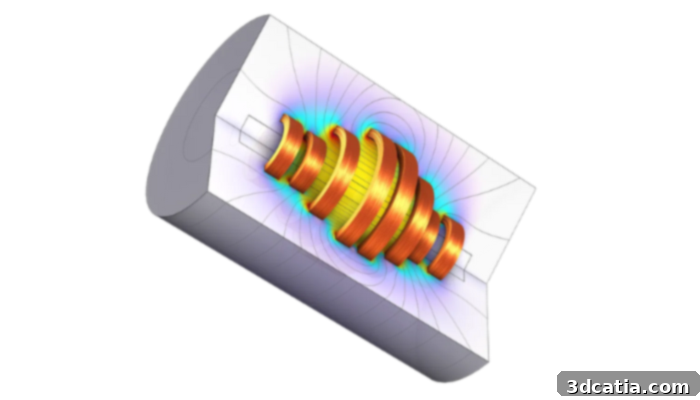
A coil model optimized to obtain a uniform magnetic field on an axis (photo credits: COSMOL Multiphysics®)
Netfabb
Acquired by Autodesk in 2015, Netfabb has established itself as a leading software solution specifically geared towards comprehensive preparation and optimization of the additive manufacturing production process. Among its core functionalities, Netfabb excels in the conversion and seamless importation of 3D models from a wide range of CAD applications, ensuring compatibility and workflow efficiency. It also provides advanced tools for maximizing the number of parts that can be efficiently nested and printed on a single build platform, thereby optimizing material usage and print time. As expected from a top-tier AM solution, Netfabb offers robust design optimization features tailored specifically for additive manufacturing.
Leveraging the immense design freedom offered by 3D printing technologies, Netfabb has deeply integrated topology optimization into its software suite, enabling users to create lighter, stronger, and more performance-driven parts. Beyond preparing designs for printing, the software plays a critical role in reducing potential failures during the actual printing process. It achieves this by providing predictive simulation capabilities that analyze how parts might be affected by various factors during printing, allowing users to make necessary adjustments beforehand. Netfabb is available in four distinct versions—Standard, Premium, Ultimate, and Simulation—each offering progressively advanced features. This tiered approach allows users to select a version that best suits their specific needs and budget, with pricing varying accordingly to the chosen version’s capabilities.
nTop Software
Headquartered in New York, nTop is a cutting-edge company dedicated to developing innovative topology optimization and generative design solutions specifically aimed at tackling complex engineering challenges within the realm of additive manufacturing. Their flagship nTop software provides engineers and designers with access to a powerful suite of features that fundamentally transform the way products are conceived, refined, and scaled for production.
Beyond its robust base option, nTop offers two specialized variants designed to further expand its modeling and automation capabilities. nTop Automate empowers users to run intricate design workflows at scale, all within a programmatic environment. This allows for automated design exploration, rapid iteration, and efficient generation of multiple design variants based on specified parameters and constraints. For its part, nTop Core facilitates the seamless connection of applications with implicit files, eliminating the need for cumbersome conversions to traditional B-rep or STL meshes. This direct implicit modeling approach results in a remarkably smooth and efficient design process, yielding higher fidelity designs and ultimately, better-performing parts with complex internal structures and geometries.
nTop software represents a highly cost-effective and powerful option for the demanding 3D printing industry, which is constantly striving to achieve significant part lightweighting while simultaneously driving down production costs and accelerating time-to-market. Its advanced capabilities make it an indispensable tool for developing next-generation products optimized for performance and manufacturability.
OpenPisco
OpenPisco is a highly flexible and modular open-source topology optimization software, making it an attractive option for researchers, educators, and companies seeking customizable solutions. Its structural design process is remarkably versatile, supporting various discretization methods including standard grids, unstructured meshes, and body-adapted meshes. This adaptability allows users to apply the software to a wide array of engineering problems with different geometric complexities.
Designed with user convenience in mind, OpenPisco offers multiple interfaces: a user-friendly graphical user interface (GUI) for visual interaction, a command-line application for scripting and automation, and a Python library for deep integration into existing workflows. A core philosophy behind OpenPisco’s development is its emphasis on modularity, extensibility, and interoperability. This design ensures that users can easily integrate custom routines, such as specialized optimization algorithms or advanced network processing functions, without needing to modify the core source code. The underlying topology optimization method in OpenPisco is based on a powerful implicit modeling engine, which enables the efficient creation and manipulation of complex, optimized geometries. OpenPisco is currently undergoing active development by IRT SystemX and Safran Tech, the prestigious Safran Research & Technology Center, ensuring its continuous improvement and cutting-edge capabilities.
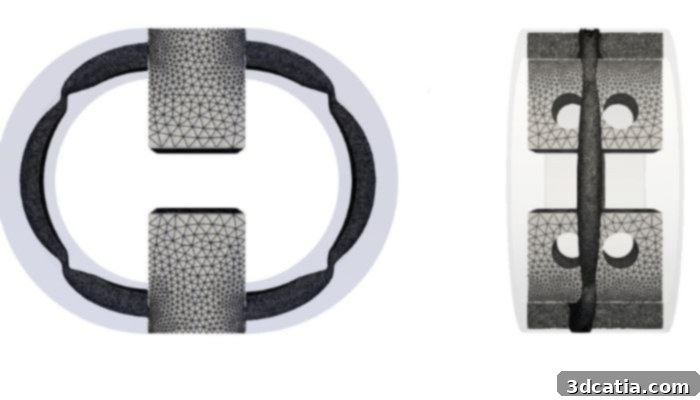
Photo Credits: OpenPisco
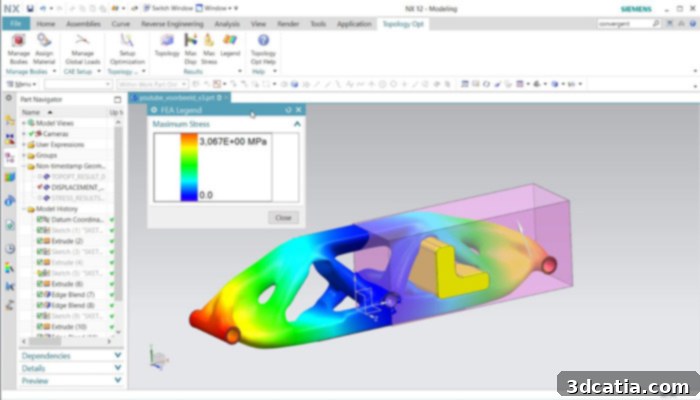
Siemens NX
Siemens NX stands as a highly integrated and comprehensive software solution developed by Siemens, designed to allow users to fully capitalize on the benefits of additive manufacturing by significantly simplifying complex modeling steps. This robust tool empowers users to design for 3D printing, meticulously prepare their parts for production, visualize designs in detail, and iterate rapidly through multiple design variations, all within a single environment. Among its rich suite of functionalities, topology optimization is a key feature, seamlessly integrated within what Siemens terms “Convergent Modeling.”
Siemens has pioneered a unique solution within NX that enables the direct convergence of traditional facet (mesh) models and precise solid (CAD) geometry within the same model. This innovative approach eliminates the tedious and often problematic need for users to convert between different file formats or export data to external optimization tools. With NX, the entire optimization process – from initial design to topology optimization and final preparation for additive manufacturing – can be performed natively on a single, unified platform. Therefore, while NX is not solely a topology optimization software, it functions as an all-in-one comprehensive solution that offers this critical function as an integral part of its advanced capabilities for additive manufacturing workflows, enhancing efficiency and reducing potential errors.
TopOpt, Topology Optimization Software for Grasshopper
TopOpt is an innovative tool meticulously integrated into Grasshopper, the popular visual programming environment of Rhinoceros 3D’s. It is specifically engineered to facilitate the exploration of novel topological optimization methods, particularly catering to the demanding fields of architecture and structural engineering. Currently in its alpha development phase, TopOpt already offers a diverse range of optimization strategies, demonstrating its potential for advanced design.
These strategies include a 2D approach, ingeniously derived from an interactive mobile application, which allows for quick conceptualization. It also features a method focused on optimizing continuous structures for both tension and compression, crucial for robust structural design. Furthermore, TopOpt supports a bi-material model, enabling the design of complex composite structures with optimized material distribution. The future development roadmap for TopOpt is ambitious, incorporating advanced features such as full 3D optimization capabilities and enhanced interactive visualization tools, which will further empower designers. Compatible with Grasshopper for Rhino 4 and 5, TopOpt represents a significant leap forward for designers and engineers who seek to integrate high-performance and exploratory optimization solutions directly into their Rhinoceros 3D and Grasshopper projects, fostering innovation in form and function.
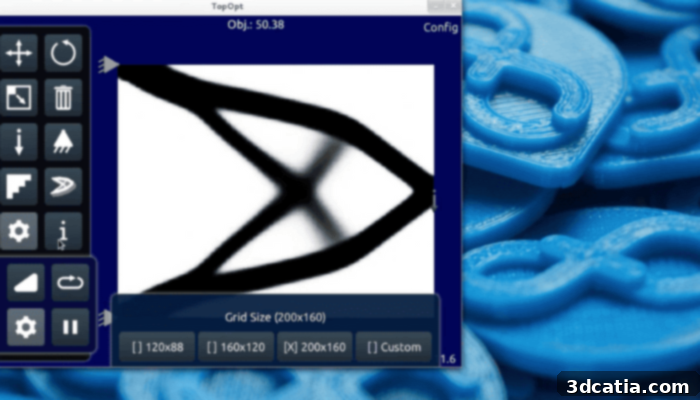
Photo Credits: TopOpt
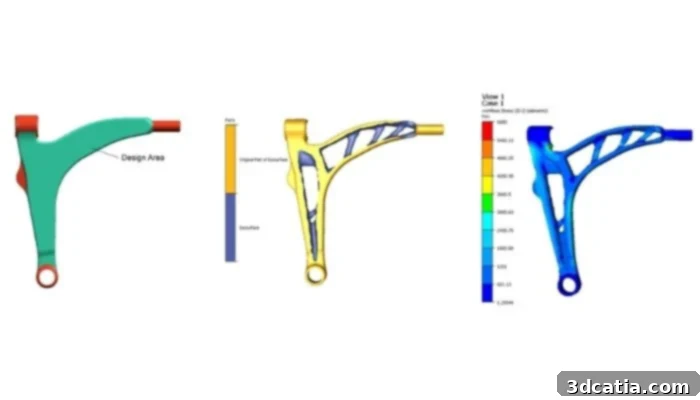
Tosca
Tosca is a premier optimization suite developed by Dassault Systèmes, a global leader in 3D design software. It delivers a powerful and sophisticated solution for both structural and fluid flow optimization, leveraging the robust capabilities of Finite Element Analysis (FEA) and Computational Fluid Dynamics (CFD) simulations. Dassault Systèmes offers two distinct product solutions within the Tosca suite to address different engineering challenges: Tosca Structure and Tosca Fluid.
Tosca Structure is an indispensable tool for optimization in the design of lightweight, rigid, and durable parts across various industries. Through its advanced topology optimization capabilities, engineers can significantly reduce the product development process, leading to accelerated time-to-market. This benefit is particularly valued by industries like automotive manufacturing, where reducing vehicle weight while maintaining structural integrity is paramount for fuel efficiency and performance. The current version of Tosca is integrated with Python 3.7.1 and has been enhanced with new features, including the automatic creation of intelligent stop conditions for optimization runs, improving efficiency and reliability. The second product, Tosca Fluid, specializes in the design and non-parametric fluid flow topology optimization for components and entire systems. This enables engineers to optimize the flow path within parts, leading to improved aerodynamic performance, reduced pressure drop, and enhanced thermal management.
Topology Optimization Software in Z88
The Z88 family of software originates from the pioneering work of Prof. Dr.-Ing. Frank Rieg, who developed the first version of the finite element software in FORTRAN at the University of Bayreuth in 1985. Today, this foundational work has evolved into several advanced variants, catering to a wide range of engineering needs while maintaining its commitment to education and accessibility. Key variants include Z88OS, an open-source calculation kernel designed for fundamental understanding of FEA principles, making it ideal for academic purposes. Z88Aurora® offers a user-friendly graphical user interface (GUI) and is capable of processing CAD data, making it suitable for practical engineering applications. Z88Arion® is the dedicated module within the Z88 family specifically developed for topology optimization, offering powerful algorithms for structural refinement.
Further enhancing its utility, the Z88 ecosystem also includes mobile applications such as Z88Tina and Z88Mobile, which enable quick visualization and analysis of simulation results on the go. Remarkably, the entire Z88 family remains free of charge, primarily serving engineering education at universities and technical colleges, democratizing access to powerful FEA and optimization tools. Z88Arion® distinguishes itself with a user-friendly interface combined with robust calculation cores. It is logically structured into preprocessor, solver, and postprocessor areas, facilitating quick familiarization for new users and enabling efficient, high-performance calculations for complex topology optimization problems. This holistic approach makes Z88 a valuable resource for both learning and practical application in the field of structural optimization.
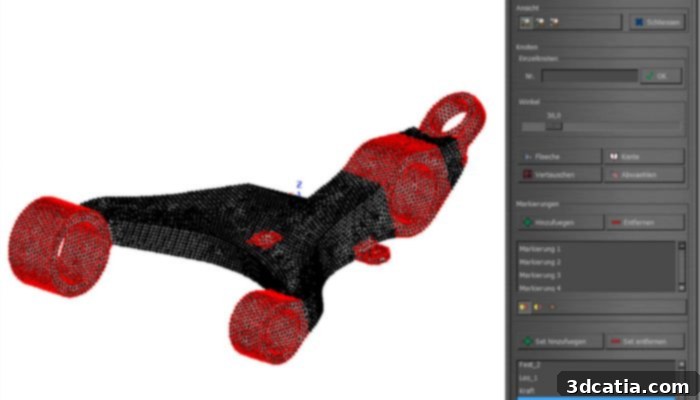
Z88Arion® picking and set management (photo credits: Z88)
This comprehensive overview highlights some of the leading topology optimization software solutions tailored for additive manufacturing. Did we miss any crucial software that deserves a spot on this list? We’d love to hear your thoughts! Share your insights in a comment below or connect with us on our Facebook and Twitter pages. Don’t forget to sign up for our free weekly newsletter to receive all the latest news and advancements in 3D printing delivered directly to your inbox!