
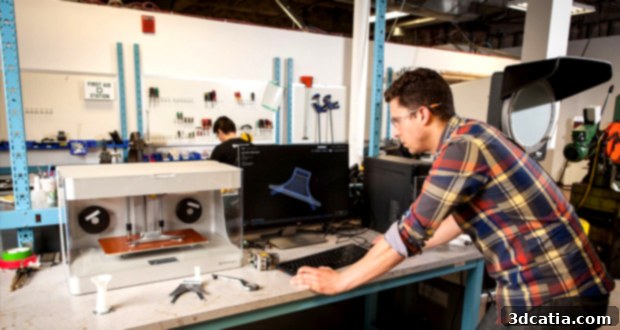
MarkForged’s Metal X: Revolutionizing Industrial Metal 3D Printing and Affordable Additive Manufacturing
Each month, we highlight groundbreaking startups that are genuinely transforming the 3D printing industry. This month, our spotlight shines on MarkForged, a company that has consistently pushed the boundaries of additive manufacturing. We had the distinct pleasure of sitting down with MarkForged’s CEO, Greg Mark, to delve into their latest innovation: the Metal X 3D metal printer. Following their pioneering work with 3D printers capable of producing robust parts from carbon fiber composites, MarkForged has now introduced the Metal X. This machine is poised to fundamentally alter the landscape of metal additive manufacturing by offering industrial-grade capabilities at a price point significantly below traditional market standards, making advanced metal fabrication more accessible than ever before.
3DN : Can you introduce us to MarkForged and explain how the company began?
At MarkForged, our journey began with a clear vision: to empower engineers and manufacturers with tools that could create functional, end-use parts directly from a 3D printer. We achieved a significant milestone by designing the world’s first and only 3D printer that seamlessly integrates both continuous fiber and plastic materials into a single print. This innovative approach allows us to produce composite parts with exceptional strength-to-weight ratios, rivaling and often surpassing aluminum in performance. The core of this uniqueness lies in our patented Continuous Fiber Filament (CFF) technology, which works in conjunction with our proprietary Eiger software. This intelligent software automatically optimizes the fiber placement—whether it’s carbon fiber, fiberglass, Kevlar, or nylon—within the part’s structure, ensuring optimal solidity, durability, and reliability for the final piece. This breakthrough enables our customers to print incredibly strong tools, fixtures, and custom-made parts with complex geometries that would be prohibitively difficult or expensive to manufacture through traditional means.

Greg Mark, CEO of MarkForged
Before founding MarkForged, my professional background as an aerospace engineer gave me invaluable insight into the world of high-performance racing technologies. This experience exposed me intimately to the challenges of prototyping, the intricate processes of part creation, and particularly the time-consuming nature of fabricating specialized components. It was this frustration with the limitations of existing manufacturing methods that fueled my desire to create MarkForged.
My primary motivation was to enable fellow engineers to print truly solid, high-quality 3D parts, fundamentally shifting 3D technologies beyond mere prototyping. In the early days, 3D printing was largely confined to creating conceptual models, visual prototypes, or novelty items. Our mission from day one has been to revolutionize manufacturing itself. We set out to replace the often lengthy, expensive, and labor-intensive processes of traditional machining and manual fabrication with efficient, on-demand 3D printing of robust, functional parts. This philosophy underpins every innovation at MarkForged, from our early composite printers to our latest metal additive manufacturing solutions.
3DN : Why move from carbon to metal?
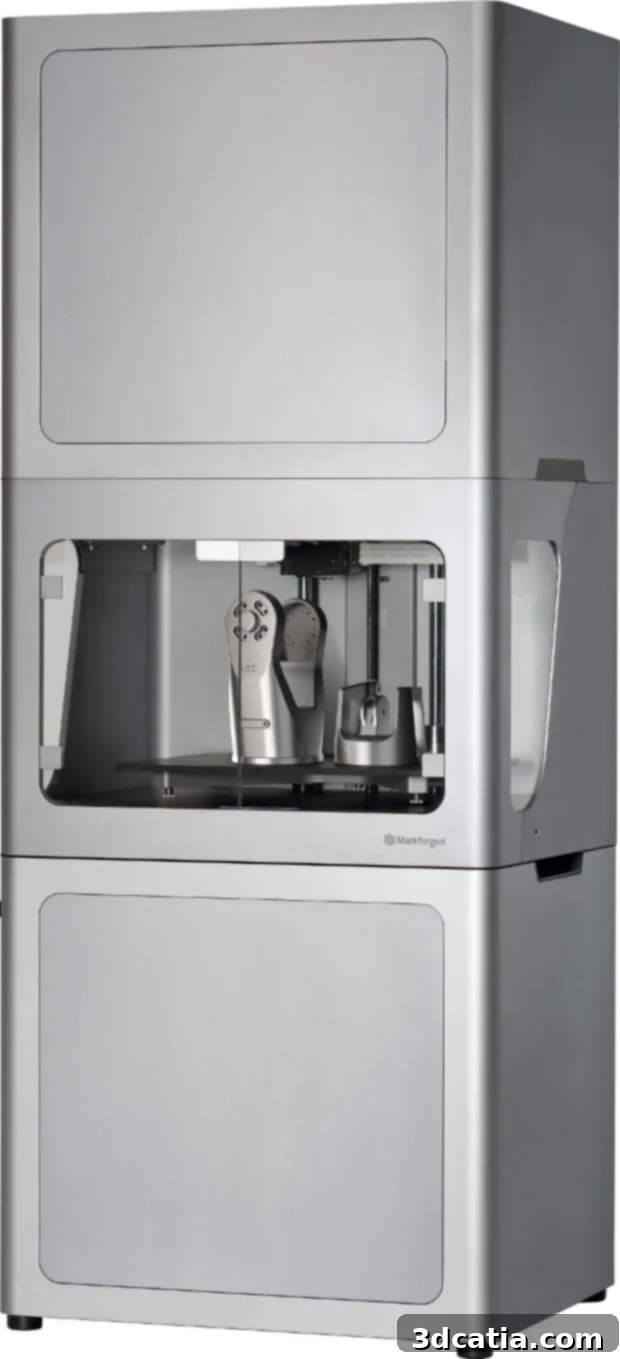
The Metal X by MarkForged
While carbon fiber stands as an incredibly light and strong material, capable of producing a vast array of complex geometries, it inherently possesses certain limitations. Specifically, when applications demand exposure to extremely high temperatures, such as internal engine components, or require exceptional wear resistance for parts subjected to constant friction and stress, carbon fiber simply isn’t sufficient. In these critical scenarios, the superior thermal properties and hardness of metal become absolutely essential. The transition to metal was a natural progression for us, driven by the need to address these high-performance applications where composites reach their limits, thereby expanding the utility of additive manufacturing across a broader spectrum of industrial requirements.
The Metal X represents a monumental shift in the accessibility of metal 3D printing. Historically, industrial-grade metal 3D printers have been prohibitively expensive, often costing hundreds of thousands or even millions of dollars, placing them out of reach for many businesses. In stark contrast, the Metal X offers an unprecedented value proposition. Priced at just $99,500 USD (approximately £79,400), it stands at a fraction—typically 1/5th to 1/10th—of the cost of traditional metal printing systems or even high-end CNC machines for certain applications. This dramatic reduction in price democratizes access to robust metal additive manufacturing. Initially, the Metal X supports high-grade stainless steels like 17-4 PH and 303, known for their excellent strength and corrosion resistance. Furthermore, MarkForged is actively developing and expanding its material library to include other critical metals such as tool steels, copper, and ultimately, superalloys, ensuring its versatility across diverse industrial demands.
3DN : How is the technology developed for the Metal X new and innovative?
The Metal X introduces a truly groundbreaking approach to metal additive manufacturing, powered by a proprietary technology we call Atomic Diffusion Additive Manufacturing (ADAM). Unlike traditional metal 3D printing methods such as DMLS (Direct Metal Laser Sintering) or SLM (Selective Laser Melting), ADAM redefines the printing process by prioritizing safety, material integrity, and isotropic strength.
The ADAM process begins with metal powders, similar to those found in laser-sintered systems, but with a crucial difference: these powders are finely encapsulated within a plastic binder. This innovative composite filament, containing the metal powder, eliminates the inherent toxicity and flammability risks associated with handling loose metal powders. This makes the Metal X a much safer and more accessible system for various workshop environments. The printer then precisely deposits this bound metal filament, layer by layer, to form a “green part.” This initial printed object, still containing its plastic binder, accurately represents the final desired geometry.
After the printing phase, the green part undergoes a debinding process, where the plastic binder is carefully removed. The final and most critical step is the sintering process. The debound part is placed in a high-temperature furnace, where it is heated to just below its melting point. During sintering, the individual metal particles fuse together, densifying the part and forming a robust, solid metal component. A key advantage of ADAM is its ability to sinter the entire piece at one time. This whole-part sintering leads to significantly stronger, fully dense parts with isotropic mechanical properties, meaning they exhibit uniform strength in all directions. This is a considerable improvement over some other additive processes where layer lines can create anisotropic weaknesses, making ADAM-printed parts exceptionally reliable and durable for demanding applications.
3DN : What sector(s) are you focusing on? Who are your customers?
Our technologies, both composite and metal, find applications across an incredibly diverse range of industries, showcasing their versatility and transformative potential. We proudly serve clients in sectors such as aerospace, where precision and lightweight strength are paramount; automotive, for prototyping, tooling, and specialized components; industrial and commercial machinery, for creating custom jigs, fixtures, and end-of-arm tooling; and medicine and dentistry, for custom surgical guides and non-implantable parts. Furthermore, our solutions extend into sports, where high-performance custom equipment is essential, and even into demanding environments like the oil and gas industries, for specialized tools and corrosion-resistant components.
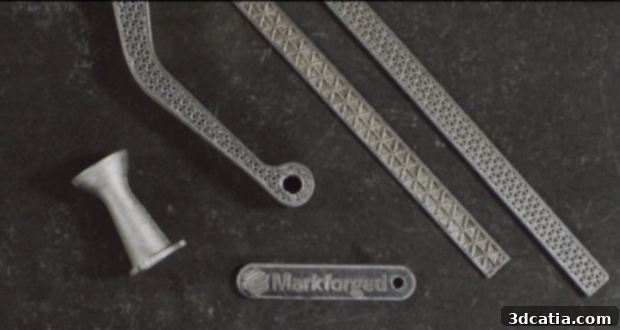
Examples of metal pieces printed by MarkForged
Today, our printers are extensively utilized in mechanical workshops for fabricating durable tools and specialized equipment, as well as directly on production lines to create custom fixtures and replacement parts on demand. Our customer base includes a broad spectrum, from engineering teams rapidly iterating through design prototypes, to manufacturers producing functional, low-volume end-use parts, and even those exploring methods for mass production in specific niches. The adaptability of our machines allows for agile manufacturing, significantly shortening lead times and reducing costs across the entire product development and production lifecycle.
3DN : In the years to come, what do you envision for the future of additive metal fabrication?
I foresee a future where metal additive manufacturing becomes profoundly more accessible and pervasive. The trajectory of declining costs will continue, making this advanced technology an economically viable option for an ever-increasing number of businesses, from global enterprises to small and medium-sized manufacturers. This accessibility will trigger a significant and overwhelmingly positive disruption across several key areas: traditional production methodologies, established inventory management practices, and the overall speed of product development.
Imagine the impact on product development alone: whether you’re a large-scale manufacturer or a nimble startup, the ability to print real, functional metal molds overnight, rather than enduring lead times of weeks or even months, will be nothing short of revolutionary. This rapid turnaround, coupled with increasingly attractive price points, will dramatically accelerate innovation and iteration cycles. Beyond molds, the capacity to print critical metal spare parts on-demand, literally overnight, carries substantial economic benefits, minimizing downtime and logistical complexities. Furthermore, the economic viability of producing smaller series of highly complex metal parts—which would traditionally be machined with great difficulty or require expensive specialized tooling—will unlock new possibilities for customization and niche markets. Ultimately, this shift towards agile, accessible metal additive manufacturing directly translates into greater profitability, enhanced operational efficiency, and a significant boost in competitiveness for our customers across all industries.
Watch the video below for an introduction to the Metal X:
3DN : Anything you would like to add for our readers?
The evolution of 3D printing over the past four years has been nothing short of astounding. What were once considered niche tools or prototyping devices have matured into incredibly powerful, yet surprisingly user-friendly, industrial machines. The barrier to entry has significantly lowered, and the capabilities have expanded exponentially. My advice to anyone considering integrating this technology is simple: when you acquire your first 3D printer, whether it’s for composites or metals, don’t just stop at making a few demonstration parts. Embrace it fully.
Once you get into the habit of seamlessly integrating 3D printing into your entire design and manufacturing process, you’ll begin to see how an ever-increasing number of your components can be designed specifically for 3D production. This iterative process, where you can design a part and then hold a physical, functional version of it in your hand on the very same day, is an incredibly empowering experience. It accelerates innovation, reduces design flaws, and dramatically shortens time-to-market. The true power of modern 3D printing lies in its ability to transform ideas into tangible reality with unprecedented speed and efficiency.
For more information on MarkForged, visit their site here.
Can MarkForged become a dominant leader in the burgeoning metal additive manufacturing market? We invite you to share your valuable opinion and insights in the comments section below. Don’t forget to connect with us on Facebook and Twitter to stay updated on the latest innovations in 3D printing!