

Markforged Blacksmith: Revolutionizing Industrial 3D Printing with AI-Powered Quality and Autonomous Manufacturing
The landscape of additive manufacturing (AM) is continually evolving, with breakthroughs that push the boundaries of what’s possible. A significant stride in this journey was recently marked by Markforged with the announcement of its AI-powered Blacksmith software, now immediately available for Markforged X7 printers. This development represents a pivotal moment, leveraging the transformative capabilities of Artificial Intelligence (AI) to enhance the reliability and efficiency of 3D printing processes.
AI, at its core, enables machines to solve complex problems and adapt to new situations based on previously acquired data, often without direct human intervention. This concept is immensely attractive to the AM sector, where precision, repeatability, and automation are paramount. By integrating advanced AI algorithms with 3D printing technologies, systems can achieve unparalleled levels of performance, significantly reducing the risk of errors and facilitating truly automated production workflows. For industrial applications, where consistency and quality are non-negotiable, Blacksmith emerges as a game-changer, moving us closer to a future of autonomous additive manufacturing where 3D printers intelligently adapt to variables and ensure accurate, precise parts right from the first print.
Markforged Blacksmith: Redefining Quality and Efficiency in Additive Manufacturing
Markforged’s Blacksmith software is engineered to create a seamless connection between part design, production, and rigorous inspection. What truly sets this technology apart is its ability to learn and improve through collective intelligence. Blacksmith leverages insights and data gathered from an entire fleet of printers, creating a robust, continuously optimizing AI model. This aggregated learning across multiple machines means that the more printers integrated into the system, the richer the data pool, leading to enhanced reliability, accuracy, and overall performance.
This fleet-wide learning capability translates directly into tangible benefits for manufacturers, instilling greater confidence in the dimensional accuracy of their printed parts. It also introduces an unprecedented level of resiliency and agility into the supply chain, allowing for rapid adaptation to design changes or production demands. Kelly Puckett, senior engineering manager for additive manufacturing at Dana Incorporated, eloquently summarizes the impact: “Markforged’s Blacksmith enables dimensional confirmation of additive parts straight off the print bed, giving engineers confidence that the parts are within spec prior to use. There is no need for secondary systems, additional equipment or separate databases for results – all of which help streamline workflows and get us to market faster. Blacksmith also allows for comparative data when printing the same part in multiple locations around the world.”
Puckett’s statement highlights Blacksmith’s ability to simplify complex validation processes. Traditionally, verifying part accuracy often involves multiple, disconnected steps—from manual measurements to external quality control systems. Blacksmith consolidates these, providing immediate, integrated dimensional confirmation. This not only accelerates time-to-market but also ensures that parts meet specifications consistently, whether they are printed in a single facility or across a globally distributed manufacturing network.

Blacksmith is available on the X7 Printer from Markforged, enabling advanced AI-driven manufacturing and inspection (photo credits: Markforged)
The Power of Real-time Quality Assurance and Closed-Loop Manufacturing
Eliminating Waste and Saving Time with Integrated Inspection
A core benefit of Blacksmith’s design is its profound impact on reducing waste and saving invaluable production time. This efficiency is achieved through the system’s inherent simplicity and its sophisticated closed-loop processing capabilities. Manufacturers are no longer forced to choose between speed and thoroughness; Blacksmith allows for the simultaneous printing and scanning of a part. This unique feature enables real-time inspection of the internal structure of a component, a critical capability often impossible or extremely difficult to achieve in a single step with conventional methods.
The software intelligently leverages the X7’s existing integrated laser micrometer, combined with a patented smart scanning process, to securely measure parts as they are being printed. This continuous feedback loop means Blacksmith can instantly determine how closely the physical printed part adheres to its intended digital design. Any deviation can be identified and, in some cases, compensated for during the print, preventing costly errors and ensuring that each part meets stringent quality requirements without the need for post-production adjustments or extensive manual checks. This integrated approach drastically minimizes material waste from failed prints and significantly cuts down on the labor and time associated with traditional quality assurance protocols.
Ensuring “First-Time-Right” Production for Industrial Applications
The concept of “first-time-right” production is a holy grail in industrial manufacturing, and Blacksmith brings this ideal significantly closer to reality for additive processes. By integrating real-time inspection and adaptive control, the software ensures that parts are consistently produced to specification on the very first attempt. This capability is paramount for industrial users who rely on the precision and repeatability of their processes for high-volume or critical component manufacturing. The immediate feedback and potential for in-process correction minimize the need for costly reprints, rework, or extensive post-production validation.
This level of quality assurance at the point of manufacture not only improves throughput but also builds greater confidence in additive manufacturing for demanding applications. For industries such as aerospace, automotive, or medical devices, where component failure is not an option, Blacksmith’s intelligent validation provides an essential layer of reliability. It transforms 3D printing from a prototyping tool into a robust production method, capable of delivering certified, high-performance parts with unprecedented efficiency and reduced operational costs.
A Vision for the Future: Markforged’s Software-First Approach to Additive Manufacturing
For David Benhaim, CTO and co-founder of Markforged, Blacksmith is more than just a software update—it represents the very future of additive manufacturing. Benhaim articulates a clear vision: “We knew that it would only be possible to reinvent manufacturing with a software-first approach to building hardware. Blacksmith fundamentally changes the way engineers think about additive manufacturing. For the first time, they will have confidence that their parts will perform as expected without a time-consuming process. Blacksmith makes our platform smarter and is the next step on our roadmap to bring the agility of software to the world of manufacturing.”
This “software-first” philosophy is a profound paradigm shift in an industry traditionally dominated by hardware innovation. It acknowledges that while advanced printing machines are crucial, it is the intelligence embedded within the software that unlocks their true potential. Blacksmith exemplifies this by transforming raw printing power into a smart, adaptive, and self-optimizing system. It empowers engineers to design with greater freedom, secure in the knowledge that the software will ensure fidelity between digital design and physical reality, minimizing the need for iterative prototyping and manual adjustments. This approach aligns perfectly with the broader trends of Industry 4.0, where digital tools and data-driven insights are rapidly reshaping manufacturing processes, fostering unprecedented levels of agility, efficiency, and reliability across entire production chains.
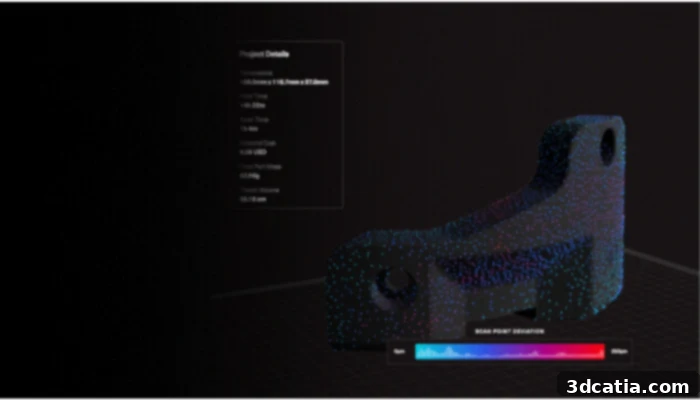
An example of how Blacksmith dynamically scans an object during the printing process for real-time quality control (photo credits: Markforged)
Industrial Readiness and Accessibility: Deploying Blacksmith in Production Environments
Blacksmith is readily available as a software subscription for all cloud-connected Markforged X7 printers, making it accessible to a wide range of industrial users. However, it’s important to note a key requirement for its optimal operation: the software necessitates an OEM-certified reference bed calibration. This specific calibration ensures the highest level of accuracy and repeatability, which is absolutely critical for the precise measurements and real-time adjustments Blacksmith performs. This requirement underscores its suitability for demanding industrial applications where precision, consistency, and traceability are paramount, distinguishing it from less rigorous solutions.
By focusing on robust industrial-grade performance, Blacksmith is poised to become an indispensable tool in production environments. It caters to manufacturers seeking to integrate additive manufacturing seamlessly into their existing workflows, providing not just speed but also verified quality. The ability to guarantee part performance directly from the print bed, coupled with fleet-wide data learning, enables organizations to scale their additive operations with confidence, moving from prototyping to reliable, high-volume production. To discover more about how Blacksmith can transform your manufacturing operations, you can find detailed information on Markforged’s official website HERE.
The Broader Impact of AI in Additive Manufacturing: Beyond Blacksmith
While Markforged Blacksmith marks a significant leap, it is also a testament to the burgeoning role of AI across the entire additive manufacturing ecosystem. The principles demonstrated by Blacksmith – real-time adaptation, automated inspection, and data-driven intelligence – are foundational to a future where AI permeates every stage of the AM lifecycle. Looking ahead, AI promises to unlock even more profound transformations.
One area of immense potential is **Generative Design**, where AI algorithms can autonomously explore thousands of design permutations, optimizing part geometries for specific performance criteria, material usage, and manufacturability far beyond what human engineers could achieve. This leads to lighter, stronger, and more efficient parts. In **Material Science**, AI is accelerating the discovery and optimization of new materials for 3D printing, predicting material properties and print parameters with unprecedented accuracy, thereby expanding the capabilities of AM to new applications and industries.
Furthermore, AI is pivotal for **Predictive Maintenance** in 3D printing. By continuously monitoring printer performance, sensor data, and print logs, AI can anticipate potential failures before they occur, scheduling proactive maintenance to minimize downtime and maximize operational efficiency. This proactive approach significantly reduces operational costs and enhances the reliability of large-scale print farms. For **Supply Chain Optimization**, AI can analyze demand fluctuations, material availability, and production capacities to make intelligent decisions about where and when to print parts, leading to more resilient, responsive, and cost-effective supply chains. This capability is especially critical for on-demand manufacturing and localized production.
Finally, the evolution of **Quality Control** itself is being redefined by AI. Moving beyond surface-level checks, AI-driven systems can conduct comprehensive, automated internal inspections, ensuring micro-level structural integrity that is impossible with manual or traditional methods. This holistic quality assurance is crucial for compliance in highly regulated sectors and for ensuring the highest performance of critical components. Ultimately, AI-powered solutions like Blacksmith are not just improving existing processes; they are enabling new manufacturing paradigms, such as **Mass Customization** at industrial scale, where highly personalized products can be produced with the speed and quality previously reserved for mass-produced items.
What do you think of Markforged Blacksmith and the future of AI in 3D printing? Let us know in a comment below or connect with us on our Facebook, Twitter and LinkedIn pages! Don’t miss out on the latest 3D printing news; sign up for our free weekly Newsletter here, delivered straight to your inbox!