
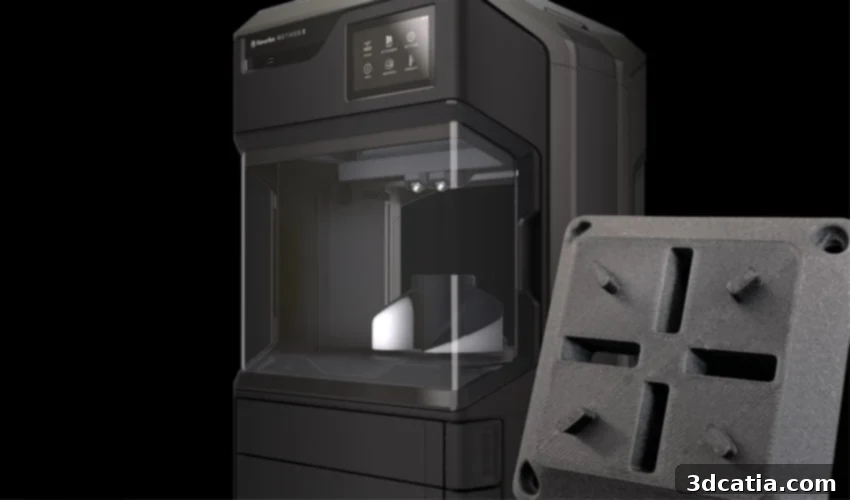
MakerBot METHOD Carbon Fiber Edition: Elevating Industrial 3D Printing with High-Performance Composites
The landscape of professional 3D printing is continuously evolving, with manufacturers pushing the boundaries of material science and machine capabilities. In a significant move, industry leader MakerBot has unveiled its latest innovation: the METHOD Carbon Fiber Edition. This new professional machine is specifically engineered to print carbon fiber reinforced nylon, a material developed by MakerBot itself, opening up new avenues for engineers and designers. Building upon the robust METHOD platform, originally introduced in December 2018, the Carbon Fiber Edition comes preconfigured with a specialized new extruder designed for composite materials. This advanced extruder will also be available as an upgrade, allowing existing METHOD and METHOD X machine owners to enhance their capabilities. With this launch, MakerBot firmly establishes its presence among a growing number of manufacturers who are catering to the increasing demand for composite 3D printing – a technology increasingly valued for its ability to produce lightweight components and replace traditional metal parts with high-strength alternatives. The complete solution, encompassing the specialized machine, the upgraded extruder, and the high-performance material, is projected to be available for purchase starting from June 2020.
MakerBot’s journey back into the forefront of professional additive manufacturing began in earnest at the end of 2018 with the introduction of the METHOD. This desktop 3D printer was a deliberate pivot towards serving the needs of professionals and industrial users, marking a significant statement in the market. Since its initial launch, the METHOD platform has seen continuous evolution and refinement. MakerBot’s commitment to an open printing ecosystem has been central to its strategy, leading to the development of new extruders and materials that empower users to create parts precisely tailored to their specific requirements. Prior to the Carbon Fiber Edition, the METHOD platform already supported a diverse range of engineering-grade materials, including ABS, ASA, Nylon, and PETG. The addition of the METHOD Carbon Fiber Edition significantly expands this material portfolio, pushing the boundaries of what’s achievable with a desktop machine. It enables engineers to design and produce parts with unprecedented strength, stiffness, and dimensional accuracy, making it possible for 3D printed components to directly replace metal in many demanding applications, fostering innovation across various industries.
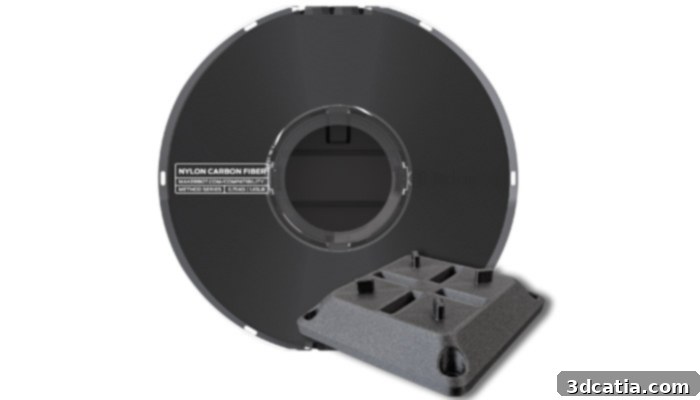
MakerBot now offers carbon fiber reinforced nylon for industrial applications | Credits: MakerBot
Unveiling the Power of Carbon Fiber Reinforced Nylon with METHOD
The core of the METHOD Carbon Fiber Edition’s appeal lies in its ability to harness the exceptional properties of carbon fiber reinforced nylon. This advanced composite material is specifically formulated to deliver outstanding mechanical and thermal performance, boasting superior heat resistance, remarkable strength, and unparalleled rigidity. These characteristics are critical for demanding industrial applications where part integrity and performance under stress are paramount. Nadav Goshen, President and CEO of MakerBot, eloquently underscores the significance of this material: “Carbon fiber nylon is one of the most sought-after and exciting classes of materials in the additive manufacturing space. Its inherent high strength, excellent heat resistance, and impressive rigidity make it an ideal choice for printing robust aftermarket parts, tools, and fixtures that traditionally would have required metal. By leveraging this material, businesses can significantly reduce costs associated with traditional manufacturing methods and enhance overall operational efficiency.” Goshen further emphasizes the broader impact, stating, “With the introduction of METHOD Carbon Fiber, we are democratizing access to composite 3D printing for a wider user base than ever before, thereby unlocking the potential for groundbreaking new applications across numerous sectors. The METHOD Carbon Fiber is not just a new product; it’s the latest, powerful addition to the rapidly expanding and evolving METHOD 3D printing platform, signifying our commitment to innovation.” This statement highlights MakerBot’s vision to make high-performance manufacturing more accessible and to drive forward the capabilities of desktop 3D printing into industrial-grade territory.
Engineering Excellence: Key Characteristics of the METHOD Carbon Fiber Edition
The METHOD Carbon Fiber Edition builds upon the proven architecture of its predecessors, the METHOD and METHOD X, inheriting their robust design while integrating specialized features for composite printing. Depending on the chosen model (METHOD or METHOD X), users will experience variations in the heated chamber capabilities, which are crucial for optimal composite processing. For the standard METHOD Carbon Fiber, users can expect a generous build volume of 190 x 190 x 196 mm, allowing for the creation of substantial parts. The machine boasts an impressive printing speed of up to 500 mm/second, enabling rapid prototyping and efficient small-batch production. Furthermore, its versatility in detail is evident in its layer resolution, which ranges from a fine 20 microns for intricate geometries to a robust 400 microns for quicker, less detailed prints. A cornerstone of its high-performance capability is the controlled thermal environment. The METHOD Carbon Fiber Edition features a heated chamber that can maintain temperatures up to 60°C. For even more demanding applications and a wider array of advanced composite materials, the METHOD X Carbon Fiber variant elevates this capability, offering a chamber temperature of up to 110°C. This meticulously controlled thermal environment is not merely a feature; it’s a critical component for achieving unparalleled print stability and preventing common issues like warping and delamination, which are often encountered when printing with high-performance composites. The result is consistently dimensionally accurate parts with an optimal surface finish, crucial for functional prototypes and end-use components.
The advanced extruder is another pivotal component, specifically designed to handle the abrasive nature of carbon fiber filled filaments while ensuring precise material deposition. This specialized extruder is engineered for durability and consistent performance, critical for maintaining print quality over numerous hours of operation. The combination of this advanced extruder, the precision-controlled build chamber, and the robust METHOD platform creates a comprehensive solution that empowers engineers to tackle complex challenges with confidence. From producing lightweight tooling and durable jigs and fixtures to creating functional prototypes and even demanding end-use parts for sectors like automotive, aerospace, and robotics, the METHOD Carbon Fiber Edition provides a reliable and accessible pathway to industrial-grade composite manufacturing on the desktop. The ability to iterate designs rapidly with high-strength materials allows for faster product development cycles and brings high-performance manufacturing closer to the design desk.
Availability, Pricing, and the Future of Composite 3D Printing
The eagerly anticipated MakerBot METHOD Carbon Fiber Edition, along with its specialized composite 3D printing solution, is slated for official availability starting June 2020. While specific pricing for the Carbon Fiber Edition itself has not been released, MakerBot has previously set the price for the base METHOD printer starting from €4,999. It is expected that the Carbon Fiber Edition, given its advanced features and material capabilities, will be positioned at a premium, reflecting its enhanced value for professional and industrial applications. However, the option to purchase the new composite-compatible extruder as an upgrade for existing METHOD and METHOD X machines offers a cost-effective pathway for current users to expand their material capabilities without investing in an entirely new system. This strategy underlines MakerBot’s commitment to supporting its existing user base while continuously innovating. For those looking to delve deeper into the technical specifications, explore application possibilities, or inquire about pricing and availability, more comprehensive information can be found on the official MakerBot website HERE. The introduction of the METHOD Carbon Fiber Edition represents more than just a new product launch; it signifies a pivotal moment in making high-performance composite 3D printing more accessible and integrated into professional workflows. It reinforces the trend towards stronger, lighter, and more durable parts being produced closer to the point of design, accelerating innovation across a multitude of industries.
As the capabilities of desktop 3D printers continue to converge with industrial-grade performance, solutions like the METHOD Carbon Fiber Edition play a crucial role in empowering engineers and manufacturers to push the boundaries of design and production. This accessibility to advanced materials and robust printing platforms means that more companies, regardless of their size, can now leverage the benefits of additive manufacturing for functional end-use parts, beyond just prototyping. We’re keen to hear your thoughts on the MakerBot METHOD Carbon Fiber Edition. What impact do you foresee it having on your projects or industry? Do you believe it makes high-performance composite printing more attainable for a wider audience? Share your insights and opinions in a comment down below or join the conversation on our Facebook and Twitter pages! And for those who wish to stay continuously informed about the latest breakthroughs and news in the dynamic world of 3D printing, don’t forget to sign up for our free weekly Newsletter, delivering all essential updates straight to your inbox.