
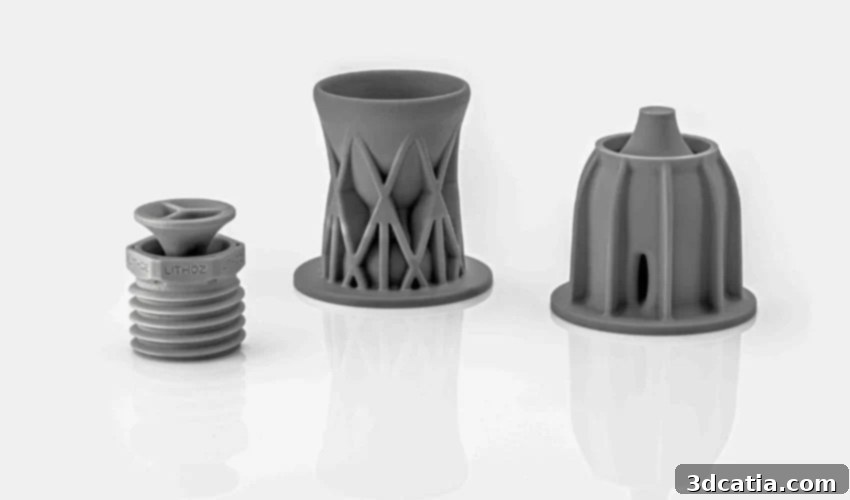
Revolutionizing High-Temperature Ceramics: Lithoz and ORNL Partner for Advanced 3D Printing
The indispensable role of ceramics in modern industrial applications is widely acknowledged. These remarkable materials are fundamental components across diverse sectors, including aerospace, defense, and various high-tech manufacturing industries, primarily due to their extraordinary properties. Renowned for their exceptional strength, chemical inertness, and ability to withstand extreme conditions, ceramics truly excel where other materials fail. Perhaps their most celebrated characteristic is their unparalleled resistance to very high temperatures, making them critical for components operating in harsh thermal environments. In a significant stride to push the boundaries of high-temperature ceramics development, Austrian additive manufacturing specialist Lithoz GmbH and the United States Department of Energy’s Oak Ridge National Laboratory (ORNL) have officially entered into a Cooperative Research and Development Agreement (CRADA). This landmark collaboration, announced by Lithoz on December 5, signifies a concerted effort to accelerate innovation in an area crucial for future technological advancements.
This strategic research and development cooperation agreement is specifically designed to leverage Lithoz’s cutting-edge 3D printing technology for intensive research into the processing of non-oxide ceramics through additive manufacturing. Both partners are committed to jointly exploring and developing advanced methods to produce 3D-printed non-oxide ceramic components capable of enduring even the most extreme temperatures. The overarching goal is to transform the additive manufacturing of these highly specialized ceramics into a scalable, industrially viable process, opening doors to unprecedented applications and performance levels across multiple sectors. This initiative addresses a critical need in advanced manufacturing, aiming to overcome the traditional limitations associated with ceramic part fabrication.
The Critical Importance of High-Temperature Ceramics
High-temperature ceramics are not just another class of materials; they are enablers of next-generation technology. Their ability to maintain structural integrity and mechanical properties at temperatures exceeding 1000°C makes them indispensable for applications where conventional metals would melt or degrade rapidly. In the aerospace industry, for example, these materials are vital for components within jet engines, missile systems, and spacecraft heat shields, where operational efficiency and safety depend heavily on extreme temperature resistance. Similarly, in the defense sector, high-performance ceramic parts are sought for their lightweight yet robust properties in armor, protective coatings, and advanced weapon systems. Beyond these demanding fields, the energy sector benefits from ceramics in high-efficiency heat exchangers, advanced combustion systems, and next-generation nuclear reactors, all requiring materials that can withstand severe thermal and corrosive environments. The challenge, however, has traditionally been in reliably and cost-effectively manufacturing complex ceramic parts, especially those made from non-oxide ceramics, which are known for their superior performance but also their difficulty in processing.
Corson Cramer, a staff scientist in the Extreme Environment Materials Processing Group at ORNL, underscored the profound impact of this collaboration. “This project will build on ORNL’s years of research in developing and testing high-temperature materials and ceramics. By combining our expertise with Lithoz 3D printing capabilities, we have the potential to change the concept of high-temperature ceramics processing for heat exchange, aerospace and defense applications,” explained Cramer. This statement highlights the synergistic nature of the partnership, where ORNL’s deep understanding of material science and extreme environments complements Lithoz’s pioneering additive manufacturing techniques. The goal is not merely incremental improvement, but a fundamental shift in how high-performance ceramic components are designed and produced, ultimately unlocking new possibilities for engineering and design that were previously unattainable.
A Strategic Alliance: Lithoz’s Innovation Meets ORNL’s Expertise
The collaboration between Lithoz and ORNL represents a powerful confluence of advanced manufacturing technology and world-class materials research. Lithoz, a pioneer in ceramic 3D printing, brings its proprietary Laser-Induced Slipcasting (LIS) technology to the forefront of this partnership. LIS is a groundbreaking additive manufacturing method designed specifically for ceramics, offering unprecedented capabilities in fabricating intricate and high-performance parts. ORNL, with its extensive history in materials science, extreme environment testing, and advanced manufacturing research, provides the critical scientific rigor and validation necessary to push these technologies into practical industrial applications. This CRADA is more than just a research project; it’s a strategic alliance aimed at addressing some of the most significant material challenges facing modern industries. The focus on non-oxide ceramics, such as silicon carbide and silicon nitride, is particularly noteworthy. These materials offer superior mechanical properties and thermal stability compared to oxide ceramics but are notoriously difficult to process using conventional manufacturing techniques, making them an ideal target for advanced 3D printing solutions.
Unveiling Laser-Induced Slipcasting (LIS) Technology for Advanced Ceramics
At the core of this innovative partnership is Lithoz’s revolutionary Laser-Induced Slipcasting (LIS) 3D printing technology. LIS distinguishes itself through its reliance on laser slurry drying, a sophisticated “net shaping” technique. This method precisely guides computer-controlled light amplification by stimulated radiation emission – essentially a laser – to selectively dry out liquid-embedded layers of ceramic solids. Unlike traditional methods that often involve extensive tooling and complex processes, LIS enables the direct fabrication of highly complex geometric parts with exceptional precision. A key advantage of LIS is its ability to produce components on a larger scale than many previous ceramic molding processes allowed, addressing a critical need for industrial applications. Furthermore, LIS excels in incorporating intricate internal channels and complex lattice structures directly into the 3D printable design. This capability is transformative, as it allows for the creation of lighter, more efficient components, especially critical for weight-sensitive applications in aerospace and defense, while also improving functionality such. These designs can enhance heat transfer, reduce material consumption, and optimize performance in ways previously impossible. Another significant benefit of LIS technology is its expanded material compatibility, making it uniquely suitable for processing challenging materials like dark ceramics, including highly sought-after silicon carbide and silicon nitride.
The ability of LIS to handle these advanced non-oxide ceramics is a game-changer. Conventional laser-based 3D printing methods often struggle with dark ceramic slurries due to their high absorption of laser energy, leading to uncontrolled heating and poor part quality. LIS, however, is specifically engineered to overcome these challenges, ensuring uniform drying and precise layer formation. This technological prowess is what makes Lithoz an ideal partner for ORNL in this endeavor to push the boundaries of high-temperature ceramic additive manufacturing. The precision offered by LIS, combined with its capacity for complex geometries, positions it as a leading technology for producing parts that can withstand extreme environments, maintain high performance, and contribute to significant advancements in various high-tech industries.
The Research Roadmap: From Concept to Industrial Scalability
Building on the robust foundation of LIS technology, the focus of the ORNL-Lithoz agreement is to comprehensively develop and test this technology to its fullest potential, ensuring its readiness for industrial application. The research roadmap is structured in distinct, yet interconnected, phases. Initially, the performance of the LIS technology will be rigorously evaluated by testing it with common oxide ceramic materials. This crucial first step allows the team to establish a baseline, validate the precision and reliability of the printing process, and refine parameters using well-understood materials. This methodical approach ensures that the underlying technology is robust before moving to more challenging substances. This initial phase will also help in optimizing the printing process, assessing factors like density, microstructure, and mechanical properties, which are critical for any ceramic application.
Following successful validation with oxide ceramics, subsequent steps in the CRADA will involve the 3D printing of components from primary non-oxide materials, specifically silicon nitride and silicon carbide. These materials are chosen for their superior performance in extreme environments but present unique processing challenges due to their chemical composition and sintering behavior. After the components are printed, a critical post-processing step known as debinding is performed. During debinding, organic binders, which are temporarily used to hold the ceramic particles together in the “green” (unfired) state, are carefully removed from the molded component. This process is crucial to prevent defects during the subsequent sintering stage. Once debinding is complete, the porous ceramic structure is then transformed into a dense, solid part through sintering – a heat treatment process that causes the ceramic particles to fuse together, eliminating voids and significantly enhancing the material’s strength and performance. After sintering, the final components undergo extensive testing to thoroughly evaluate their performance, mechanical properties, and ability to withstand the extreme temperatures and conditions for which they are designed.
This entire stage is absolutely crucial for achieving the overarching aim of the cooperation agreement: to create high-performance ceramics capable of withstanding extreme temperatures, particularly for the aerospace industry, where silicon nitride and silicon carbide are in high demand for critical components. The successful additive manufacturing of these ceramic parts, capable of enduring incredibly high temperatures at an industrial level, will unlock further areas of application not only in aviation and aerospace but also within the defense industry and various other high-performance sectors. The ability to produce complex geometries from these advanced materials efficiently and reliably will accelerate innovation, improve safety, and enhance the overall performance of next-generation systems across a multitude of industries.
Transformative Impact Across Key Industries
The potential impact of this Lithoz-ORNL collaboration extends far beyond the laboratory, promising transformative changes across several critical industries. In the **aerospace** sector, the ability to 3D print complex, high-temperature non-oxide ceramic components means engineers can design more efficient and lighter jet engine parts, thermal protection systems for spacecraft, and advanced components for hypersonic vehicles. This leads to improved fuel efficiency, enhanced performance, and increased safety margins. For the **defense industry**, these advancements translate into superior armor solutions, more durable missile components, and high-performance sensors that can operate reliably in harsh battlefield conditions, providing a significant strategic advantage. The **energy sector** stands to benefit immensely as well, with the development of more robust and efficient components for advanced nuclear reactors, industrial gas turbines, and high-temperature heat exchangers. The enhanced thermal stability and corrosion resistance of these 3D-printed ceramic parts will lead to longer operational lifespans, reduced maintenance costs, and higher energy conversion efficiencies. Furthermore, various other **high-performance industrial applications**, ranging from specialized tooling and manufacturing equipment to advanced chemical processing plants, will gain access to custom-designed ceramic parts that can withstand extreme environments, chemical attack, and severe wear, ultimately driving innovation and productivity across the board. The flexibility of additive manufacturing combined with the extreme properties of non-oxide ceramics truly opens up a new paradigm in material engineering and product design.
This strategic partnership between Lithoz and ORNL underscores a shared vision for the future of advanced materials and manufacturing. By combining Lithoz’s pioneering LIS 3D printing technology with ORNL’s profound expertise in high-temperature materials research, the two organizations are setting a new benchmark for what is possible in ceramic additive manufacturing. The focus on scalable production of non-oxide ceramics for extreme environments is a testament to their commitment to addressing real-world industrial challenges and driving technological progress. As the research unfolds, the outcomes of this CRADA are expected to pave the way for a new generation of high-performance ceramic components, revolutionizing design, performance, and efficiency across vital global industries.
What are your thoughts on this groundbreaking agreement between Lithoz and ORNL? We invite you to share your insights in a comment below or join the discussion on our LinkedIn, Facebook, and Twitter pages! Don’t miss out on the latest 3D printing news – sign up for our free weekly Newsletter here, delivered straight to your inbox! You can also explore all our videos and interviews on our YouTube channel.
*All Photo Credits: Lithoz