
Revolutionary Volumetric 3D Printing: UC Berkeley’s ‘Replicator’ Transforms Manufacturing with Light-Sensitive Resins
The realm of additive manufacturing, commonly known as 3D printing, is continuously evolving, pushing the boundaries of what’s possible in product design and production. A groundbreaking innovation from researchers at the University of California, Berkeley, marks a significant leap forward in this field. They have developed a novel 3D printer that employs a unique light-sensitive resin, capable of solidifying into complex objects in mere minutes – a stark contrast to the hours or even days required by conventional methods. This revolutionary machine has been aptly nicknamed the “Replicator,” a nod to the iconic Star Trek device celebrated for its ability to materialize any object on demand. This moniker perfectly encapsulates the ambition and transformative potential of this new technology, which promises to redefine rapid prototyping and mass customization.
Unlike traditional 3D printing techniques that build objects incrementally, depositing material layer by meticulous layer, the Berkeley Replicator creates entire structures simultaneously. It achieves this remarkable feat by projecting intricate patterns of light directly into a volume of resin, which solidifies almost instantaneously. This fundamental difference – moving from a sequential, layer-by-layer accumulation to a holistic, volumetric creation – not only drastically accelerates the printing process but also opens up a plethora of unprecedented manufacturing opportunities. The ability to form an object all at once mitigates issues like weak layer adhesion and surface imperfections often associated with traditional additive processes, paving the way for stronger, smoother, and more integrated final products.
New Manufacturing Opportunities Redefining Product Design
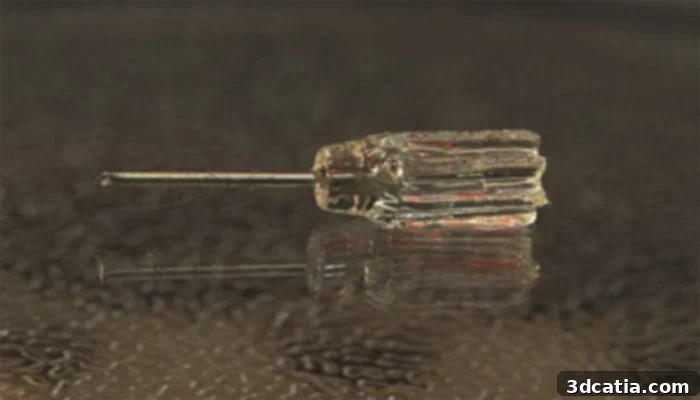
This pioneering volumetric printing process unlocks a diverse range of manufacturing possibilities previously deemed challenging or impossible with conventional 3D printing. Consider, for instance, the intricate task of adding a custom handle to an existing metal screwdriver shaft. With the Replicator, this can be achieved by simply plunging the metal component into the light-sensitive resin bath, allowing the new handle to solidify directly onto it. A traditional layer-by-layer 3D printer would grapple with this due to material adhesion issues, print bed constraints, and the difficulty of integrating a pre-existing object into its build sequence. The Replicator’s approach seamlessly integrates new components with existing structures, suggesting a future where customization and repair become remarkably straightforward. This capability extends beyond simple attachments, enabling the creation of objects that are inherently smoother, more flexible, and significantly more complex in their internal geometries than what typical additive manufacturing can produce.
The potential impact of this technology is particularly profound within medical fields, where precision, speed, and biocompatibility are paramount. Researchers highlight its great promise for applications requiring transparent parts, such as intricate surgical models, personalized prosthetics that perfectly match a patient’s anatomy, or even components for advanced diagnostic equipment. The ability to rapidly produce bespoke medical devices on demand, potentially even at the point of care, could revolutionize patient treatment and device development cycles. Furthermore, the inherent smoothness of volumetric prints reduces the need for extensive post-processing, which is a critical advantage in applications where surface finish and sterility are crucial. This paradigm shift in manufacturing methodology offers a pathway to highly personalized products across various industries, from consumer goods to specialized industrial equipment.
Hayden Taylor, an assistant professor of mechanical engineering at the University of California, Berkeley, enthusiastically shared his vision for the technology’s future: “I think this is a route to being able to mass-customize objects even more, whether they are prosthetics or running shoes.” His statement underscores the significant implications for industries that thrive on personalization. He further elaborated on the transformative potential for product design: “The fact that you could take a metallic component or something from another manufacturing process and add on customisable geometry, I think that may change the way products are designed.” This capability suggests a hybrid manufacturing approach where traditional methods and cutting-edge volumetric 3D printing converge, leading to innovative designs and optimized production workflows. Instead of designing a product entirely from scratch, designers could now integrate advanced, custom-printed features onto existing robust components, leading to efficiencies in material use, cost reduction, and enhanced functionality.
Understanding the ‘Replicator’s’ Volumetric Printing Technology
Even among advanced 3D printers that leverage light-based techniques, such as stereolithography (SLA) or Digital Light Processing (DLP), the standard operational paradigm involves building an object layer by successive layer. These methods cure thin slices of resin using UV light or a projector, stacking them to form the final part. However, the scientific community has been actively pursuing faster, more integrated light-based printing solutions. We previously reported on a promising new technique emanating from the University of Michigan, which promised exceptionally rapid small-scale manufacturing. Researchers there estimated their method to be potentially 100 times faster than other conventional approaches. Their innovative technique for solidifying liquid resin involved using two distinct light sources to precisely control where the resin would harden and where it would remain in its fluid state, offering a degree of spatial resolution and speed improvement.
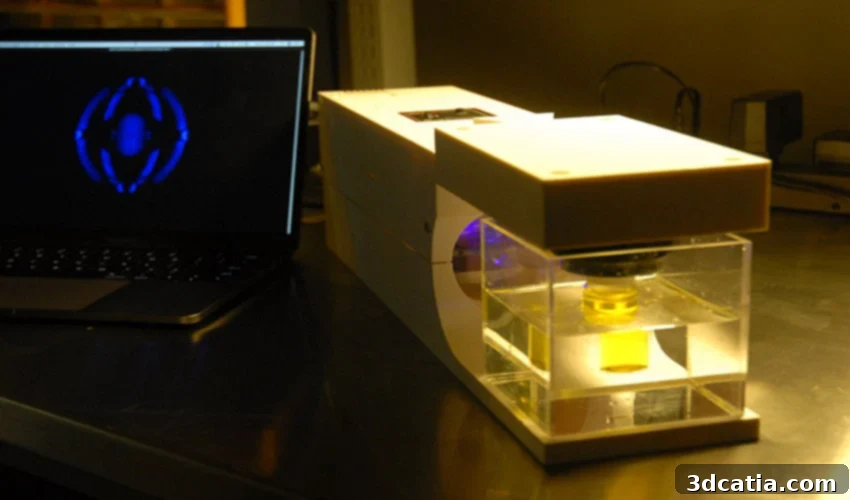
While the Michigan approach marked a significant advancement, the methodology employed by the UC Berkeley researchers for their “Replicator” printer is fundamentally different, focusing on true volumetric solidification. Their ingenious setup utilizes a rotating cylinder filled with a specifically formulated light-sensitive resin. This resin possesses a unique property: it solidifies only when exposed to a precise, cumulative threshold of light energy. The core innovation lies in how this light is delivered. Instead of curing layers, patterns of light representing the object’s entire three-dimensional shape are projected simultaneously from multiple angles through the rotating cylinder. Essentially, a video projector, connected to a laptop, generates a sequence of calculated images that correspond to the desired object’s geometry, which are then beamed into the resin as the cylinder rotates. This continuous, multi-directional light exposure causes the resin to polymerize and harden exactly where the light intensity crosses the critical threshold, forming the object in one swift action.
Elaborating on the simplicity and accessibility of the core components, Hayden Taylor explained: “Basically, you’ve got an off-the-shelf video projector, which I literally brought in from home, and then you plug it into a laptop and use it to project a series of computed images, while a motor turns a cylinder that has a 3D-printing resin in it.” This statement highlights that while the underlying scientific principles are sophisticated, the hardware components are surprisingly common. However, Taylor was quick to emphasize that the true ingenuity lies in the “subtleties” of the process. He added, “Obviously there are a lot of subtleties to it – how you formulate the resin, and, above all, how you compute the images that are going to be projected, but the barrier to creating a very simple version of this tool is not that high.” This implies that the selection and precise formulation of the photosensitive resin, along with the complex algorithms required to generate the correct multi-angular projection data, are the critical intellectual property and engineering challenges that make the Replicator possible and effective.
Inspired by Reversing CT Scans: A Diagnostic Approach to Manufacturing
UC Berkeley researchers used new 3D printing technology to create a model of Rodin’s ‘The Thinker.’ Photo Credits: Stephen McNally
The innovative principle behind the Replicator’s volumetric printing method draws direct inspiration from medical imaging technology, specifically Computed Tomography (CT) scans. As Professor Taylor explains, their technology essentially “reverses” the established CT scanning process. In a CT scan, X-rays are projected through a patient’s body from numerous different angles. Sophisticated detectors then capture the varying patterns of X-ray absorption, and complex algorithms are used to reconstruct a detailed, three-dimensional image of the internal geometry and composition of tissues and organs. This diagnostic method provides invaluable insight into structures that are otherwise hidden from view. The fundamental concept is to use patterns of energy transmission to reveal an object’s form.
Applying this concept to manufacturing required a brilliant inversion. Taylor elaborated: “Essentially we reversed that principle. We are trying to create an object rather than measure an object, but actually a lot of the underlying theory that enables us to do this can be translated from the theory that underlies computed tomography.” Instead of using X-rays to detect a pre-existing object, the Replicator uses precisely calculated light patterns to *create* an object within the resin bath. The light projections, akin to the X-ray beams in a CT scanner, are designed to converge and reach the critical solidification threshold only at the exact points that define the desired object’s geometry. This “additive tomographic” approach is a testament to interdisciplinary innovation, repurposing advanced diagnostic principles for groundbreaking fabrication capabilities. The algorithms that reconstruct images in CT scans are adapted to *construct* the light patterns necessary for 3D printing, enabling the simultaneous formation of complex shapes.
A crucial element for the success of this volumetric 3D printing method is the specialized light-sensitive liquid resin. The researchers had to meticulously develop a liquid that wouldn’t prematurely solidify when only a few rays of light passed through it, but rather only when the cumulative light exposure reached a specific threshold. This selective hardening is key to forming precise geometries. The ideal 3D-printing resin for this process is composed of a sophisticated mixture: liquid polymers provide the structural backbone, photosensitive molecules act as the active agents that initiate polymerization upon light exposure, and, critically, dissolved oxygen plays a vital role. The oxygen inhibits the polymerization process at low light intensities, ensuring that the resin only hardens where the light energy is concentrated and sustained enough to overcome this inhibition. This controlled reaction allows for the formation of intricate shapes with smooth surfaces, while the surrounding resin remains liquid and reusable.
Beyond its functional properties during the printing process, this specialized resin also offers significant environmental benefits. A notable advantage is the ability to recycle unused resin. Traditional 3D printing often leaves behind considerable amounts of waste material, especially in processes like powder bed fusion or support structures in FDM/SLA. With the Replicator, any resin that does not reach the solidification threshold remains in its liquid state. Researchers found that this unused resin can be 100% recycled by simply heating it up in an oxygen atmosphere. This process breaks down any partially polymerized components and restores the resin to its original, pristine liquid form, ready for subsequent printing jobs. This commitment to sustainability not only reduces material waste but also lowers operational costs, making volumetric 3D printing an even more attractive and responsible manufacturing solution for the future.
You can find more detailed information and insights directly from UC, Berkeley HERE.
The ‘Replicator’ technology from UC Berkeley stands as a testament to pioneering research, pushing the boundaries of what is achievable in additive manufacturing. By moving beyond conventional layer-by-layer deposition, this volumetric 3D printing method promises faster production, enhanced object integrity, and unprecedented opportunities for customization and integration with existing components. Its applications, ranging from advanced medical devices to highly personalized consumer goods, signify a potential paradigm shift in how products are designed and brought to life. The ingenious adaptation of CT scan principles, coupled with a sustainable resin system, underscores a holistic approach to innovation. This development is not merely an incremental improvement but a foundational step towards a future where complex, customized objects can be materialized on demand, quickly and efficiently.
What do you think of this revolutionary new 3D printing method? How do you envision it transforming various industries? We invite you to share your thoughts and insights in a comment below or join the discussion on our Facebook and Twitter pages! Don’t forget to sign up for our free weekly Newsletter, to receive all the latest news and innovations in 3D printing delivered straight to your inbox!