
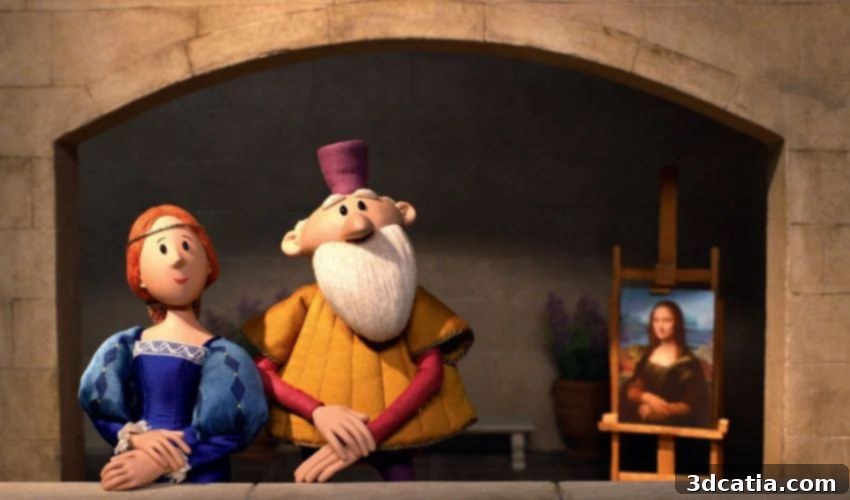
How “The Inventor” Film Blends Leonardo da Vinci’s Genius with Cutting-Edge 3D Printing Technology
Leonardo da Vinci, the quintessential Renaissance man, continues to captivate and inspire generations across countless disciplines – from the intricate studies of human anatomy to groundbreaking engineering concepts, and from profound philosophical inquiries to breathtaking artistic masterpieces. His unparalleled genius and insatiable curiosity redefined what it meant to be a polymath, making him an enduring figure whose story we never tire of exploring. In a remarkable new venture that breathes fresh life into Da Vinci’s legendary narrative, audiences are invited into the world of “The Inventor,” a stop-motion animated film directed by Jim Capobianco, in collaboration with French co-director Pierre-Luc Granjon and animation director Kim Keukeleire. This cinematic marvel boasts a star-studded voice cast, including Marion Cotillard, Daisy Ridley, Matt Berry, and Stephen Fry as the iconic inventor himself. Beyond its rich tapestry of history, art, and technology, “The Inventor” introduces a surprising, yet crucial, cast member: modern 3D printing technology.
Indeed, additive manufacturing emerged as an indispensable tool during the film’s extensive production, playing a pivotal role in crafting the intricate puppets and mechanical elements that bring Leonardo’s world to life. Director Jim Capobianco strategically partnered with the renowned French animation studio Foliascope and leveraged advanced 3D technologies from Dassault Systèmes throughout the entire creative process. The specialized 3D printing of various puppet components was expertly handled by the company, Initial, highlighting a significant leap in how animated films are conceptualized and executed. Following its initial release in the United States in September 2023, “The Inventor” has now captivated European audiences, making its debut in French theaters on January 31st, 2024. To delve deeper into this innovative production, 3Dnatives had the privilege of attending a private screening in Paris, offering an exclusive glimpse into the film’s artistic and technological brilliance.
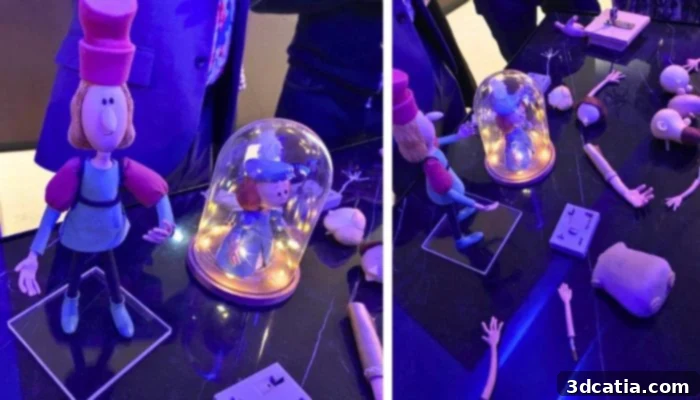
The puppets that appear in the film were made by hand with the help of 3D printing. (Credits: 3Dnatives)
A Journey Through Leonardo’s Life: The Film’s Narrative and Production
While an animated film, “The Inventor” transcends typical genre boundaries, offering a compelling and insightful experience for audiences of all ages. It intricately narrates Leonardo da Vinci’s later life, chronicling his struggles and triumphs in Italy, particularly his ideological clashes with the Pope in Rome. Ultimately, it depicts his momentous decision to relocate to France to continue his groundbreaking studies and artistic endeavors, a move that required significant compromises but opened new avenues for his genius. The entire production of this visually stunning and historically rich film spanned approximately two years, a testament to the meticulous craftsmanship involved in stop-motion animation. The creation of the puppets alone, a task entrusted to the skilled artisans at Foliascope studio, consumed an entire year, illustrating the dedication to detail required for each character. A subsequent year was then dedicated to the painstaking stop-motion animation process itself, where every frame was carefully manipulated and photographed to bring the story to life.
Revolutionizing Puppet Making: The Synergy of Craftsmanship and 3D Printing
One of the most captivating aspects of “The Inventor” is its seamless integration of time-honored meticulous craftsmanship with cutting-edge technology in the creation of its characters. While the main bodies of the puppets were meticulously handcrafted and assembled by skilled artisans, certain critical components, such as the puppets’ feet, were produced using advanced LPBF (Laser Powder Bed Fusion) metal 3D printing technology. This innovative approach offered several distinct advantages. Metal 3D printing allowed for the precise creation of complex geometries and intricate details that would be exceptionally challenging, if not impossible, to achieve through traditional methods. More importantly, it provided the desired strength and durability necessary for the puppets to withstand the rigorous demands of stop-motion animation, where each figure is moved and photographed thousands of times. The enhanced structural integrity and precise shaping of the 3D-printed feet also facilitated smoother, more controlled movements, enabling the animators to achieve a greater range of expressive poses and nuanced actions for the characters. This hybrid production method not only pushed the boundaries of stop-motion animation but also exemplified how additive manufacturing can serve as a powerful complement to traditional artistic techniques, opening new frontiers for creative expression in filmmaking.
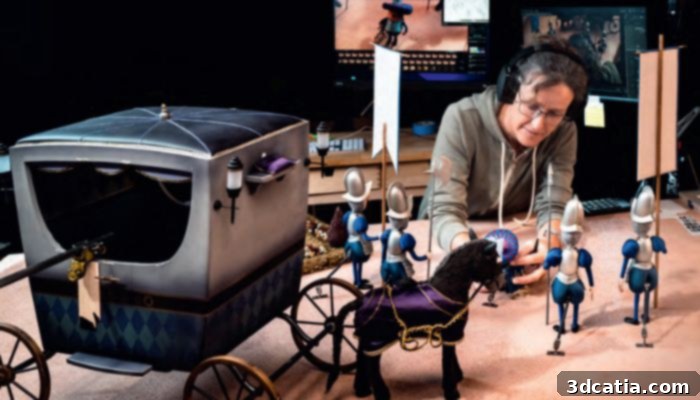
To make each scene of the film in stop motion, it was necessary to take a picture of each movement of the puppets, and then combine them into a montage. (Credits: theinventorfilm-Jean-Marie Hosatte)
Jim Capobianco’s Vision: Bringing Leonardo’s Humanity to the Big Screen
It comes as no surprise that such a masterfully crafted film is the brainchild of an accomplished visionary. American screenwriter and director Jim Capobianco, who both wrote and directed “The Inventor,” boasts an impressive portfolio of animated classics, including seminal works like “The Lion King,” “Coco,” and “Finding Nemo.” His talent has been recognized with an Oscar nomination for the critically acclaimed film “Ratatouille,” among other accolades. With “The Inventor,” Capobianco marks his directorial debut for a feature film, a project he chose to bring to life in France as a profound homage to the very places where Leonardo da Vinci spent his final, formative years. Capobianco shared his personal motivation, stating, “I wanted to delve into the life of Leonardo da Vinci as a human being, as well as a genius. To also bring to the scene his experience, the move from Italy to France, the difficulties he encountered, the people who accompanied him.” This intimate perspective underscores the film’s ambition to explore not just the inventor’s intellect but his emotional journey, his resilience, and the human connections that shaped his extraordinary existence. This focus on Leonardo’s personal story, including his challenges and relationships, makes the film resonate deeply with audiences, presenting a more holistic portrait of the historical icon.
The OpenCodex Challenge: A Digital Revival of Leonardo’s Inventions
Another fascinating detail that enriched the production of “The Inventor” was the innovative “OpenCodex Challenge.” Launched by Dassault Systèmes’ 3DEXPERIENCE Lab, this global initiative sought to digitally resurrect and understand Leonardo da Vinci’s visionary sketches and inventions. The challenge invited designers, engineers, and enthusiasts from across the globe to join the OpenCodex community, utilizing Dassault Systèmes’ advanced 3D software, such as CATIA, to meticulously reconstruct the inventor’s conceptual models and intricate machines. This endeavor was not merely about creating digital replicas; it was about gaining a deeper, functional understanding of how these brilliant devices were intended to operate. The participants, through their collaborative efforts and technological prowess, helped to interpret and visualize Leonardo’s foresight, contributing invaluable insights and actual 3D models that were then incorporated into the film. This challenge served as a bridge between historical genius and contemporary digital design, demonstrating the power of modern simulation and design tools in unlocking the secrets of the past and inspiring future innovation.
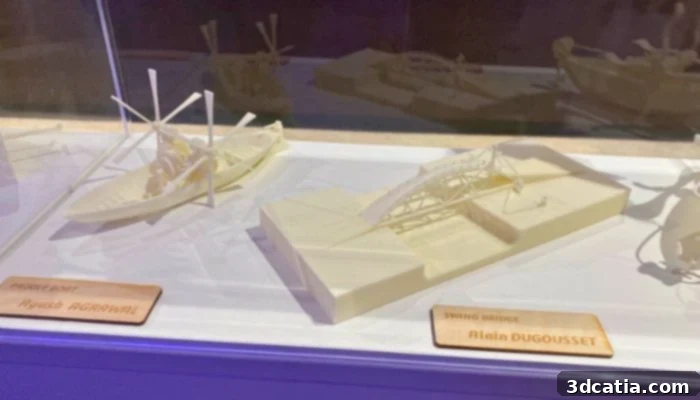
Some of the models of the 3D printed OpenCodex Challenge winners. There were five winners and their designs are now part of the film. (Credits: 3Dnatives)
Inspiring Future Innovators: The Fusion of Science, Technology, and Art
Frédéric Vacher of Dassault Systèmes eloquently articulated the broader vision behind this collaboration: “With this film, we have the ambition to inspire young people towards science and technology, we need these talents. The production of the future is digital and 3D. Bringing together The Worlds of Science, Technology and the Arts will contribute to a more sustainable future.” This statement encapsulates the profound message embedded within “The Inventor.” It’s not just a film about a historical figure; it’s a beacon for future generations, illustrating the critical interdependency of STEM (Science, Technology, Engineering, and Mathematics) and the creative arts. By showcasing how advanced 3D technologies, like additive manufacturing and sophisticated design software, can enable artistic expression and scientific understanding, the film champions a holistic approach to innovation. It demonstrates that the greatest advancements often emerge at the intersection of diverse disciplines, encouraging young minds to explore their passions across traditional boundaries and embrace the digital tools that are shaping our future. The narrative of Leonardo, a master of both art and science, perfectly mirrors this contemporary imperative, making the film a powerful educational and inspirational tool.
3D Printing: A New Frontier in Filmmaking
“The Inventor” undeniably represents another significant milestone in the evolving integration of 3D printing technologies into the cinematic world. This follows the groundbreaking success of Guillermo del Toro’s Oscar-winning “Pinocchio,” where the world’s most famous puppet was famously brought to life with the aid of 3D printing. The rapid advancements in additive manufacturing are transforming various stages of filmmaking, from pre-production to principal photography. Prototyping complex props and set pieces, fabricating highly customized final parts with unprecedented precision, and enabling rapid iterations of designs are just some of the tangible benefits. The ability to visualize intricate 3D models digitally and then physically manifest them through printing offers filmmakers unparalleled creative freedom and efficiency. This technology is proving invaluable for creating unique creature designs, detailed miniatures, specialized camera rigs, and even functional mechanical components for practical effects. As seen in “The Inventor,” 3D printing facilitates the intricate movements required for stop-motion animation and allows for the accurate reconstruction of historical artifacts and inventions. Its speed, customization capabilities, and capacity to handle extreme geometric complexity are making additive manufacturing an indispensable tool in modern cinematic production, promising an exciting future for visual storytelling.
What are your thoughts on “The Inventor” and the innovative application of 3D printing in its production? We invite you to share your insights and comments below, or engage with us on our LinkedIn, Facebook, and Twitter pages! Don’t miss out on the latest advancements and stories in the world of additive manufacturing; sign up for our free weekly Newsletter here to receive top 3D printing news directly in your inbox. You can also explore all our compelling video content on our dedicated YouTube channel.
*Cover photo credits: Curiosity Studio Limited