

Revolutionizing Rocket Propulsion: How LEAP 71 Combines AI and 3D Printing for Breakthrough Space Engines
The aerospace industry stands at the precipice of a new era, fueled by groundbreaking innovations. For years, the transformative potential of 3D printing in space has been evident, with giants like NASA and ESA consistently pushing boundaries in leveraging additive manufacturing for critical components. From lightweight structural elements to complex propulsion systems, 3D printing has proven its worth in creating designs previously impossible with traditional methods. Now, a powerful new force, artificial intelligence, is emerging as a revolutionary partner, promising to accelerate development cycles and unlock unprecedented levels of design optimization. The synergy between AI and 3D printing is best exemplified by companies like LEAP 71, a trailblazer demonstrating how this powerful combination can lead to advanced approaches and tangible results in high-performance applications. This Dubai-based innovator has successfully developed and rigorously tested a 3D-printed liquid propellant rocket engine, powered by its proprietary AI-based software tool, Noyron, marking a significant leap forward in space propulsion technology.
LEAP 71: Pioneering the Future with Computational Engineering
We’ve previously highlighted the impressive work of LEAP 71 and their ambitious vision. Founded on the principles of computational engineering, the company is dedicated to driving technological progress through highly sophisticated software and advanced additive manufacturing techniques. Their core philosophy revolves around the idea that complex engineering challenges, especially in the demanding realm of aerospace, can be solved more efficiently and effectively by leveraging algorithmic design and automated processes. This approach minimizes human error, drastically reduces development timelines, and opens up a vast design space that traditional methods simply cannot explore. For the manufacturing of their cutting-edge products, including their latest rocket engine, LEAP 71 relies heavily on additive manufacturing, a process perfectly suited for intricate geometries and rapid iteration.
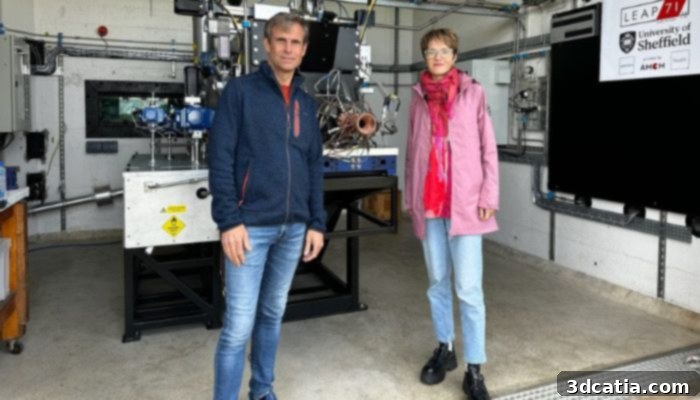
LEAP71 was founded by aerospace engineer Josefine Lissner and entrepreneur Lin Kayser, blending deep technical expertise with entrepreneurial drive.
Noyron: The AI Brain Behind Revolutionary Design
At the heart of LEAP 71’s success lies its proprietary Noyron software. The primary objective of the TKL-5 rocket engine project was to unequivocally demonstrate the exceptional capabilities of this advanced software and to rigorously test the resulting large computational engineering model of the propulsion system. Noyron employs sophisticated AI algorithms to automatically implement complex logical and physical processes throughout the entire manufacturing design process. This means that instead of human engineers meticulously crafting every detail in traditional CAD software, Noyron autonomously generates, optimizes, and validates designs based on predefined parameters and performance requirements. Using this groundbreaking software, LEAP 71 was able to develop the complete model for the TKL-5 rocket engine – entirely digitally and under computer control, with minimal to no direct human intervention in the design generation phase. This level of automation ensures unprecedented precision, consistency, and an ability to explore a multitude of design variations that would be prohibitively time-consuming otherwise.
Accelerated Development and Unprecedented Efficiency
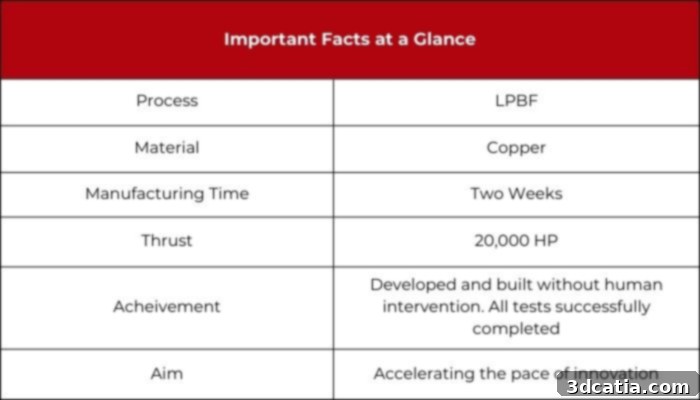
The impact of Noyron’s AI-driven approach on production time has been truly remarkable. By virtually eliminating the need for traditional, labor-intensive CAD design, the TKL-5 engine moved from final specification to a manufactured product in an astonishingly short period – just two weeks. This contrasts sharply with conventional aerospace engineering projects, which often require many months, or even years, for similar design and prototyping phases. The efficiency gains are not merely incremental; they represent a paradigm shift in how complex propulsion systems can be brought to fruition. Following its rapid production, the engine was successfully tested on June 14, 2024, in Wescott, UK, demonstrating flawless operation on its very first test run. This success underscores the robustness and accuracy of Noyron’s AI-generated designs and the precision of the additive manufacturing process.
Collaborative Innovation: A Multi-Expert Endeavor
While LEAP 71 and its Noyron software were central to the triumph of the rocket engine’s development, the company strategically leveraged the expertise of several key partners to bring the project to fruition. The physical engine itself was expertly printed on an EOS M290 metal 3D printer by AMCM, a renowned German pioneer in industrial 3D metal printing. The choice of material was crucial: copper. This selection was deliberate, as copper’s exceptional thermal conductivity allows for the creation of very powerful engines capable of active cooling, a critical requirement for high-performance rocket propulsion where extreme temperatures are encountered. Copper’s ability to rapidly dissipate heat is unparalleled, enabling engineers to design highly efficient combustion chambers and cooling channels that are inaccessible through traditional manufacturing. Beyond manufacturing, the project benefited from academic collaboration with the British “Race to Space” team from the University of Sheffield. This team provided invaluable feedback and performed essential post-processing work on the engine before it underwent its inaugural test at Airborne Engineering’s specialized test site. During the test launch, all critical parameters, including temperature values and pressure readings, remained well within established limits, allowing the involved teams to confidently confirm the engine’s integrity and its planned functionality.
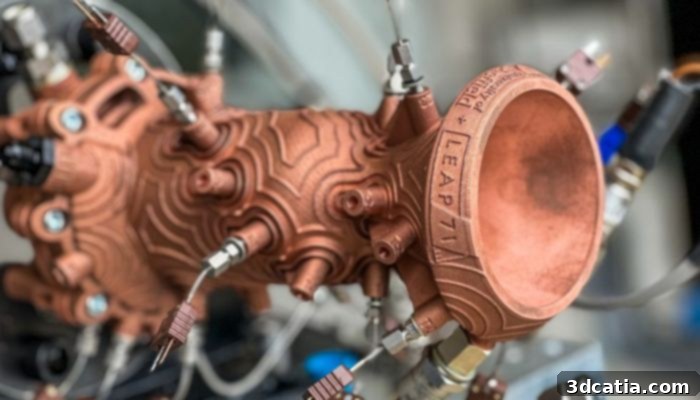
The engine was made from copper using a sophisticated 3D printing process, allowing for complex internal cooling channels.
The TKL-5 Engine: Design, Materials, and Performance
The TKL-5 engine is a testament to advanced engineering. Its compact size makes it ideally suited for deployment as the final stage of an orbital rocket, perfectly designed for precise maneuvering and payload delivery in space. This powerhouse delivers a substantial thrust of 5 kN, equivalent to lifting a mass of 500 kg, or an impressive 20,000 hp. Like many other advanced propulsion systems, the TKL-5 utilizes cryogenic liquid oxygen and kerosene as its propellants. This specific combination, despite the inherent difficulties associated with handling cryogenic fuels, was a strategic decision by LEAP 71. Kerosene not only serves as a vital propellant but also plays a crucial role in the engine’s sophisticated cooling system. As kerosene is meticulously forced through a network of intricately designed, thin ducts within the engine structure, it absorbs immense heat, effectively cooling critical components and preventing the engine from succumbing to the extreme temperatures generated during combustion. Even with combustion temperatures soaring to 3000°C, this ingenious cooling mechanism ensures that the engine’s external surface can be maintained stably at below 250°C, a remarkable feat of thermal management made possible by copper’s properties and the design freedom offered by 3D printing.
Data-Driven Iteration and the Future of Space Accessibility
Beyond its sophisticated cooling system, LEAP 71’s engineers have ingeniously integrated comprehensive monitoring capabilities into the rocket drive. Numerous connections are strategically placed throughout the engine to measure temperature and pressure in real-time. This invaluable data can be fed directly back into the Noyron computational model. This closed-loop feedback system is revolutionary: the live performance data informs and refines the software, allowing Noyron to continuously learn and optimize. The AI is capable of generating new design variants of the engine model in less than 15 minutes, which can then be directly manufactured and tested, creating an agile and iterative development cycle that is unprecedented in traditional aerospace. Josefine Lissner, aerospace engineer and Managing Director of LEAP 71, eloquently underscores the profound importance of Noyron in accelerating these developments, stating:
This is an important milestone for us and the entire industry. We can automatically create functional rocket thrusters and directly move to practical validation. From final specification to manufacturing, the design of this engine took less than 2 weeks. In traditional engineering, this task would take many months or even years. Each new engine iteration takes only minutes. Innovation in space propulsion is hard and costly. With our approach, we hope to make space more accessible for everyone.
Lissner’s vision highlights the broader impact of LEAP 71’s work. By drastically reducing the time and cost associated with developing new propulsion systems, their methodology promises to democratize access to space, enabling more frequent launches, fostering greater innovation in satellite technology, and potentially paving the way for more ambitious space exploration missions. The combination of AI-driven design and rapid additive manufacturing creates an ecosystem where complex engineering challenges can be overcome with unparalleled speed and efficiency, truly opening up the cosmos for future generations.
To delve deeper into the innovative world of LEAP 71 and their groundbreaking work, you can find more information HERE. We invite you to share your thoughts and insights on this exciting development in a comment below or join the conversation on our LinkedIn, Facebook, and Twitter pages! Don’t miss out on the latest 3D printing news and innovations – sign up for our free weekly newsletter here, delivered straight to your inbox! You can also explore all our compelling videos and further content on our YouTube channel.
*All Photo Credits: LEAP 71