
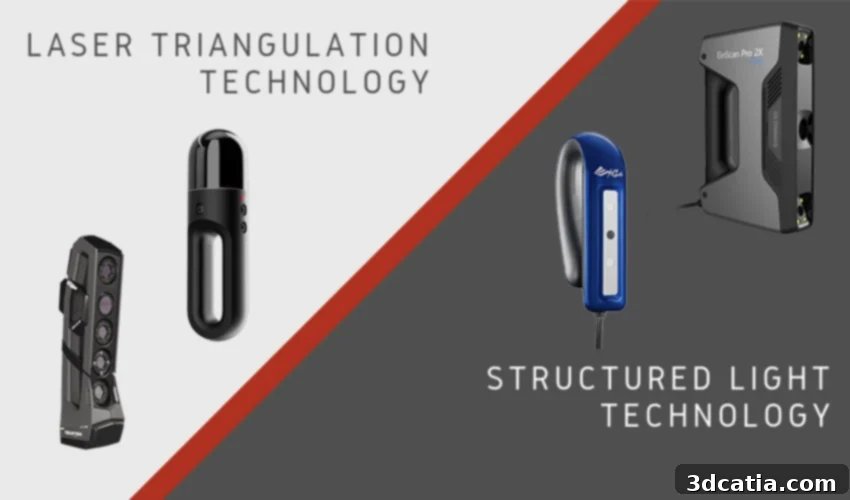
Mastering 3D Scanning: Laser vs. Structured Light for Optimal 3D Printing Results
In the dynamic world of additive manufacturing, 3D scanners have become an indispensable tool, significantly streamlining the workflow for 3D printing. These sophisticated devices are crucial for accurately capturing the intricate geometries and sometimes even the visual appearance (such as colors) of physical objects. By collecting precise data, 3D scanning profoundly enhances the entire design process, accelerating development cycles, minimizing errors in data acquisition, and ultimately delivering substantial savings in both time and financial resources. Whether for reverse engineering, quality inspection, or rapid prototyping, integrating 3D scanning into a project can elevate efficiency and precision to new heights.
The realm of 3D scanning is diverse, built upon various technological principles, each offering distinct advantages and inherent limitations. Understanding these underlying technologies is key to selecting the most appropriate tool for a given task. This comprehensive article delves into two of the most prevalent and widely utilized technologies for 3D scanning in the context of 3D printing: laser triangulation and structured light projection. We will explore their operational mechanics, evaluate their respective benefits and drawbacks, and ultimately guide you through the critical decision-making process. How do laser scanners truly stack up against structured light scanners? More importantly, which technology is the optimal choice for your specific project requirements, ensuring you achieve the best possible outcomes for your 3D printing endeavors?
Laser Scanners: Technology, Benefits, and Limitations Explained
Laser scanners operate on the fundamental principle of trigonometric triangulation, a method that allows them to meticulously capture the exact 3D shape of an object as millions of precise data points. The process begins with the scanner projecting either a single laser point or a finely focused laser line onto the surface of the object. A strategically positioned sensor then captures the reflection of this laser light. Given that the exact distance between the sensor and the laser’s source is known and fixed, the system can accurately determine the distance to each scanned point by meticulously calculating the angle at which the laser light reflects back to the sensor. With this detailed distance information, the scanning hardware constructs a highly accurate map of the object’s surface, culminating in a comprehensive 3D scan.
This technique is aptly named triangulation because the laser emitter, the point (or line) of light on the object’s surface, and the sensor collectively form a distinct triangle. The known dimensions within this triangle (the distance between emitter and sensor, and the angle of reflection) enable the precise calculation of the third side, which is the distance to the object. The market offers a wide array of laser scanners, catering to various needs and budgets. Consumers can choose from compact handheld devices for flexibility, sturdy desktop scanners ideal for smaller objects and controlled environments, or robust professional/industrial devices engineered for high-volume, precision applications. A common characteristic across all these types, however, is their operational range; they typically function most effectively within a relatively short range to maintain optimal accuracy.
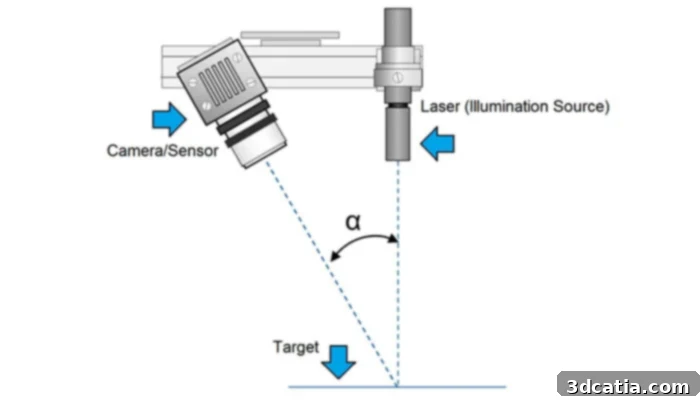
The primary advantages of laser triangulation technology lie in its exceptional resolution and unparalleled accuracy. These scanners are capable of achieving accuracy on the order of tens of micrometers, making them suitable for applications demanding extreme precision, such as intricate engineering parts or detailed artifact reproduction. Furthermore, the fundamental design principles of laser scanners can be relatively straightforward, which contributes to their affordability; it is possible to acquire a high-quality laser 3D scanner at a very reasonable price point, particularly for desktop models. Their ability to deliver high-fidelity data makes them a favorite for industries requiring meticulous dimensional verification and precise digital representations.
However, it’s crucial to acknowledge the inherent limitations of laser triangulation. The performance of these scanners can be significantly impacted by the surface properties of the object being scanned. Highly shiny, reflective, or transparent surfaces often present considerable challenges for this technology. Light can scatter unpredictably from glossy surfaces or pass directly through transparent materials, making it difficult for the sensor to accurately capture the reflected laser light. This often necessitates surface preparation, such as applying a matte scanning spray, which can add an extra step to the workflow and potentially influence the object’s original state. Understanding these limitations is vital for successful project planning and execution.
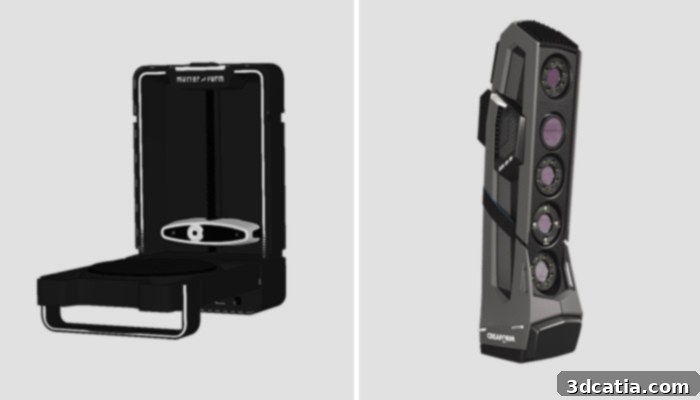
For example, the Matter & Form V2 (on the left) is a desktop laser 3D scanner, retailing for $749. The Go!SCAN SPARK (on the right) from Creaform is a professional handheld laser 3D scanner with a starting price around $30,000.
Structured Light Scanners: Technology, Benefits, and Limitations Explained
A significant portion of modern handheld 3D scanners, particularly those favored for 3D printing applications, leverage structured light technology. While also rooted in trigonometric triangulation, this method diverges from laser scanning by projecting an entire pattern of light onto the object’s surface, rather than just a single line or dot. This pattern, which can be white or blue light, typically consists of a series of intricate stripes, although patterns of dots or other complex shapes are also employed. The projection is typically achieved using an LCD projector or another stable light source. One or more sensors (often high-resolution cameras), positioned at a slight offset from the projector, then capture the deformation and distortion of this projected pattern as it wraps around the object’s contours. By analyzing how the pattern distorts, the scanner’s software can precisely calculate the distance to every single point within its field of view, creating a comprehensive 3D surface map almost instantaneously.
Similar to laser scanners, structured light devices are primarily designed for short-range applications, offering versatility in their form factors, ranging from highly portable handheld units ideal for scanning objects of varying sizes to stationary scanners mounted on tripods for stable, precise captures of smaller, intricate items. This adaptability makes them suitable for a broad spectrum of uses, from reverse engineering consumer products to capturing human anatomy.
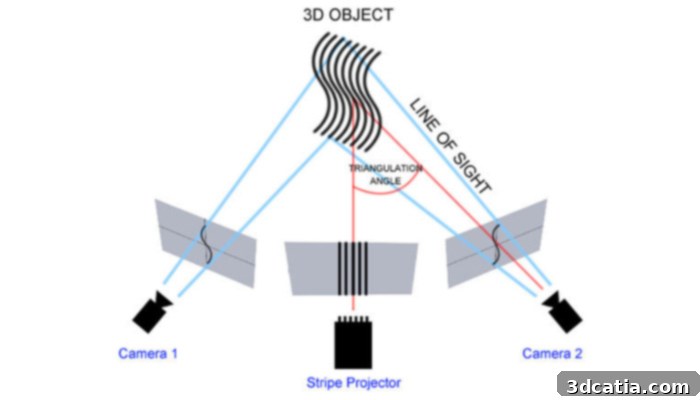
The paramount benefit of structured light technology is its remarkable scanning speed. Unlike laser scanners that often trace lines across a surface, structured light scanners capture an entire “snapshot” of the object’s geometry with each projected pattern. This allows for rapid data acquisition, with a single scan often completed in approximately 2 seconds, and the ability to cover a relatively large scanning area per shot. This speed is invaluable for projects requiring quick turnaround times or the scanning of numerous objects. Furthermore, structured light scanners are celebrated for their exceptional accuracy and high resolution, rivaling that of laser scanners. They can also capture color textures, providing a more complete and visually rich digital model, which is a significant advantage for applications like cultural heritage preservation or product visualization.
However, structured light scanners do have their specific sensitivities. One of their notable drawbacks is their susceptibility to ambient lighting conditions. Strong or inconsistent external light sources, especially sunlight, can interfere with the projected pattern, making it challenging for the sensors to accurately detect the light deformation. This makes working outdoors, or in environments with uncontrolled lighting, extremely difficult or even impossible without additional measures to shield the scanning area. While laser scanners can also be affected by bright light, structured light scanners tend to be more sensitive to variations in ambient illumination. Additionally, like laser scanners, very dark, highly reflective, or transparent surfaces can still pose challenges, often requiring the application of a matte scanning spray for optimal results.
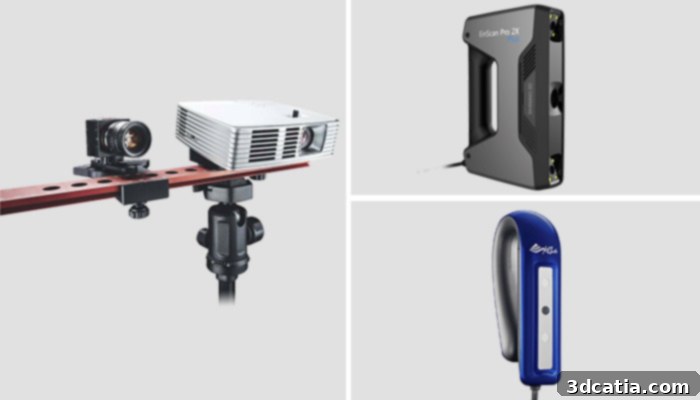
For example, the Structured Light Pro S3 (on the left) from HP is a mounted on tripod device, retailing at around $4,390 (3,930€). The EinScan Pro 2X (top) from Shining3D is a professional handheld structured light device, costing around $6,899 and the Scanner 2.0 (bottom) from XYZprinting is also a handheld device for beginners that costs $256 (226€).
Beyond Short-Range: Exploring Other 3D Scanning Technologies
While laser triangulation and structured light technologies excel in short-range 3D scanning, capturing intricate details of small to medium-sized objects, they encounter limitations when the requirement shifts to scanning objects from a significant distance. For projects demanding the capture of much larger subjects or expansive environments, alternative technologies designed for medium to long-range 3D scanning become essential.
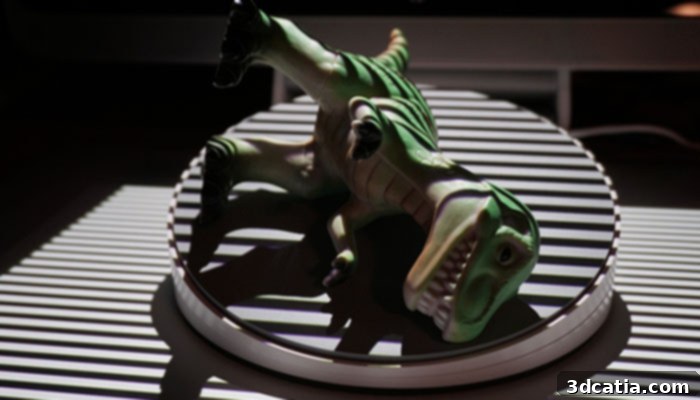
3D scanning using structured light technology
One prominent long-range technology is the Time-of-Flight (TOF) 3D scanner, which primarily utilizes laser pulse technology. Although it employs lasers similar to short-range laser scanners, its operational principle is fundamentally different. TOF scanners capitalize on the precisely known speed of light. The system functions by emitting a laser pulse and then meticulously measuring the exact duration it takes for that pulse to travel from the scanner, reflect off the object’s surface, and return to the scanner’s sensor. By simply multiplying this measured time by the speed of light, the scanner can determine the distance to the target point with remarkable accuracy over vast distances. These scanners are particularly valuable for applications such as surveying, architectural documentation, and scanning large industrial sites where traditional short-range methods would be impractical.
A variation of Time-of-Flight scanning incorporates phase-shift systems. This technique operates on a similar principle to laser pulse technology but introduces an additional layer of sophistication by modulating the power of the continuous laser beam. Instead of measuring the time of a pulse, the scanner compares the phase difference between the outgoing laser beam and the returning reflected beam. This phase shift directly correlates to the distance traveled. Phase-shift systems generally offer higher accuracy than simple laser pulse TOF scanners for medium ranges because phase can be measured with greater precision than very short time intervals. However, their flexibility for extremely long-range scanning might be somewhat less compared to basic pulse-based systems due to potential issues with phase ambiguity over vast distances.
It’s important to note that while Time-of-Flight 3D scanners are unparalleled for large-scale applications, they typically do not achieve the same level of micrometer-scale accuracy as short-range laser or structured light scanners. The trade-off for their expansive range is often a slightly lower resolution and precision in capturing fine details. Nonetheless, for tasks such as scanning an entire building, a vast landscape, or large industrial components, TOF technology is almost exclusively the go-to solution. Its ability to quickly capture comprehensive point clouds of immense structures makes it indispensable for industries like construction, civil engineering, and urban planning.
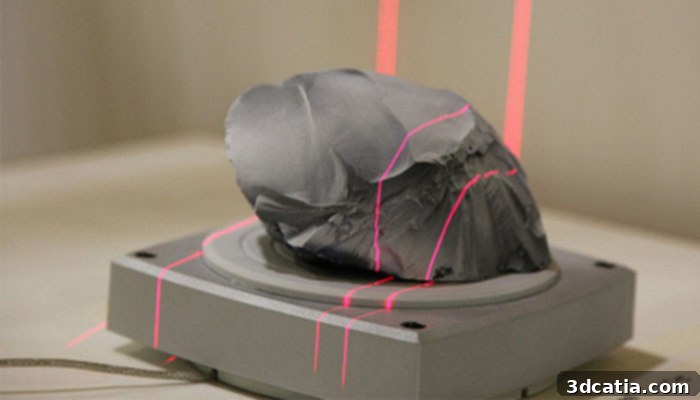
3D scanning using laser triangulation technology
Choosing the Right 3D Scanner for Your Project
The decision between laser triangulation and structured light scanners, or even delving into longer-range technologies, hinges entirely on your specific project requirements. Consider the following factors when making your choice:
- Object Size and Complexity: For small to medium-sized objects with intricate details, both laser and structured light excel. For larger objects or entire environments, Time-of-Flight scanners are necessary.
- Required Accuracy and Resolution: If micrometer-level precision is paramount (e.g., for precision engineering or quality control of small parts), high-end laser or structured light scanners are ideal. For architectural or large-scale mapping, TOF scanners offer sufficient accuracy.
- Surface Properties: If your objects have consistently matte, opaque surfaces, laser scanners are often robust. For objects with varied textures and where color information is desired, structured light can be advantageous. For shiny or transparent objects, surface preparation (e.g., scanning spray) is almost always required for both short-range technologies.
- Scanning Environment: Structured light scanners perform best in controlled indoor environments with stable lighting. Laser scanners are generally more tolerant of ambient light, though extreme conditions can still be an issue. TOF scanners are designed for outdoor and large-scale environments.
- Speed Requirements: For rapid data acquisition of an entire object or many objects, structured light scanners’ full-field capture is incredibly efficient. Laser scanners, while accurate, can be slower due to line-by-line scanning.
- Budget: Entry-level laser and structured light scanners are available at consumer-friendly prices, with professional-grade models escalating in cost. Long-range TOF scanners represent a significant investment, typically reserved for industrial and professional applications.
- Portability: Handheld options exist for both laser and structured light, offering flexibility for scanning objects in various locations.
By carefully evaluating these aspects against your project goals, you can confidently select the 3D scanning technology that best aligns with your needs, ensuring optimal data capture for your 3D printing and design workflows. The right scanner not only saves time and money but also unlocks new possibilities for innovation and precision in your work.
Was this helpful in choosing which technology you should choose for your next project? Let us know in a comment below, or on our Facebook and Twitter pages! Sign up for our free weekly Newsletter to get all the latest news in 3D printing straight to your inbox!