
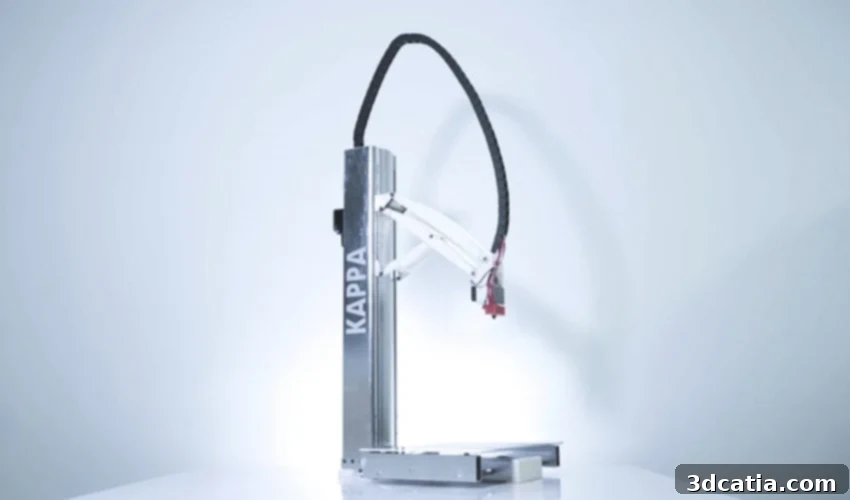
Kappa 3D Printer: Revolutionizing Affordable 3D Printing with Linear Precision
The world of 3D printing is constantly evolving, with innovations pushing the boundaries of accessibility and performance. A new contender, the Kappa 3D printer, is making significant waves by introducing a unique linear mechanism at an incredibly affordable price point. Developed by Ionic3DP, this innovative machine aims to bring high-quality, precise 3D printing to a wider audience, starting with a pre-order price as low as $245.
Introducing Kappa: A New Era of Desktop 3D Printing
Ionic3DP, the visionary company behind the Kappa 3D printer, successfully launched its Kickstarter campaign to raise $50,000. The goal was to fund the initial production and market penetration of the first-ever 3D printer to incorporate a sophisticated linear mechanism. The campaign rapidly garnered enthusiastic support, quickly surpassing its initial target and attracting significant interest from both individual backers and investors alike. This early success underscored the market’s hunger for innovative, cost-effective 3D printing solutions.
The Kappa printer is not merely another entry into the crowded 3D printing market; it represents the culmination of a year and a half of dedicated research and development. This extensive work was carried out at the prestigious National University of Singapore, where engineers and designers meticulously crafted its unique architecture. Ionic3DP proudly states that the Kappa’s core design is fundamentally based on Scott-Russell’s ‘linear motion mechanism’. This engineering principle, renowned for its robustness and accuracy, is a technology widely utilized and proven in demanding sectors such as the automotive industry and advanced robotics. Its application in a desktop 3D printer promises unparalleled quality and precision, setting a new benchmark for what users can expect from an entry-level device.
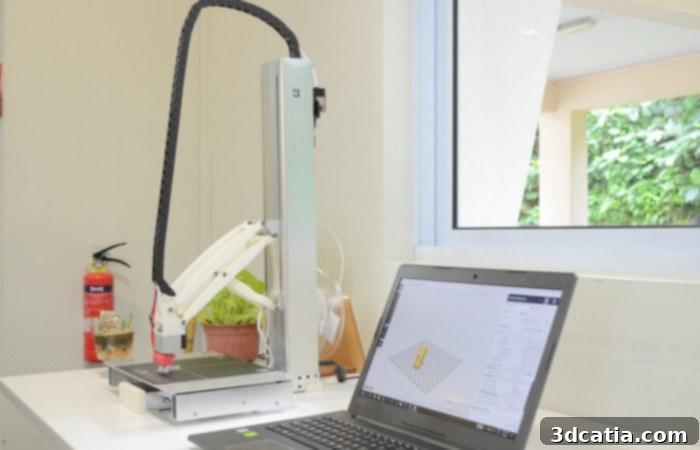
The Kappa is based on movement of Scott-Russel
Engineering Excellence: The Scott-Russell Mechanism Explained
At the heart of the Kappa’s innovative design lies the Scott-Russell linear motion mechanism. Unlike conventional Cartesian or Delta 3D printers that rely on multiple independent motors and complex belt systems for X, Y, and Z axis movements, the Scott-Russell mechanism simplifies motion. It achieves precise linear translation through a system of interconnected arms and pivots. In the Kappa, this translates to two relatively long arms and a single shorter arm, which together articulate to position the print head with remarkable accuracy and repeatability.
This ingenious arrangement is not just simpler; it’s inherently more stable and less prone to inaccuracies caused by belt stretch or backlash often seen in traditional systems. The direct linear movement ensures that the nozzle maintains a consistent path, leading to higher print quality, smoother surfaces, and accurate dimensions. The robustness of this mechanism, as evidenced by its application in industrial automation and vehicle suspension systems, guarantees enhanced durability and reliability for the Kappa 3D printer. This means less maintenance, fewer calibration issues, and a more consistent printing experience for the user.
Kappa: A Simpler, Smarter Design for 3D Printing
Beyond its revolutionary movement system, the Kappa 3D printer incorporates several thoughtful design elements aimed at enhancing user experience and print quality. The print head, securely held by the unique two-long-one-short arm assembly, glides effortlessly atop a sturdy vertical aluminum chassis. The coordinated movement of these arms precisely dictates the X and Y axes, ensuring fluid and accurate deposition of material.
A particularly clever design feature is the integration of the printer’s frame as a passive heat management system. The heat generated by the stepper motors and the extruder is efficiently dissipated throughout the robust aluminum chassis. This ingenious approach effectively transforms the entire frame into a large heat sink, preventing overheating of critical components. This not only extends the lifespan of the electronics and motors but also contributes to greater machine stability during prolonged printing operations, minimizing thermal expansion effects that can impact print quality.
Further streamlining the design, all essential electronics are meticulously housed within the chassis. This integrated approach eliminates the clutter of external wires, connectors, or dangling cables that can often interfere with the printing process, pose safety hazards, or simply detract from the printer’s aesthetics. The result is a cleaner, more reliable, and visually appealing machine that prioritizes functionality and user safety.
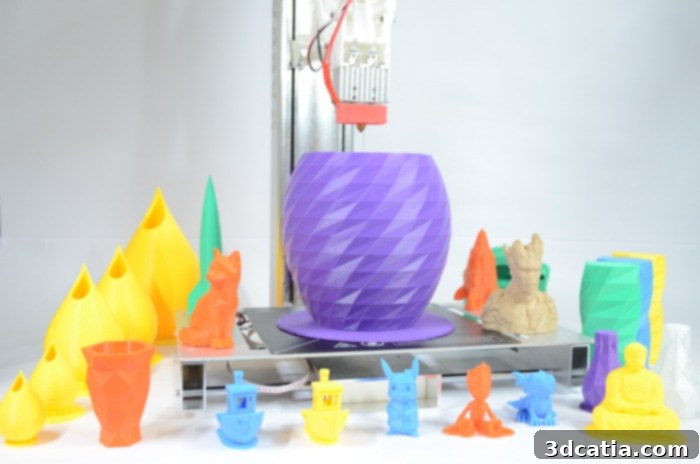
The Kappa boasts a generous print volume of 200 x 200 x 200 mm, a size well-suited for a wide range of hobbyist and prototyping projects. The linear movement of the nozzle, directly relative to the print plate, is instrumental in maximizing this build area within a compact machine footprint. Ionic3DP has also prioritized user convenience, designing the Kappa to be remarkably compact and extraordinarily easy to assemble. The team proudly states that users can have their Kappa ready for its first print in as little as 5 minutes, requiring only 6 screws for complete setup – a testament to its plug-and-play philosophy.
Adding to its user-friendly features, the Kappa incorporates a removable heated print plate. This plate is ingeniously secured by magnets, eliminating the need for tedious recalibration after each use or removal. This feature not only simplifies the process of removing finished prints but also ensures consistent bed leveling, leading to improved first-layer adhesion and overall print success. Such thoughtful design choices underscore Kappa’s commitment to making high-quality 3D printing accessible and hassle-free for everyone.
Unbeatable Value: How Kappa Achieves Such a Low Price
Perhaps the most compelling aspect of the Kappa 3D printer, alongside its innovative technology, is its astonishingly low price point. With a starting price for early backers at just 329 Singapore dollars, which translates to approximately $245 USD or €205, the Kappa positions itself as one of the most accessible 3D printers on the market. This introductory price, exclusively offered to the first supporters of the Kickstarter campaign, represents an incredible opportunity to acquire cutting-edge technology without breaking the bank.
Even after the initial Kickstarter phase, the official retail price is projected to be 340 Singapore dollars, roughly $284 USD. This figure remains remarkably noteworthy, as it places the Kappa well below the industry average for desktop FDM (Fused Deposition Modeling) 3D printers, especially those boasting similar levels of precision and build quality. The ability of Ionic3DP to offer such advanced technology at a fraction of the cost typically associated with high-performance machines is a game-changer. It significantly lowers the barrier to entry for hobbyists, educators, small businesses, and anyone curious about exploring the vast possibilities of additive manufacturing.
This aggressive pricing strategy, combined with the printer’s unique features, contributed significantly to the rapid success of its crowdfunding campaign. The promise of an affordable, high-precision 3D printer resonated deeply with a market eager for innovation that doesn’t come with a premium price tag. The decision to leverage a Kickstarter campaign allowed Ionic3DP to gauge market demand, secure early funding, and establish a passionate community around its product before mass production, proving to be a highly effective launch strategy.
Kickstarter Success and Future Outlook
The overwhelming response to the Kappa’s Kickstarter campaign is a clear indicator of its potential impact on the 3D printing landscape. The campaign effortlessly reached its funding goal, collecting an impressive $48,000 in a mere 10 days. This rapid and substantial funding demonstrated robust market confidence in Ionic3DP’s vision and the Kappa’s innovative design. With the funding goal not only met but significantly exceeded, production was slated to begin swiftly, with initial deliveries scheduled for March 2018.
The enthusiastic reception suggests that the Kappa is poised to become a significant disruptor in the desktop 3D printer market. Its combination of an innovative linear mechanism, user-friendly design, and an incredibly attractive price point creates a compelling value proposition that few competitors can match. As more users adopt this technology, it will be exciting to see how the Scott-Russell mechanism influences future 3D printer designs and how it contributes to making 3D printing more accessible and reliable for creators worldwide. To witness the Kappa in action, you can check out the campaign video below:
What are your thoughts on the groundbreaking Kappa 3D printer and its unique approach to linear motion? We invite you to share your valuable opinions and insights in the comments section below or engage with fellow enthusiasts and experts within the vibrant 3D Natives forum.