News
Wisconsin Researchers Transform Dairy Waste for 3D Printing
Two professors at the University of Wisconsin-Platteville have unveiled a new breakthrough that combines agriculture with additive manufacturing. The researchers have developed a new technique to turn spoiled milk into an eco-friendly 3D printing material. The method was recently
- 3 min read
- News
- Six more stories
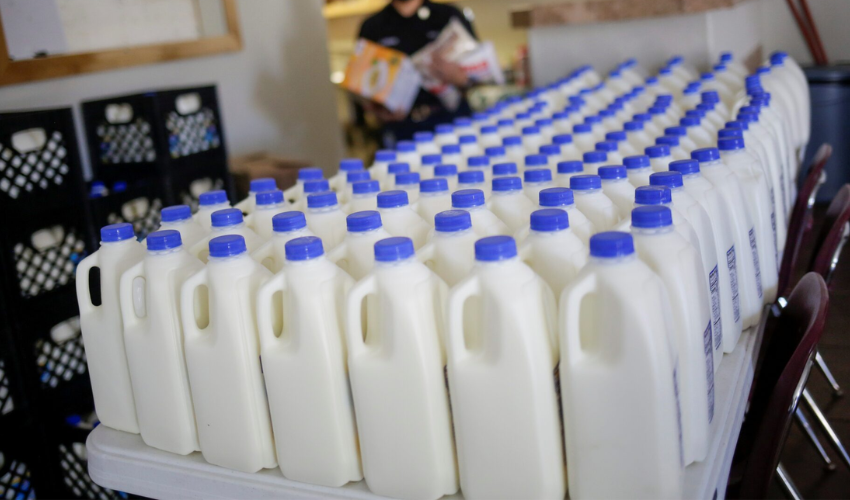
Two professors at the University of Wisconsin-Platteville have unveiled a new breakthrough that combines agriculture with additive manufacturing. The researchers have developed a new technique to turn spoiled milk into an eco-friendly 3D printing material. The method was recently patented and uses milk proteins such as casein and whey to create new sustainable filaments for 3D printing. This would help reduce plastic waste and open new revenue streams for American dairy farmers.
The project first began as a response to the dairy industry’s excess milk production during the COVID-19 pandemic. Supply chain disruptions led to the widespread dumping of milk, resulting in significant profit losses for farmers. However, instead of letting the surplus go to waste, Dr. John Obielodan and Dr. Joseph Wu saw an opportunity to use the milk’s proteins. They first focused on extracting the proteins from spoiled milk and incorporated them with polymer blends that are used in 3D printing. After years of experimentation, the team successfully produced a biocomposite material that is both strong and flexible in high-performance applications.
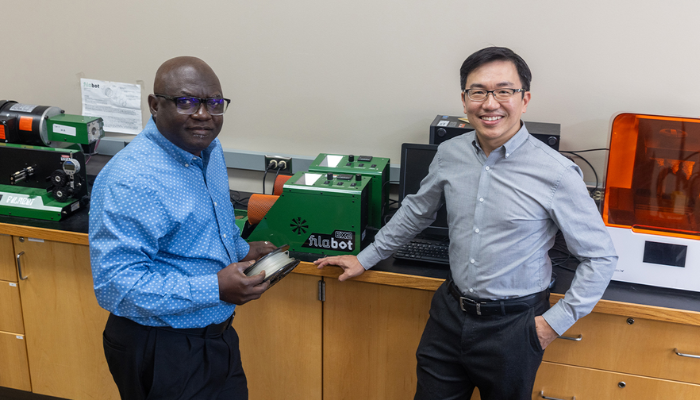
Dr. John Obielodan (left) and Dr. Joseph Wu (right) stand in their lab after announcing the new patented material. (Photo Credit: University of Wisconsin-Platteville)
The research itself focused on testing which proteins performed best in combination with existing 3D printing materials. Students from the university’s chemistry and mechanical engineering departments also took part in purifying the proteins and adjusting formulations to help optimize the strength and printability of the material. The result was a unique polymer that performs well and is also biodegradable. This would provide an alternative to petroleum-based plastics that currently dominate the industry.
More from the desk
Six other notes from the rest of the bench.
 ApplicationsBacteria Could Play a Role in 3D Printed Construction on MarsAs NASA puts it, “no other planet has captured our collective imagination quite like Mars.” In recent years focus has turned from travel to the Moon to the space race to Mars. The more ambitious among us aims to colonize…
 ApplicationsEmpa Researchers develop 3D printing ink from CelluloseThe Swiss Federal Laboratories for Materials Science and Technology (Empa) have created a new ecological ink that is made from one of the main building blocks of plant material, cellulose. Thanks to their research, their ink may be the development…
 ApplicationsUC Berkeley’s SpaceCAL 3D Printer Demonstrates Success in OrbitA team of UC Berkeley researchers, spearheaded by Ph.D. student Taylor Waddell, has achieved a significant milestone in additive manufacturing with the development of the SpaceCAL 3D printer. Launched into suborbital space aboard the VSS Unity on June 8th as…
 MaterialsHarvard scientists develop 3D printed shape shift materialA team of researchers at the Harvard John A. Paulson School of Engineering and Applied Sciences (SEAS) has developed a material that can be 3D printed into any shape and pre-programmed with reversible shape memory. In other words, once a…
 Guides#3DStartup: Gameet and the Future of Assisted Reproduction Through 3D Printing3D printing has proven to be a versatile tool across industries as diverse as engineering, medicine, and pharmaceuticals. But did you know it’s also making an impact in the field of assisted reproduction? In this area, the technology opens up…
 Applications3D Printing Helps California Hypercar Smash Five Track RecordsCzinger Vehicles recently broke records in California with its 3D printed hypercar known as the 21C. The car broke five lap records at some of the state’s most famous racetracks. The company dubbed the campaign “Gold Rush,” which saw the…