Applications
Empa Researchers develop 3D printing ink from Cellulose
The Swiss Federal Laboratories for Materials Science and Technology (Empa) have created a new ecological ink that is made from one of the main building blocks of plant material, cellulose. Thanks to their research, their ink may be the development…
- 3 min read
- Applications
- Six more stories
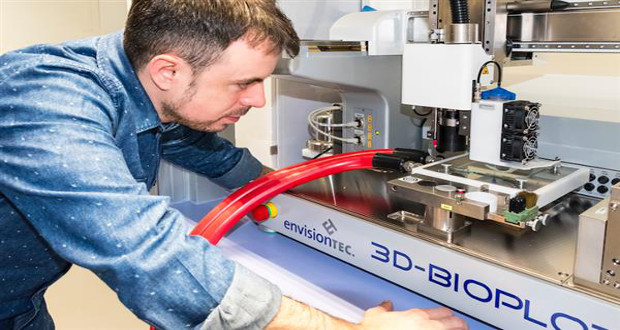
The Swiss Federal Laboratories for Materials Science and Technology (Empa) have created a new ecological ink that is made from one of the main building blocks of plant material, cellulose. Thanks to their research, their ink may be the development needed to bring more environmentally friendly inks into fruition.
Working alongside researchers Dr. Gilberto Siqueira and Dr. Tanja Zimmermann from the Laboratory for Applied Wood Materials, as well as researchers from Harvard University and ETH Zurich, they were able to bring a new technology that has the power to bring 3D printing down an even more sustainable path.
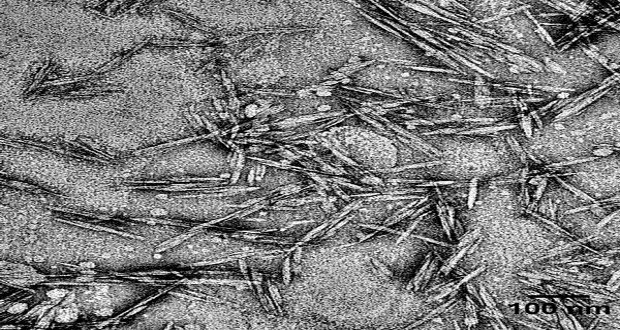
The cellulose nanocrystals under a microscope
The ink is made up of nanocrystals, that are created using cellulose- a glucose packed structure that is found in wood. As cellulose doesn’t naturally take the form of a crystal, the researchers found parts of the structure where the cellulose fibrils, the small, slender fibers, had a more ordered structure. Once found, researchers applied an acid treatment that left them with the nanocrystals, tiny rod-shaped structures that were 120 nanometers long and 6.5 nanometers in diameter.
More from the desk
Six other notes from the rest of the bench.
 NewsThe world’s largest construction 3D printer is ready to be sent to The Middle EastWe told you back in March about how COBOD International had sold its BOD2 construction 3D printer to the Saudi Arabian company Elite for Construction & Development Co. This version of the BOD2 is the largest construction 3D printer in…
 NewsHow to 3D print high-performance materials (PAEK, PEI…): Experts give their advice!The additive manufacturing sector has seen an expansion in high-performance materials research in recent years, particularly for polymers. These include high-performance thermoplastics, better known by their acronyms, PEEK, PEKK and PEI (ULTEM). We are also seeing the development
 NewsTOP 5 videos of the week: 3D pen, 3D dumplings, and more!A new selection of the best 3D printing videos of the week, just for you! Find our TOP 5 videos of the week below and tell us what your favorite video is in a comment or on our Facebook and Twitter…
 NewsTokyo Olympics Medal Ceremony Podiums 3D Printed Using Recycled PlasticThe various applications of additive manufacturing have become increasingly broad. For instance, 3D printing is now used in aeronautics, automotive, fashion, food, even in the world of sports. Now, for the first time in its history, additive manufacturing is coming…
 NewsTOP 5 videos of the week: Furniture, the great beyond and more!A new selection of the best 3D printing videos of the week, just for you! Find our TOP 5 videos of the week below and tell us what your favorite video is in a comment or on our Facebook and Twitter page.…
 NewsCan bio-printing tumour cells, become a treatment against cancer?A student from the University of Waikato in New Zealand, Shalini Guleria, is now seeking to identify the best treatment for all breast cancer patients. She turned to bio-printing to 3D print tumour cells. It would be possible to collect cells in a…