Materials
Aectual 3D Prints Planters From Recycled Plastic
In order to tackle the mounting issues concerning humanity’s ability to recycle plastic, many industries have turned to the additive manufacturing sector for solutions. For instance, a few weeks ago, we were talking to you about 3D printed beams made…
- 3 min read
- Materials
- Six more stories
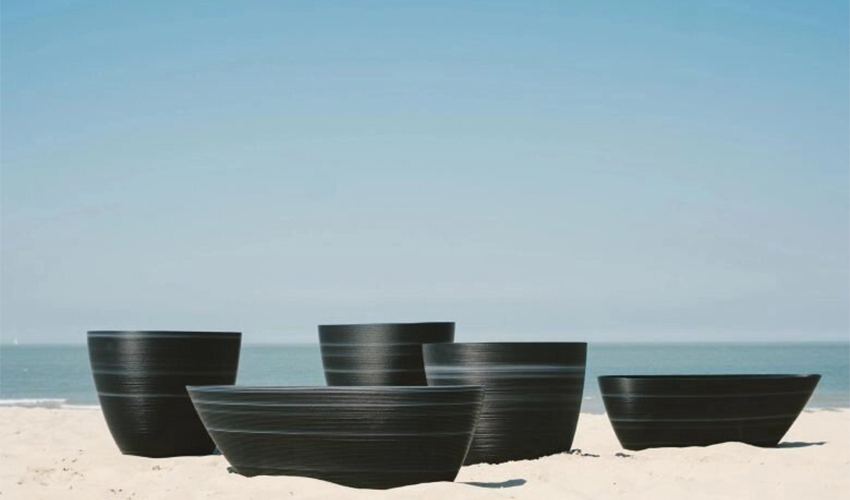
In order to tackle the mounting issues concerning humanity’s ability to recycle plastic, many industries have turned to the additive manufacturing sector for solutions. For instance, a few weeks ago, we were talking to you about 3D printed beams made from recycled plastic, developed by researchers at the Polytechnic University of Valencia, with the aim of replacing reinforced concrete. And Spanish scientists are not the only ones looking into the matter. In collaboration with architectural firm DUS Architects, Dutch sustainable architecture firm Aectual uses 100% recycled plastic to make plant pots dubbed ‘Mussel’ planters.
It was to respond to the invitation of the Belgian magazine Sabato that the two companies decided to develop this project. Each year, as part of the “Knokke” series, Sabato invites a team of designers to produce an item made from materials found in the Belgian coastal town. This year, DUS Architects and Aectual decided to use plastic. “We have to get rid of the negative idea that plastic is a disposable product,” says Hans Vermeulen, co-founder and CEO of Aectual. “It is also a raw material with which you can make beautiful things, with the new craft of 3D printing. We want to help make the highly-polluting construction world cleaner, and the world a little bit more beautiful. It all starts on a small scale with this planter.”
Aectual planters printed from recycled plastics (Photo Credit: Aectual)
The characteristics of 3D printed planters
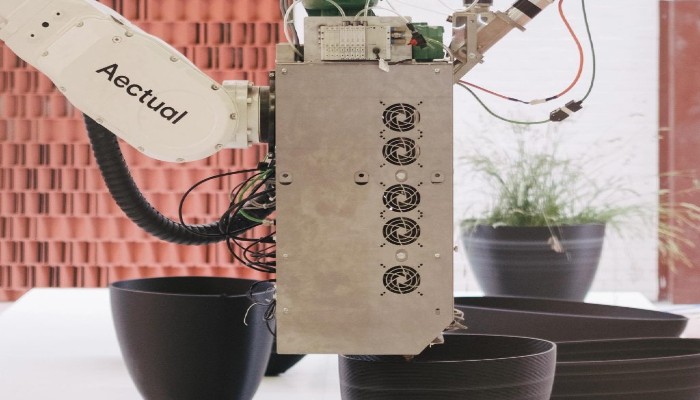
The design of the 3D printed planters is inspired by mussels because just like additive manufacturing, mussels create their shell layer by layer. To begin manufacturing these planters, Aectual used its four robotic-armed 3D printers — which are capable of printing over a 500 sq. ft area with a range of 360°. Made from plastics found on the beaches of Knokke, but also waste from Belgian households, the planters have been individually printed, which is why they each have unique details. Finally, the Dutch company revealed that the amount of plastic used for the manufacture of a single jar is equivalent to 120 bottles of shampoo.
More from the desk
Six other notes from the rest of the bench.
 Applications3D printing goes to space on Airbus’ Eurostar Neo satellites3D printing is going back into space! Airbus has used Additive Layer Manufacturing (ALM) technology (otherwise known as 3D printing or additive manufacturing) for the creation of radio frequency (RF) components for two Eurostar Neo satellites which are planned to…
 ApplicationsA 3D Printed Hip Prosthesis Has Been Successfully Implanted in PolandAdditive manufacturing is increasingly known for its many benefits in medicine. Time and again, it has made it possible to produce perfectly fitted parts for every person, a necessity especially when it comes to parts like prostheses. Now, this has…
 ApplicationsDeutsche Bahn Is Using 3D Printing to Make the Train Fleet of the FutureFaster, cheaper and more efficient – that’s how Deutsche Bahn, Germany’s national railway service, plans to handle train maintenance in the future. For that reason, DB has now signed a deal with the American company Essentium to ensure train maintenance…
 NewsWood 3D Printing Is Being Used for More Eco-Friendly LightsThough best known for polymers and metals, more than ever 3D printing is widening its horizons when it comes to material development. This is especially the case when it comes to more sustainable materials. And what could be more eco-friendly…
 MaterialsPEEK vs PEKK: Which High Performance Material Should You Choose?PEEK and PEKK are high performance polymers, known for their strength and thermal properties, that are increasingly used in additive manufacturing industry. PEEK and PEKK demonstrate sufficient mechanical strength at temperatures over 250°C, and can resist deformation well above
  GuidesHow to Enhance Traceability in Additive Manufacturing by Integrating Digital Product PassportsOne of the biggest benefits of digital manufacturing is the ability to more easily trace parts throughout their lifetime. Product traceability is critical when it comes to quality control, regulatory compliance and supply chain transparency. However, it can be hard…