
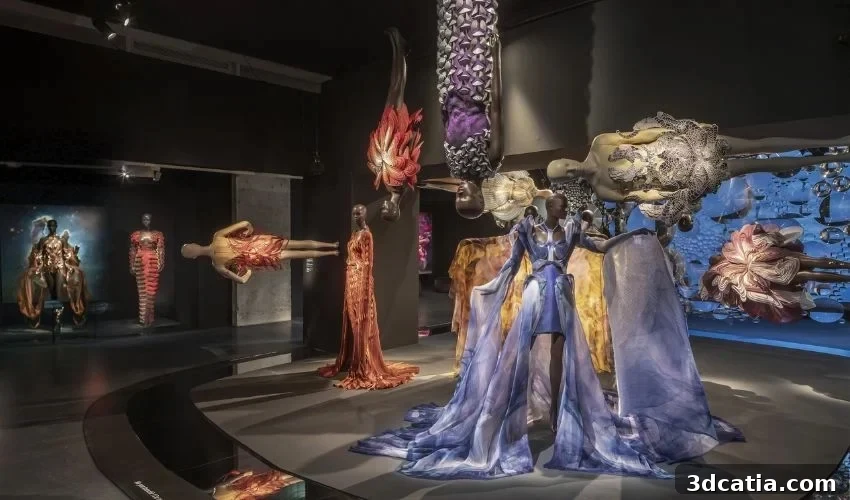
Iris van Herpen’s major retrospective has arrived in New York after stops in Paris, Brisbane, Singapore, and Rotterdam, marking its first North American presentation. From May 16 through December 6, 2026, the Brooklyn Museum houses “Iris van Herpen: Sculpting the Senses.” More than 140 haute couture creations are shown across the museum’s fifth floor, representing nearly two decades of work in which the designer has merged fashion, science, and advanced digital fabrication.
Originally organized by the Museum of Decorative Arts in Paris in 2023, the exhibition has traveled internationally and was always planned to include a New York stop. The retrospective presents a comprehensive view of van Herpen’s evolving practice and technological innovations.
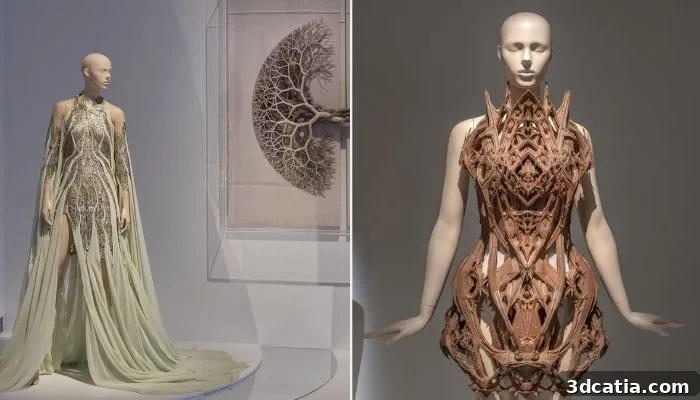
The exhibition brings together more than 140 haute couture pieces. (Photo credits: Iris van Herpen.)
For followers of van Herpen’s career, the show provides context for her technological legacy. In 2010 she unveiled the Crystallization top at Amsterdam Fashion Week—the first 3D-printed fashion piece shown on that platform. Created with architect Daniel Widrig and Materialise, the piece was produced in white polyamide using selective laser sintering (SLS) and required six days of continuous printing.
The designer continued experimenting with additive and digital processes. In 2011 the Skeleton dress, also made with SLS in white nylon, extended her exploration of sculptural forms. In 2018 the Foliage dress, developed with Delft University of Technology using PolyJet technology, advanced 3D printing techniques by printing 0.8 mm-thin petal patterns directly onto tulle, a process that required some 260 hours of continuous printing. In 2024 van Herpen unveiled her first 3D-printed wedding dress, and in 2025 she introduced Ecosophy, which blends organza and lace with 3D-printed elements.
Not every work in “Sculpting the Senses” relies on additive manufacturing. The exhibition includes a version of the bubble dress seen on Eileen Gu at a recent Met Gala, created from iridescent glass bubbles hand-fused with UV light. This underscores how van Herpen’s methods extend beyond 3D printing to include laser cutting, parametric modeling, biomaterials inspired by biology, fractal geometry, and collaborations that draw on neuroscience. While 3D printing is frequently associated with her name, her practice is wide-ranging and resists simple categorization.
Van Herpen’s creations have attracted high-profile admirers: Beyoncé, Björk, Cate Blanchett, Lady Gaga, Miley Cyrus, and Ariana Grande are among the artists who have worn her designs. Many of those iconic pieces are on display in New York as part of the retrospective, offering visitors a rare chance to study both the technical processes and the expressive forms that define her work.
The show runs through December 6 at the Brooklyn Museum. Visitors can use this opportunity to examine the interplay of material innovation and couture craftsmanship and to consider how much of the collection incorporates 3D-printed components.
What do you think of Iris van Herpen’s work? Share your impressions in the museum or through social channels. The exhibition highlights an important chapter in contemporary fashion—where cutting-edge technology, material research, and artistic vision converge to redefine couture.
*All Photo Credits: Iris van Herpen