
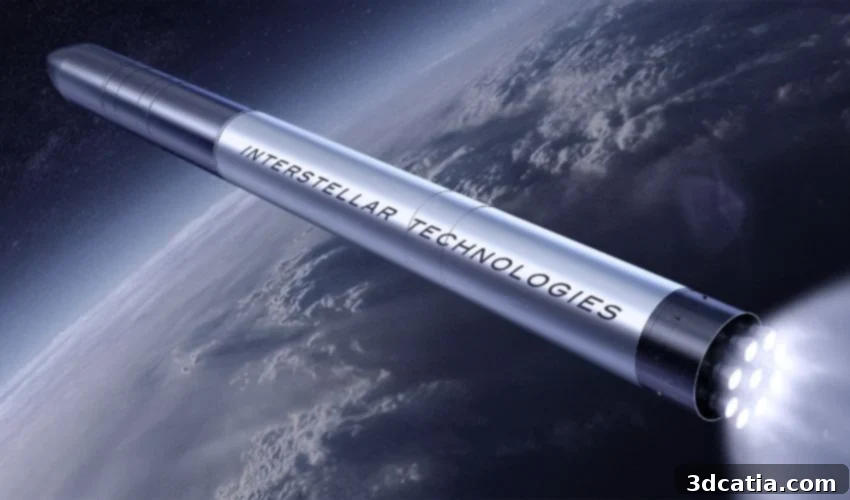
Interstellar Technologies: Propelling Japan’s Space Ambitions with Advanced Additive Manufacturing
The global space industry is undergoing a monumental transformation, with cutting-edge technologies like additive manufacturing, commonly known as 3D printing, playing a pivotal role. Major players such as SpaceX, NASA, ESA, Relativity Space, and Blue Origin are all heavily invested in leveraging 3D printing for various aspects of space exploration and rocket development. While this list predominantly features entities from Europe and the United States, the “3D printing space race” is indeed a global phenomenon. Companies across the world are rapidly adopting these innovative techniques to push the boundaries of what’s possible in aerospace. One such pioneering entity is Interstellar Technologies, a dynamic Japanese startup that has recently captured international attention. Earlier this year, Interstellar Technologies announced significant funding from both the Japanese government and Toyota, signaling Japan’s ambitious ramp-up in its space programs. To delve deeper into Interstellar Technologies’ vision, its groundbreaking projects, and the crucial role of additive manufacturing in its operations, we had the privilege of sitting down with Satoshi Nakayama, a key figure in the company’s leadership.
3DN: Could you introduce yourself and your connection to 3D printing?

Satoshi Nakayama
My name is Satoshi Nakayama, and I currently serve as a Director of the Board and VP of Launch Vehicle at Interstellar Technologies Inc. My journey in the space industry began well before joining Interstellar. For 12 years, I was part of Mitsubishi Precision Company, where I held the position of Project Manager. In this role, I was deeply involved in the development of sophisticated navigation sensors specifically designed for rockets operated by the Japanese Government. This experience provided me with invaluable, frontline insights into the intricacies and operational nuances of Japan’s traditional space industry. I joined Interstellar Technologies in 2021, drawn by its innovative spirit and ambitious goals. Since then, I’ve contributed significantly to areas such as avionics development, ensuring the reliability of our systems, and establishing robust quality assurance protocols. My dedication and contributions led to my appointment as VP of Launch Vehicle in May of last year.
During my extensive time working on government-operated rockets, I often observed that the deeply ingrained traditional and inherently risk-averse nature of Japan’s space industry presented considerable challenges when it came to embracing truly new technologies and fostering radical innovations. This environment, while ensuring stability, often stifled the pace of progress. My experience at Interstellar Technologies, however, has been profoundly different and incredibly refreshing. Here, we actively dare to break away from conventional approaches and enthusiastically take on bold, unprecedented challenges. We believe firmly that Interstellar’s core mission is to act as a catalyst, driving fundamental transformation and modernization within Japan’s broader space industry. We are not just building rockets; we are building a new paradigm for how space exploration and utilization can be approached in Japan.
Our flagship orbital vehicle, ZERO, is a testament to this philosophy. It is meticulously designed and built, incorporating an array of new suppliers, innovative components, and truly groundbreaking technologies from across various sectors. By successfully launching ZERO into orbit, we aim to transcend mere theoretical challenges and convert them into tangible, proven achievements. This success will not only validate our innovative approach but also significantly contribute to the expansion and vibrancy of not just Japan’s, but also the wider Asian space industry. Furthermore, it will play a crucial role in strengthening the region’s overall space supply chain, fostering a more robust and self-reliant ecosystem for future space endeavors.
3DN: What is Interstellar Technologies’ mission? How did the company come about?
Interstellar Technologies is a pioneering Japanese startup that was founded in 2013 with a clear and ambitious mission: to establish affordable and readily accessible space infrastructure for everyone. Our ultimate goal is to create a future where the boundless opportunities of space are truly within reach for individuals, businesses, and nations alike. Since our inception, we have demonstrated significant progress and capability, having successfully conducted seven launches, including three triumphant suborbital flights. This impressive track record positions Interstellar Technologies as the first private Japanese company to successfully reach space, a monumental achievement that underscores our commitment to innovation and execution. Our dedicated team has grown substantially, now comprising over 200 talented employees strategically located across four different offices throughout Japan, all working cohesively towards our shared vision.
At the core of our current endeavors, we are intensely focused on the development of two key initiatives: ZERO, our cutting-edge orbital launch rocket, and Our Stars, a suite of advanced satellite services. Through the synergy of these two projects, we are striving to establish Japan’s first truly vertically integrated rocket and communications satellite business. This integrated approach is designed to streamline operations, enhance efficiency, and drastically reduce the costs associated with both launching payloads into space and providing robust satellite-based communication services. By controlling both the launch vehicle and the satellite services, we aim to offer an end-to-end solution that will make access to space more affordable, reliable, and frequent for a diverse range of clients, from governmental agencies to private enterprises and research institutions.
3DN: Could you tell us about how you use additive manufacturing to make rockets? What are the benefits of using additive manufacturing for space applications?
In the demanding and highly specialized field of rocket manufacturing, additive manufacturing (AM) is not merely a supplementary technology; it is a transformative force. We leverage AM extensively to achieve two primary, yet interconnected, objectives: significantly enhancing design flexibility and substantially improving production efficiency. One of the most compelling advantages of AM in this context is its unparalleled ability to integrate multiple complex components, such as intricate engine parts and high-performance turbopumps, into a single, cohesive structure. This consolidation of parts yields a multitude of critical benefits. Firstly, it drastically reduces the overall component count, which in turn simplifies the assembly process, minimizes potential points of failure, and streamlines the supply chain. Secondly, this integration directly translates to a significant reduction in the rocket’s weight, a paramount factor in aerospace where every gram counts towards payload capacity and fuel efficiency. Furthermore, consolidated, 3D-printed parts often exhibit increased strength and enhanced reliability due to optimized designs and fewer joints or welds. Ultimately, these combined advantages contribute immensely to the overall optimization of the rocket’s performance, safety, and cost-effectiveness.
Let’s consider specific examples from our ZERO orbital vehicle to illustrate these benefits. ZERO utilizes a highly efficient turbopump system, a critical component responsible for rapidly delivering propellants (fuel and oxidizer) to the engine’s combustion chamber. This turbopump operates by rotating an impeller at extremely high speeds. The power required to drive this turbopump comes from a Gas Generator (GG), which is essentially a small, self-contained rocket engine. This GG combusts a mixture of liquid methane and liquid oxygen, producing hot combustion gases. These gases are then precisely directed onto turbine blades, which, in turn, drive the turbopump’s impeller.
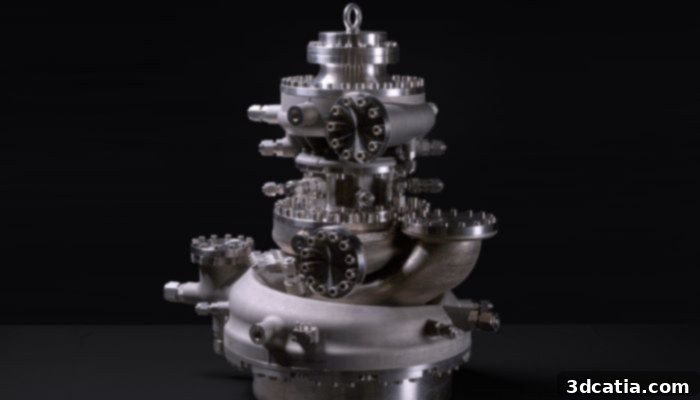
The turbopump used in ZERO
The Gas Generator itself operates at a relatively moderate temperature of around 400°C. Its combustion chamber features a spherical design, which is beneficial for efficient combustion. To significantly reduce production costs for this critical part, we employ an innovative method: the spherical chamber is cast using a specialized 3D-printed mold. This mold is then filled with Inconel, a superalloy renowned for its exceptional heat resistance, high strength at elevated temperatures, and resistance to oxidation and corrosion. By utilizing a 3D-printed mold, we can create complex internal geometries that would be exceedingly difficult or prohibitively expensive to achieve with traditional machining, while still benefiting from the material properties of a cast Inconel part. This hybrid approach allows us to balance performance requirements with cost-efficiency, a critical consideration in rocket development.
Furthermore, the injector, another vital component that precisely delivers propellants into the combustion chamber, is directly 3D printed from stainless steel. Injectors are inherently complex parts that demand extremely precise internal flow channels to create specific, highly optimized spray patterns for efficient combustion. Achieving these intricate geometries with traditional manufacturing methods often involves multiple separate components, extensive machining steps, and complex assembly, all of which introduce potential failure points and drive up costs. Additive manufacturing, however, allows us to produce these intricate geometries as a single, monolithic unit, eliminating the need for multiple components and reducing machining steps dramatically. Stainless steel is chosen for its excellent strength, corrosion resistance, and ability to withstand the demanding conditions within the injector. This direct 3D printing approach ensures unparalleled precision and consistency, crucial for reliable engine performance.
Additionally, the turbopump turbine manifold, which is responsible for efficiently directing the hot combustion gases from the Gas Generator to the turbine blades to impart rotational energy, is also 3D-printed from Inconel. This component is then seamlessly integrated directly with the overall turbopump structure. This integrated manufacturing approach yields a lightweight yet robust design, while simultaneously enabling the incorporation of highly efficient internal flow channels. These optimized channels are meticulously designed to ensure ideal gas distribution to the turbine, maximizing energy transfer and overall turbopump efficiency. The ability to create such complex internal structures through 3D printing is a game-changer, as it allows for designs that were previously impossible to manufacture, leading to superior performance.
By comprehensively adopting 3D printing across these and other critical components, Interstellar Technologies has dramatically accelerated its development cycles. Parts that once required months of labor-intensive manufacturing using traditional precision casting and extensive machining processes can now be produced with significantly greater efficiency and in a fraction of the time. This rapid prototyping and production capability directly translates into faster innovation in rocket technology, allowing us to iterate designs more quickly, test components more frequently, and bring our advanced rockets to fruition at an unprecedented pace.
3DN: You have raised quite a lot of money from companies like Toyota as well as the Japanese government. How will you be using this to advance Japan’s presence in Space? How will AM play a role?
The demand for small satellite launches globally has been experiencing exponential growth, driven by advancements in miniaturization, increased commercial applications, and strategic governmental needs. However, not all countries have been able to keep pace with this accelerating demand. For instance, in 2024, the United States conducted an impressive 158 orbital launches, and China followed with 68. In stark contrast, Japan’s launch frequency has remained comparatively limited, averaging only around 7 launches per year. This disparity highlights a significant gap that needs to be addressed if Japan is to fully capitalize on the burgeoning space economy and secure its position as a leading space-faring nation.
Recognizing this critical need, the Japanese government has set an ambitious and strategic goal: to secure approximately 30 domestic launches per year by the early 2030s. This target is not arbitrary; it is designed to meet the diverse and growing domestic and international demands for access to space, ranging from Earth observation and communication satellites to scientific research payloads. In line with this national objective, Interstellar Technologies was honored to be selected for the Small Business Innovation Research (SBIR) program. The SBIR program is a crucial initiative created by the Japanese government specifically to stimulate and boost the development of advanced space technology within the country’s private sector. Through this highly competitive program, we have successfully secured substantial funding, amounting to up to ¥8 billion, which is approximately $53.5 million. This funding is instrumental in accelerating our research, development, and manufacturing capabilities for launch vehicles, directly contributing to Japan’s ambitious launch frequency targets.
Beyond government support, we have also forged a powerful strategic capital and business alliance with Woven by Toyota, Inc., a key company within the prestigious Toyota Group. This partnership is immensely significant because it allows us to integrate Toyota’s world-renowned expertise into our rocket development and production processes. Toyota’s core strengths lie in key areas such as meticulous cost optimization, drastic lead time shortening through lean manufacturing principles, and the establishment of highly efficient mass production systems – all attributes that are traditionally associated with the automotive industry but are increasingly vital for making space access affordable. Together, through this alliance, we are committed to strengthening the entire space supply chain, enhancing corporate governance, and fundamentally advancing rocket mass production capabilities. Our collective goal is to offer internationally competitive launch services that will not only serve Japan’s needs but also significantly expand Asia’s access to space, fostering greater collaboration and innovation across the region.
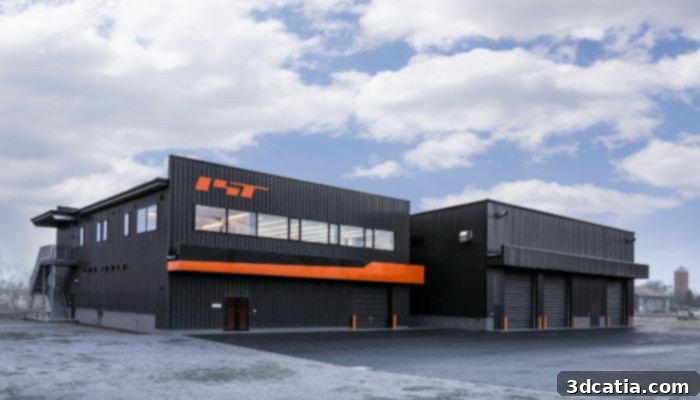
Interstellar’s main office in Taiki
As for the role of additive manufacturing (AM), its importance continues to grow exponentially. Currently, in rocket development worldwide, there’s a clear trend towards producing increasingly large and complex components, such as propellant tanks and entire combustion chambers, using advanced 3D printing techniques. This shift is driven by the unparalleled advantages that AM offers. These include the ability to consolidate numerous parts into a single, integrated structure, which leads to a significant reduction in component count and assembly time. Furthermore, AM enables drastic weight reduction through optimized lattice structures and topology optimization, while simultaneously enhancing the overall strength and improving the reliability of these critical parts by minimizing welds and joints, which are often weak points in traditionally manufactured components. The geometric freedom offered by AM allows engineers to design structures with internal channels and features that are impossible to achieve with conventional machining, leading to more efficient and robust rocket components.
At Interstellar Technologies, we are not just adopters of 3D printing; we are active pioneers in expanding its application. We are continuously working on developing new manufacturing processes tailored for advanced aerospace applications and exploring novel materials that can withstand the extreme conditions of spaceflight. By relentlessly advancing these cutting-edge technologies, our primary aim is to significantly enhance ZERO’s market competitiveness. This focus on AM will enable us to produce rockets that are not only more powerful and reliable but also more cost-effective to manufacture and launch. Concurrently, these advancements in additive manufacturing directly contribute to the robust growth of Japan’s space industry, fostering a new era of innovation and manufacturing capability. It also plays a vital role in strengthening its supply chain, making it more resilient and less reliant on external sources for critical components. Moving forward, we are unwavering in our commitment to continually explore new possibilities in design and manufacturing, pushing the very boundaries of what is achievable in space technology. For those interested in learning more about our pioneering work and our vision for the future of space, you can find comprehensive information on our official website HERE.
We invite you to share your thoughts on Interstellar Technologies and our mission! Please let us know what you think in a comment below or connect with us on our LinkedIn, Facebook, and Twitter pages! Don’t forget to sign up for our free weekly Newsletter here to get the latest 3D printing news delivered straight to your inbox! You can also find all our engaging videos on our YouTube channel. For more in-depth 3D printing news and developments specifically within the aerospace and defense sectors, be sure to check out our dedicated page HERE.