
Canon’s Breakthrough in Ceramic 3D Printing: Reshaping Industrial Additive Manufacturing
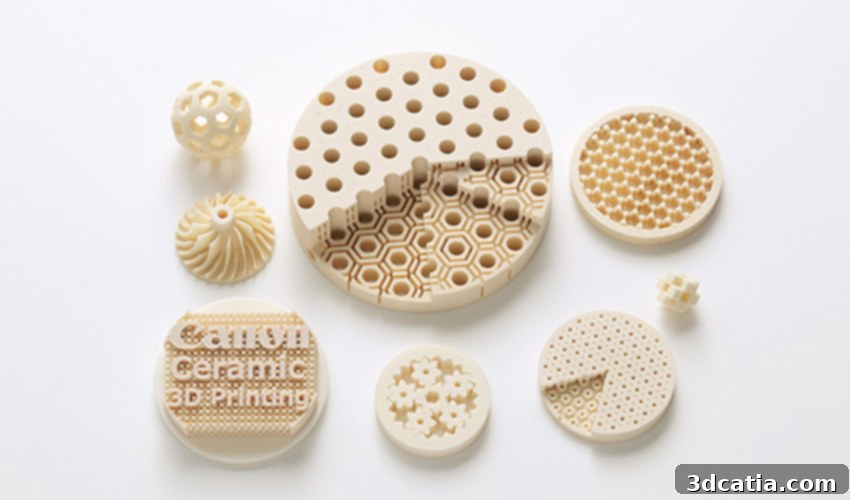
Japanese imaging and optical giant Canon, renowned globally for its cameras, copiers, and printers, made its initial foray into the additive manufacturing market last year with the introduction of its FDM MARV 3D printer. This compact office machine, however, had a somewhat limited market impact, being primarily confined to specific regions including China, Korea, Germany, and Poland. While this initial venture didn’t achieve widespread acclaim, Canon’s strategic commitment to 3D printing has remained unwavering. The company has now announced a significant leap forward, revealing the development of a pioneering new ceramic 3D printing technology complemented by its own proprietary material. This innovative move signifies Canon’s serious intent to become a key player in the advanced materials sector of additive manufacturing. The manufacturer explicitly states that this new Canon ceramic 3D printing technology is capable of producing remarkably complex geometries, such as intricate honeycomb structures, which are notoriously difficult to achieve with conventional manufacturing methods.
The Dynamic Landscape of Ceramic Additive Manufacturing
Ceramic additive manufacturing represents a rapidly growing niche within the broader 3D printing industry. While it has yet to reach the immense scale and ubiquity of plastic or metal 3D printing processes, its unique material properties position it for substantial expansion. Ceramic-based materials offer unparalleled resistance to heat, corrosion, and wear, alongside excellent insulating properties, making them indispensable in highly demanding applications. However, working with ceramics in additive manufacturing presents its own set of significant challenges. One of the primary hurdles lies in the post-processing phase, particularly the annealing process. This thermal treatment, crucial for densifying ceramic parts and achieving their desired mechanical properties, can often lead to considerable shrinkage of the workpiece and, consequently, a loss of precision. Managing these material characteristics requires sophisticated process control and a deep understanding of ceramic science.
Despite these technical complexities, several innovative players have successfully navigated the challenges, pushing the boundaries of what’s possible in ceramic additive manufacturing. Companies like the New York-based Kwambio, with its advanced ceramic 3D printers, and the Israeli firm XJet, known for its NanoParticle Jetting technology that handles both metal and ceramic, have demonstrated remarkable success in producing high-quality ceramic parts. Their achievements highlight the immense potential of this sector. The inherent attributes of 3D printed ceramic parts – superior heat resistance, exceptional corrosion resistance, and effective insulating capabilities – make them highly valuable across diverse industries. For instance, these characteristics make ceramics an ideal choice for the dental industry, where biocompatibility, durability, and precise fit are paramount for applications like crowns, bridges, and implants. The continued innovation from companies like Canon is poised to further accelerate the growth and adoption of ceramic additive manufacturing, overcoming existing barriers and opening up new frontiers for material science and industrial design.
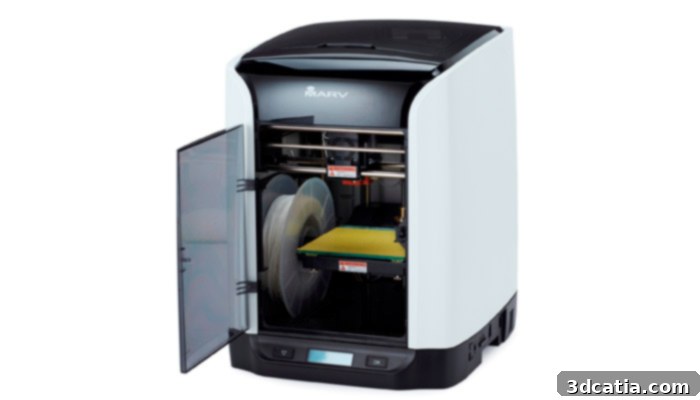
FDM MARV 3D Printer
Canon’s Groundbreaking Ceramic 3D Printing Technology Revealed
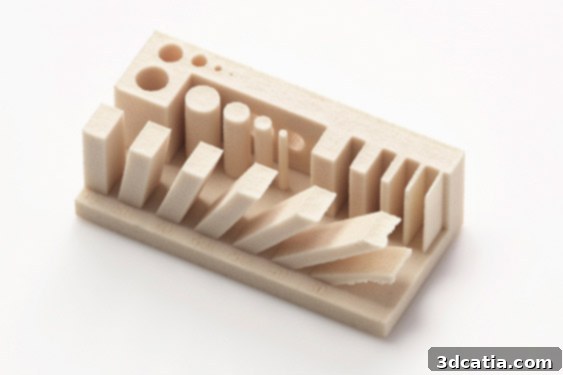
Canon has confirmed the development of a cutting-edge ceramic material, primarily based on alumina, specifically engineered to be compatible with its newly unveiled 3D printing technology. Beyond its proprietary process, Canon emphasizes that this advanced alumina material is also well-suited for use in selective laser melting (SLM) additive manufacturing systems, showcasing its versatility and potential for broader industrial integration. While Canon has maintained a degree of discretion regarding the intricate details of its specific printing methodology, their statements strongly focus on the remarkable capabilities of the material and the resulting printed parts. The company asserts that this innovative material and process combination can stably produce exceptionally complex components, including delicate hollow structures and intricate porous designs. These types of geometries are notoriously challenging, if not impossible, to achieve with traditional manufacturing techniques such as molding or subtractive processes like metal cutting, due to limitations in internal access and material removal.
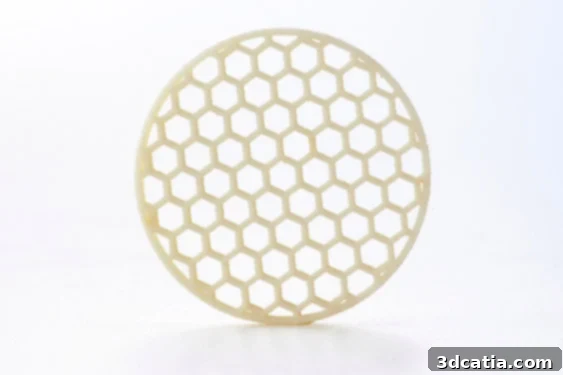
A prime example of the precision achievable with Canon’s new technology is the creation of complex honeycomb shapes, featuring hexagonal recesses with a diameter of approximately 19 mm. What truly sets this development apart is the exceptional accuracy maintained throughout the manufacturing process. Canon reports that high accuracy can be consistently obtained, with differences in external dimensions measuring less than 0.8% both before and after the crucial annealing phase. This level of precision is a monumental achievement in ceramic additive manufacturing, directly addressing one of the industry’s most significant challenges: controlling shrinkage and warpage during high-temperature post-processing. By minimizing dimensional variations to such a degree, Canon’s technology significantly enhances the reliability and repeatability of ceramic part production, making it suitable for applications where strict tolerances are non-negotiable. This breakthrough in material science and process control positions Canon to revolutionize the creation of high-performance ceramic components, opening doors for designs previously constrained by manufacturing limitations.
Unlocking New Industrial and Medical Applications with Ceramic Additive Manufacturing
The potential applications of Canon’s ceramic additive manufacturing technology are vast and transformative, spanning numerous critical industrial fields. Canon foresees that “Ceramic parts manufactured using this technology are expected to be used in all kinds of industrial fields, from parts for equipment that demands heat resistance and insulating properties, such as electric furnaces, to parts facing exposure to chemicals that require corrosion resistance.” This encompasses a wide array of high-performance components. For instance, in sectors like aerospace and energy, where extreme temperatures and harsh environments are commonplace, parts requiring exceptional heat resistance for turbine components, heat exchangers, or protective coatings could greatly benefit. The superior insulating properties of these ceramics would be invaluable in electronics and high-voltage applications, ensuring operational integrity and safety. Furthermore, for industries dealing with aggressive chemicals, such as chemical processing plants or medical equipment sterilization, the outstanding corrosion resistance of Canon’s ceramic materials offers unparalleled durability and longevity for crucial parts, reducing downtime and maintenance costs.
Beyond immediate industrial uses, the Japanese manufacturer harbors ambitious plans to expand its ceramic 3D printing process into the demanding health sector. This strategic move involves the development of specialized ceramic materials that are fully compatible with medical and surgical applications. The potential impact here is immense, ranging from customized patient-specific implants to advanced surgical instruments and prosthetics. The inherent biocompatibility of certain ceramics, combined with the precision and design freedom of additive manufacturing, could lead to innovative medical devices that offer improved patient outcomes, faster recovery times, and enhanced functionality. Imagine dental implants perfectly matched to an individual’s anatomy, or complex bone scaffolds that promote natural tissue regeneration. Canon’s entry into this highly regulated and critical market underscores the profound capabilities and strategic vision behind their ceramic 3D printing innovation. This technology promises to be a game-changer, fostering new design paradigms and pushing the boundaries of what ceramic materials can achieve across a diverse spectrum of applications. For more detailed insights into the Canon ceramic 3D printing process, readers can find additional information HERE.

- 3D printed ceramic parts
The Future Trajectory of Additive Manufacturing with Canon
Canon’s significant investment and innovation in ceramic 3D printing mark a pivotal moment for the additive manufacturing industry. As a global leader with vast experience in precision engineering and material science, Canon’s entry into the advanced ceramics space brings with it credibility, resources, and a commitment to pushing technological boundaries. Their ability to deliver high-precision ceramic parts with complex geometries, particularly managing the challenges of shrinkage and post-processing, addresses critical pain points that have historically slowed wider adoption of ceramic AM. This move is not just about a new product; it’s a strategic declaration that advanced materials, especially ceramics, are central to the future of industrial production. It underscores a broader trend towards expanding the material palette of 3D printing beyond plastics and metals, enabling the creation of components with properties previously unattainable through traditional means.
The impact of Canon’s ceramic 3D printing technology is poised to resonate across various high-value sectors, from aerospace and automotive to energy and biomedical applications. By enabling the fabrication of components that are lighter, more durable, more resistant to extreme conditions, and custom-designed for specific functions, Canon is set to accelerate innovation in these fields. Their focus on both industrial heat/corrosion resistance and future medical compatibility highlights a comprehensive vision for additive manufacturing that encompasses both immediate commercial opportunities and long-term societal benefits. As Canon continues to refine its technology and develop new materials, its contributions will undoubtedly shape the direction of the ceramic additive manufacturing market, fostering competition and encouraging further advancements from other players. This development signals a vibrant future where ceramic 3D printing moves from a niche technology to a mainstream solution for critical engineering challenges, driven by the expertise of established manufacturing giants like Canon.
What are your thoughts on this exciting new Canon ceramic 3D printing technology and its potential impact on industrial and medical applications? We invite you to share your perspectives in a comment below or join the conversation on our Facebook and Twitter pages! Don’t forget to sign up for our free weekly Newsletter to receive all the latest news and updates in the world of 3D printing directly in your inbox!