
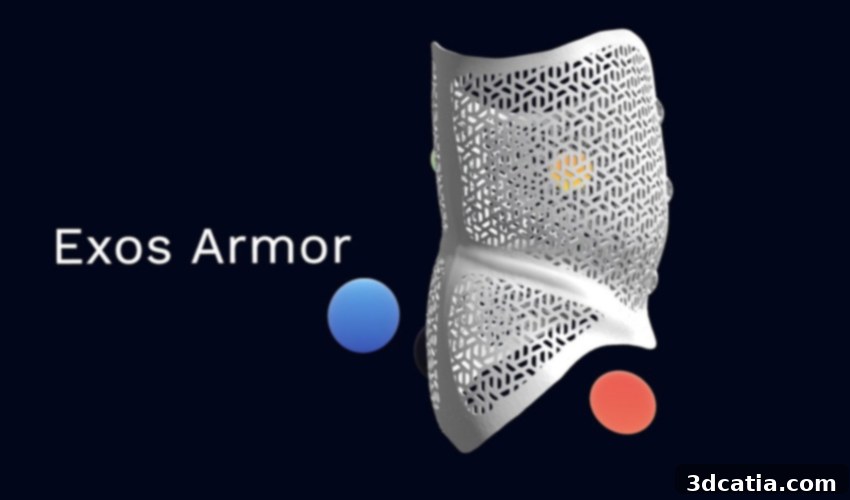
Exos Armor: Revolutionizing Scoliosis Treatment with Advanced 3D Printed Back Braces
The world of orthopedic treatment is continuously evolving, driven by innovations that promise enhanced patient comfort, superior efficacy, and sustainable practices. A prime example of this transformative progress emerged at CES 2021, where the Italian biomedical startup Exos unveiled its revolutionary 3D printed back brace, aptly named Armor. This pioneering device is specifically engineered to significantly improve posture and provide an advanced solution for individuals battling scoliosis. What sets the Exos Armor apart is not only its clinical effectiveness but also its profound commitment to eco-sustainability, being entirely 3D printed from eco-friendly materials. This innovative approach results in a brace that is remarkably light yet exceptionally strong, offering a new benchmark in patient-centric orthopedic care.
By harnessing the power of additive manufacturing, Exos has meticulously developed a back brace that not only matches the therapeutic effectiveness of traditional bracing methods but also introduces a host of unparalleled advantages. Patients using the Exos Armor benefit from vastly superior comfort, improved breathability, and enhanced overall functionality. Beyond the direct patient benefits, the adoption of 3D printing technology has streamlined the production process, drastically increasing manufacturing speed while simultaneously minimizing the environmentally harmful consequences often associated with conventional production techniques. This dual benefit of advanced medical care and ecological responsibility positions the Exos Armor as a true game-changer in the medical device landscape.
Understanding Scoliosis and the Limitations of Traditional Bracing
Exos, an Italy-based biomedical startup, comprises a dedicated team of engineers and designers united by a singular mission: to fundamentally revolutionize bracing in the orthopedic treatment of scoliosis. Scoliosis is a complex and often debilitating condition characterized by a sideways curvature of the spine. Its prevalence is significant, affecting an estimated 6-9 million people in the United States alone. While the exact cause of scoliosis remains unknown in the majority of cases (idiopathic scoliosis), it can sometimes manifest as a secondary condition resulting from other underlying issues, such as cerebral palsy and muscular dystrophy.
For decades, the standard treatment for moderate to severe scoliosis, particularly in adolescents, has involved the use of rigid back braces. Among these, the Boston brace is perhaps the most common. Traditional Boston back braces are notoriously uncomfortable and restrictive, typically fabricated from thick, inflexible plastic material. The prescribed wear time is extensive, often ranging from 16 to 23 hours daily, for prolonged periods spanning 6 to 18 months, or even longer. This regimen places a substantial physical and psychological burden on patients, impacting their daily lives, self-esteem, and social interactions. The lack of breathability in these thick plastic braces frequently leads to skin irritation, rashes, and excessive sweating, especially during warmer months, exacerbating discomfort and reducing patient compliance. Furthermore, the financial cost of these essential devices can be prohibitive, with Boston braces typically costing between $2,500 and $2,600, and more specialized options like the Cheneau brace reaching prices around $8,500. These significant costs, coupled with the inherent discomfort, highlight the urgent need for more effective, patient-friendly, and economically viable alternatives.
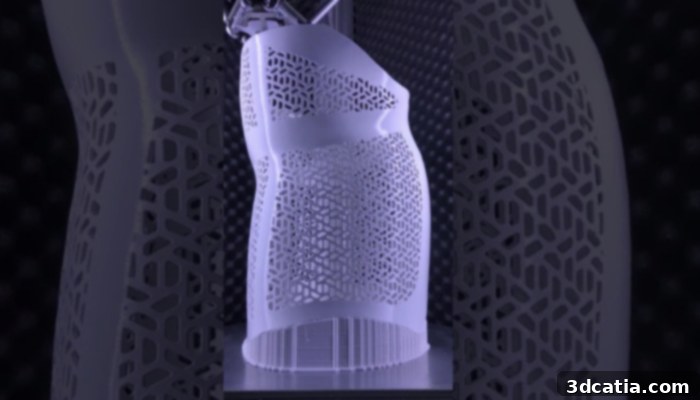
The Exos Armor being 3D printed (Credit: Exos)
The Exos Armor: A New Era of Personalized Bracing
Recognizing the profound limitations and challenges posed by conventional bracing, Exos leveraged the full potential of 3D printing to completely redesign the production process and the brace itself. This innovative approach has led to dramatic improvements in every aspect of brace design and manufacturing. One of the most significant breakthroughs is in production speed; the Exos Armor can be manufactured in just a few days, representing an astonishing 90% reduction in production time compared to traditional methods that can take weeks. This rapid turnaround not only gets the brace to patients faster but also allows for quicker adjustments and iterations, ensuring optimal fit and effectiveness.
Thanks to the inherent capabilities of additive manufacturing, Exos has been able to meticulously optimize both the strength and flexibility of their braces. This precision engineering allows for specific areas of the brace to be more rigid for corrective support, while other areas can be designed with greater flexibility for enhanced comfort and movement. Crucially, 3D printing facilitates true mass customization. This means that while production can be scaled efficiently, each individual brace is uniquely tailored to the specific anatomical contours and corrective needs of the patient. This level of personalization is virtually impossible with traditional manufacturing and significantly contributes to better patient outcomes and higher compliance rates.
Unparalleled Comfort and Design
The innovative design and material optimization of the Exos Armor make it exceptionally patient-friendly. The 3D printed back brace is a remarkable 50% lighter than its traditional counterparts, dramatically reducing the physical burden on the wearer. This reduction in weight, combined with a sleek profile, makes the brace far less noticeable under clothing and significantly more comfortable for prolonged wear. Furthermore, the design incorporates a breathable holed pattern, a direct benefit of 3D printing’s geometric freedom. This intricate pattern allows for superior air circulation, addressing one of the major complaints associated with traditional, non-breathable plastic braces. The improved airflow helps prevent skin irritation and keeps the wearer cooler, especially in warmer climates or during physical activity.
Beyond being lighter, the Exos Armor is also approximately 30% thinner than most traditional back braces. This significant reduction in bulk makes the brace far less conspicuous and much more comfortable to wear under everyday clothing, thereby minimizing the psychological impact and social stigma often experienced by brace-wearers. Exos confidently claims that “you can wear Exos Armor during hot summer days without breaking a sweat,” a testament to its superior breathability and comfort. This feature alone is a monumental improvement for patients who previously endured uncomfortable, sweaty experiences with conventional braces, particularly in warmer climates or during active lifestyles.
Complete Customization and Future-Proof Design
The versatility of the Exos Armor extends to its complete customization capabilities, making it suitable for virtually any clinical situation and patients of all ages. Each brace is meticulously tailored with millimetric precision, ensuring an exact fit that maximizes therapeutic effectiveness and patient comfort. This level of customization goes beyond mere fit; patients can personalize their brace across a range of aesthetic and functional attributes including color, material properties, unique patterns, specific shapes, and even additional functionalities and accessories. This empowers patients with a sense of ownership and individuality, transforming a medical device into a more integrated and less intrusive part of their lives.
Furthermore, the Exos Armor is thoughtfully equipped with a modular closure system. This ingenious design allows for multiple types of configurations, providing flexibility for different body types and therapeutic requirements. Crucially, the modularity also offers the potential for the brace to be upgraded or modified over time as a patient’s condition changes or as new advancements become available. This “future-proof” design ensures that the Exos Armor remains a relevant and adaptable solution throughout the patient’s treatment journey, further solidifying its position as a leading-edge medical device.
The Broader Impact of 3D Printing in Orthotics
While 3D technologies have been increasingly integrated into bracing and orthotics for some time – for instance, the “Boston 3D” system relies on CAD (Computer-Aided Design) software as a critical part of its treatment workflow – the Exos Armor represents a significant leap forward. It is part of a new generation of fully 3D printed orthoses, where the entire device is fabricated using additive manufacturing, rather than just leveraging CAD for design and then conventional manufacturing. This distinction is crucial because direct 3D printing unlocks unparalleled design freedom, allowing for complex internal geometries, lattices, and variable stiffness structures that are impossible to achieve with traditional molding or fabrication methods.
The shift towards fully 3D printed orthoses, exemplified by the Exos Armor, signifies a broader trend in medical innovation. Additive manufacturing facilitates patient-specific designs with unprecedented precision, reduces material waste, and enables rapid prototyping and production cycles. For patients, this translates to braces that are not only more effective in correcting spinal curvature but also vastly more comfortable and less intrusive, thereby significantly improving adherence to treatment protocols. The ability to use eco-friendly and bio-compatible materials further enhances the appeal of these next-generation medical devices. Exos is at the forefront of this revolution, demonstrating how cutting-edge technology can address long-standing challenges in healthcare with elegant, efficient, and sustainable solutions. You can find out more about the Exos Armor and its transformative capabilities HERE.
What are your thoughts on the groundbreaking Exos Armor and the future of 3D printed medical devices? We’d love to hear from you! Let us know your insights in a comment below or join the conversation on our Facebook and Twitter pages! Don’t miss out on the latest advancements in additive manufacturing – sign up for our free weekly Newsletter here, and get the most recent 3D printing news delivered straight to your inbox!