
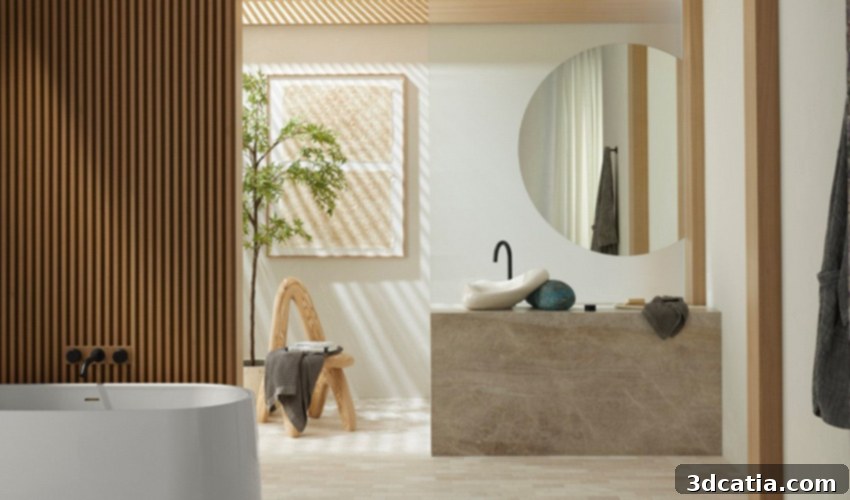
Transforming Spaces: The Revolutionary Impact of 3D Printing in Interior Design
As 3D printing technology continues its impressive integration across diverse industrial sectors, its influence is undeniably expanding beyond manufacturing floors and into our daily lives. A key area where this innovation is making a tangible difference is interior design. The possibilities unlocked by additive manufacturing are reshaping how we envision and create our living and working environments, moving beyond conventional limitations. Initially, polymers were the dominant materials in early 3D printing applications, but relentless research and development have brought about significant advancements. Today, designers are increasingly embracing a broader palette, including materials like sand, wood, and even marble, to bring their creative visions to life. This sector thrives on imagination, making 3D printing an ideal solution that offers unparalleled design freedom. This article delves into the dynamic synergy between additive manufacturing and artistic creativity, exploring how it’s gaining substantial ground in the realms of interior design and architecture, pushing the boundaries of what’s possible in crafting personalized and sustainable spaces.
Interior design is an intricate discipline focused on shaping the aesthetic and functional experience of interior spaces. It achieves this by skillfully manipulating spatial volume, surfaces, lighting, and textures. This applies to every corner of a home or commercial building, encompassing bathrooms, kitchens, living rooms, and bedrooms, as well as offices and public spaces. The range of objects that can be produced using 3D printing for interior design is remarkably vast and ever-growing. This includes everything from bespoke furniture pieces, ergonomically designed chairs, and unique tables to innovative lighting fixtures, stylish bathroom accessories, and an endless array of decorative items. The ability to produce such a diverse array of customized objects empowers individuals and designers to infuse their spaces with precise touches and intricate details that truly reflect their personal style and functional needs. Furthermore, adopting additive manufacturing significantly enhances both the sustainability and customization potential of home decor and larger architectural projects, contributing to more eco-conscious and uniquely tailored environments.
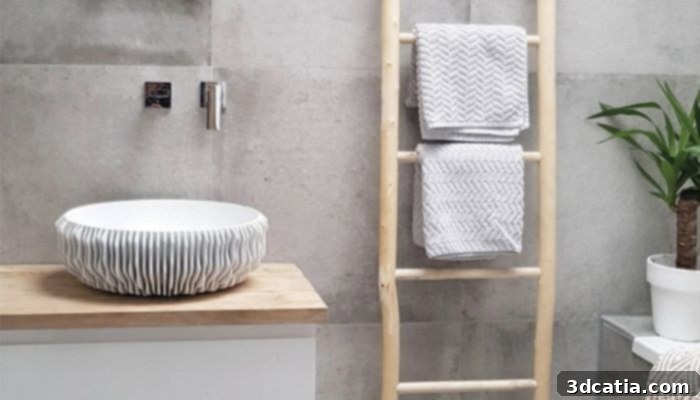
A strikingly elegant 3D-printed washbasin crafted from sand, exemplifying innovative bathroom furniture design (photo credits: Sandhelden)
The Unrivaled Benefits of 3D Printing in Interior Design and Home Decor
One of the most compelling advantages of additive manufacturing in interior design is the extraordinary ease with which virtually any conceptualized part can be brought to fruition. 3D printing offers an unparalleled degree of design freedom, allowing creators to materialize complex geometries, intricate patterns, and organic shapes that would be impossible or prohibitively expensive to produce with traditional manufacturing methods. This benefit isn’t exclusive to large-scale manufacturers or design studios; even individuals with a home 3D printer can leverage this capability to craft personalized items and home decor accents. Beyond design flexibility, other significant advantages of integrating 3D printing into interior design include the capacity for versatile production scales. This technology supports the printing of large volumes using XXL 3D printers, ideal for substantial furniture pieces or architectural elements, alongside the efficient production of small and medium-sized runs. This adaptability ensures high flexibility and rapid turnaround times, crucial for meeting diverse project requirements and accelerating design iterations. Moreover, the ability to produce items on demand significantly reduces waste and inventory, further contributing to the appeal of this innovative approach.
A prime example of this innovation in action is Sandhelden, a pioneering German company that harnesses the power of 3D printing to create exquisite bathroom furniture, notably washbasins made from sand. Their approach highlights the practical benefits: “We are not subject to minimum order quantities. On the largest printer, we’re able to print around 150 washbasins in a print box in less than 24 hours. So it doesn’t matter if all the washbasins are identical or if each one is a slightly different size,” they explain. This exemplifies how 3D printing empowers businesses to cater to individual customer preferences without incurring prohibitive costs or lead times. The ability to produce bespoke items rapidly and efficiently, even in larger quantities, marks a significant departure from traditional mass production models. Another inherent characteristic of 3D printing, which we will explore in more detail, is its profound commitment to environmental sustainability – a crucial aspect in today’s design and manufacturing landscape.
Leading 3D Printing Technologies Revolutionizing Interior Design
The world of 3D printing encompasses a wide array of processes, and no single technology is universally “best” suited for all interior design applications. The optimal choice depends on several critical factors, including the desired surface finish, the specific material compatibility required, and the ultimate functional and aesthetic application of the final product. A close examination of the market reveals a growing trend: more and more companies are seamlessly integrating additive manufacturing into their production workflows to gain a competitive edge. The iconic Swedish brand IKEA, for instance, embraced 3D printing several years ago, showcasing its forward-thinking approach. Their inaugural collection of 3D-printed objects, launched in 2018, utilized Selective Laser Sintering (SLS) printing and was developed in collaboration with renowned designer Bea Åkerlund. SLS is particularly valued for its ability to produce highly durable and functional parts with complex geometries, making it ideal for furniture components and detailed decorative elements. Another compelling illustration comes from the London studio Alaska, which employed SLS technology to construct a table featuring intricately 3D-printed legs capable of robustly supporting a solid walnut tabletop, demonstrating the structural integrity and design possibilities offered by this method.
Another powerful and versatile technology making significant inroads in interior design is Binder Jetting. This process stands out for its compatibility with an exceptionally broad spectrum of materials, including metals, sand, wood, ceramics, and various composites, offering designers immense creative freedom. Companies like Sandhelden, as previously mentioned, are actively leveraging Binder Jetting for the creation of their distinctive bathroom collections, producing elegant and robust fixtures. A particularly innovative example is Forust, a company founded in 2019, which ingeniously utilizes wood waste as its primary manufacturing material for a range of decorative parts and other applications. Forust also provides an accessible online printing service, allowing customers to order samples or submit their own unique designs for production. By applying sophisticated colors and textures to 3D-printed sawdust, Forust has pioneered a wide array of functional and creatively appealing possibilities. Their strategic partnership with Desktop Metal has further expanded their capabilities, enabling both companies to utilize Binder Jetting with metal powder and wood waste for a growing number of sustainable projects, underscoring the eco-friendly potential of this technology.
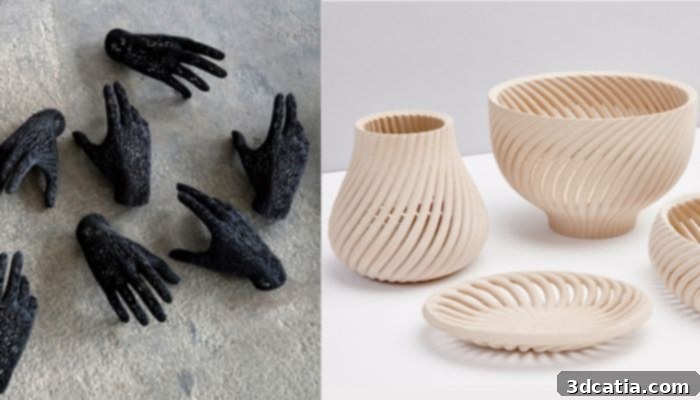
On the left, IKEA’s trailblazing first project showcasing SLS technology in interior design, and on the right, a striking project from Forust Corporation utilizing Desktop Metal’s advanced binder jetting.
For individuals seeking a more accessible entry point into 3D printing for home decor and personalization, Fused Deposition Modeling (FDM) technology presents a highly affordable and popular option. FDM printers are widely available on the market, with prices starting from just a few hundred euros, making it feasible for hobbyists and DIY enthusiasts to manufacture their own 3D-printed parts at home. The primary materials compatible with FDM technology are thermoplastics, including popular choices such as PLA (Polylactic Acid), ABS (Acrylonitrile Butadiene Styrene), Nylon, and PETG (Polyethylene Terephthalate Glycol). Each of these filaments offers distinct properties, from PLA’s ease of use and biodegradability to ABS’s strength and heat resistance, and PETG’s durability and flexibility. This versatility allows home users to select the ideal material for their specific project, whether it’s a decorative vase, a functional organizer, or a custom light fixture. Notable projects utilizing FDM technology include the innovative chairs designed by Bits & Parts, which feature a distinctive puzzle-like assembly, available in three different models. These examples demonstrate FDM’s capability to produce aesthetically pleasing and functional pieces that enhance interior spaces, all while offering the convenience and cost-effectiveness of home-based manufacturing.
Key Materials Driving 3D Printing Innovations in Interior Design
Selecting the appropriate material is a crucial step in creating successful 3D-printed decorative pieces and functional items for interior design. Several factors must be carefully considered, including the material’s inherent properties such as flexibility, strength, durability, and texture. Additionally, the desired color, transparency, specific type of use (e.g., structural, decorative, food-safe), and the final aesthetic finish are all vital considerations. The most commonly employed materials in 3D printing for interior applications are polymers and metals, which are available in various forms—resin, filament, or powder—depending on the chosen 3D printing technology. Polymers, with their vast array of characteristics, can be utilized for an incredibly wide range of parts and decorative objects, from intricate sculptures and custom light diffusers to robust furniture components. Their adaptability in terms of color, transparency, and mechanical properties makes them a cornerstone of modern interior design using additive manufacturing.
Beyond synthetic options, the integration of ceramics and organic materials offers a unique opportunity to infuse interior spaces with a genuine, natural aesthetic and tactile quality. Imagine lamps crafted from wood, showcasing its inherent grain and warmth, or cutlery and kitchenware made from elegant glass or rugged stone, providing both beauty and functionality. As highlighted earlier, sand is another remarkable material, especially for items like innovative bathroom fixtures, offering a unique texture and earthy appeal. Furthermore, clay is gaining traction as a 3D printing material, known for its ability to produce pieces with a wonderfully smooth yet rigid finish. This makes it ideal for artistic ceramics, planters, or unique decorative elements that evoke a sense of craftsmanship and connection to natural elements. The photo below vividly illustrates some examples of parts 3D printed with this diverse palette of materials, demonstrating the richness and versatility that additive manufacturing brings to interior spaces, blending natural beauty with technological innovation.
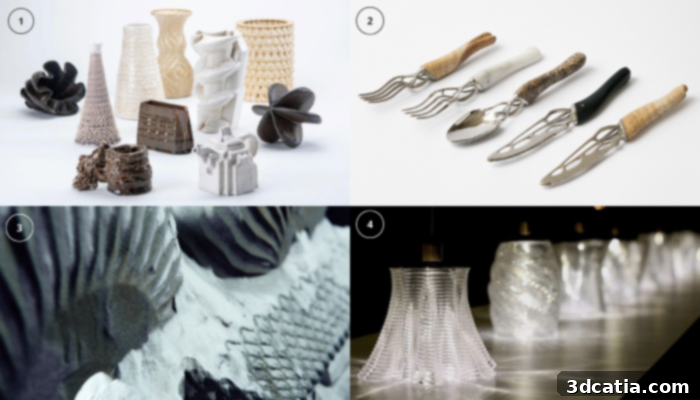
1. Exquisite objects crafted from ceramic and organic materials; 2. Elegant cutlery made from stone; 3. Textured decorative piece fashioned from sand; 4. A refined item created with glass.
Embracing Sustainability: 3D Printing’s Eco-Friendly Edge in Design
Sustainability has emerged as a paramount concern across all industries, and interior design is no exception. Many companies are now placing particular emphasis on environmental responsibility, not only through large-scale initiatives like 3D printed homes but also by integrating this eco-conscious technology into various aspects of design. This commitment often manifests in projects where 3D printing and recycling work hand-in-hand, fostering a more circular economy. For instance, innovative designers like Barbara Gollackner have masterfully transformed food waste into functional and aesthetically pleasing 3D-printed tableware, showcasing the potential for creative material reuse. Similarly, a remarkable 3D-printed pavilion constructed in the Middle East utilized thousands of recycled water bottles, demonstrating how discarded plastics can be given a new life as architectural elements.
The environmental benefits of 3D printing extend even further. Additive manufacturing is inherently more efficient than traditional methods because it builds objects layer by layer, using only the precise amount of material needed for a given part. This “on-demand” and “just-in-time” production significantly minimizes material waste, dramatically reducing scrap rates compared to subtractive manufacturing processes that cut away excess material. Bold Design, a forward-thinking interior design company, articulates this advantage: “When creating products for mass production, 3D printing enables us to manufacture objects as close as possible to the end users. We limit storage by producing in small batches, on-demand, without necessarily increasing costs, unlike injection molding processes which require expensive and complex tooling. By mastering design for 3D printing, we are able to manage both the aesthetic aspect and highly technical elements within the same part, limiting human intervention, which makes it possible to obtain precise, high-quality objects at very reasonable prices, personalize them and take care of the environment.” This holistic approach underscores how 3D printing supports localized production, reduces transportation emissions, and enables the creation of complex, high-quality, sustainable products at competitive prices.
Other noteworthy projects further highlight the sustainable potential. The Institute of Advanced Architecture of Catalonia (IAAC) made headlines with the construction of a unique 3D-printed wall featuring integrated staircases, fabricated entirely from a blend of rice and clay – a testament to ecologically sustainable material innovation. In the realm of outdoor design, Aectual has pioneered planters made from 100% recycled plastic, demonstrating a commitment to repurposing waste into durable, attractive products. Hans Vermeulen, co-founder and CEO of Aectual, insightfully remarked: “It’s also a raw material with which we can make beautiful things, thanks to the new craft of 3D printing. We want to help make the polluting world of construction cleaner and more beautiful. It all starts on a small scale with this planter.” This sentiment perfectly encapsulates the transformative power of 3D printing in making tangible contributions to a greener future, starting with everyday objects.
Finally, the manufacturing of furniture using 3D printing presents particularly exciting opportunities from an ecological perspective. The ability to use 100% recycled plastics or even recycled urban waste as feedstock materials significantly closes the loop on material consumption. For instance, R3direct specializes in printing plastic in granulated form, a process that inherently requires less energy and emits fewer CO2 emissions compared to using traditional filament. The granules they use are derived directly from recycled packaging, such as fruit juice bottles and cartons, turning what would typically be waste into robust and stylish street furniture. This innovative approach not only diverts waste from landfills but also creates durable, aesthetically pleasing products that contribute to urban landscapes while minimizing environmental impact. Such initiatives demonstrate the profound and diverse ways 3D printing is championing sustainability in modern interior and urban design.
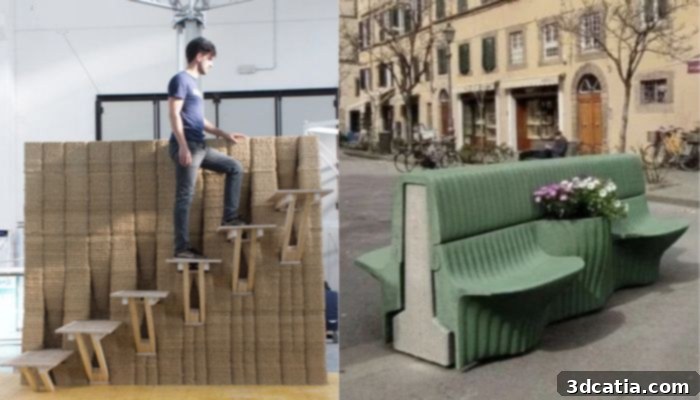
On the left, an innovative wall and staircase made from an ecological blend of clay and rice by IAAC; on the right, the R3direct ecological bench, a shining example of sustainable street furniture.
Additive Manufacturing: The Ultimate Tool for Unmatched Customization
One of the most compelling and transformative advantages of additive manufacturing, particularly within the realm of interior design, is its unparalleled capacity for customization. Decorating a home is an intensely personal endeavor, where individual tastes, preferences, and stylistic choices are paramount and rarely up for debate. 3D printing empowers individuals and designers to achieve precisely this: to personalize home furnishings and decorative elements to an unprecedented degree. This is because 3D printing liberates users from the constraints of mass-produced items, allowing them to bring to life designs they have always envisioned but were previously unable to realize due to manufacturing limitations. It truly gives free rein to imagination and creativity, transforming abstract ideas into tangible, unique objects that perfectly match an individual’s vision.
The beauty of 3D printing’s customization capability is that it extends even to individual users who possess their own 3D printers. The rise of accessible FDM printers, for example, means that hobbyists and homeowners can actively participate in the design and production process of their home decor. We’ve already seen countless inspiring examples of DIY 3D printing for home interiors, including bespoke lamps with intricate shades, unique decorative objects like vases and flower pots tailored to specific aesthetics, or even custom-designed chairs and furniture components. The potential is boundless – let your imagination run wild and integrate truly unique, 3D-printed objects into your home to create spaces that are authentically yours! For those with 3D design skills, the possibilities expand even further; they can modify existing designs or entirely redesign specific rooms or objects within their home. Numerous intuitive software programs are available for creating these designs, catering to various skill levels, from beginners to seasoned professionals. Alternatively, a vast repository of ready-to-print designs can be found on diverse online file platforms, offering a starting point for anyone looking to personalize their living spaces with additive manufacturing.
What Does the Future Hold for 3D Printing in Interior Design?
Having explored the transformative role of 3D printing in interior design, from its materials and technologies to its benefits in customization and sustainability, the pertinent question remains: what does the future hold for this dynamic sector? The answer is unequivocally promising. Almost every industry is now recognizing and integrating additive manufacturing into their production processes, thanks to the multitude of advantages it offers in terms of flexibility, efficiency, and innovation. From small, independent designers creating unique artisanal pieces to large corporations seeking agile and sustainable manufacturing solutions, all see a significant market opportunity. This technology allows for unparalleled freedom in designing, manufacturing, and marketing products that truly resonate with individual customer needs and evolving aesthetic sensibilities.
The continually expanding variety of materials available on the market, coupled with advancements in 3D printing technologies, means that an almost infinite number of parts can be created. This ranges from highly detailed, intricate decorative objects and personal accessories to robust furniture, bespoke lighting fixtures, specialized cutlery, and beyond. It is only a matter of time before we witness the emergence of even more innovative companies and groundbreaking projects dedicated to revolutionizing interior design through the power of 3D printing. We anticipate a future where design projects consistently stand out not only for their exceptional personalization and originality but also for their unwavering commitment to environmental responsibility. We are excited to continue tracking these developments and will keep you informed of any new breakthroughs, so stay tuned!
What are your thoughts on the evolving role of 3D printing in interior design and home decor? We invite you to share your perspectives in a comment below or join the conversation on our LinkedIn, Facebook, and Twitter pages! Don’t forget to sign up for our free weekly Newsletter here to receive the latest 3D printing news directly in your inbox! You can also find all our engaging videos and tutorials on our YouTube channel.
*Cover Photo Credits: Kohler