
Revolutionizing Restorative Dentistry: Full-Mouth Rehabilitation with Advanced 3D Printed Crowns
The landscape of restorative dentistry is undergoing a profound transformation, driven by the remarkable advancements in digital workflows and additive manufacturing. These innovations are paving the way for more precise, efficient, and patient-centric treatments. This article delves into a compelling full-mouth rehabilitation case spearheaded by Dr. Guvinder Gakhal, which powerfully illustrates this paradigm shift. The case involved a patient suffering from severe generalized tooth wear, a complex condition effectively addressed through the strategic application of SprintRay 3D printed crown resin. By meticulously following structured workflows, refined through extensive education and training, Dr. Gakhal’s approach exemplifies how modern digital dentistry can achieve exceptional clinical and aesthetic outcomes while adhering to minimally invasive principles. This detailed account underscores the immense potential of 3D printing technology in restoring oral health and function, ensuring both longevity and patient satisfaction.
Leveraging 3D Printing Technology for Comprehensive Tooth Wear Restoration
The featured patient, a 56-year-old male electrician, presented with significant and widespread tooth wear, a direct consequence of chronic nocturnal bruxism. Bruxism, characterized by the habitual grinding or clenching of teeth during sleep, had led to a substantial loss of tooth height over many years. Although the patient reported no immediate pain, the ongoing structural degradation of his dentition posed a high and imminent risk of pulp exposure. Pulp exposure, where the inner nerve and blood vessels of the tooth become vulnerable, can lead to severe pain, infection, and ultimately, tooth loss. Recognizing the critical nature of his condition, early and comprehensive intervention was paramount. The primary objectives were to preserve the remaining natural tooth structure, prevent the escalation to more complex and costly restorative challenges in the future, and crucially, maintain optimal oral function, including proper chewing and speaking capabilities. This proactive approach highlights the importance of timely diagnosis and advanced treatment planning in managing such progressive conditions.
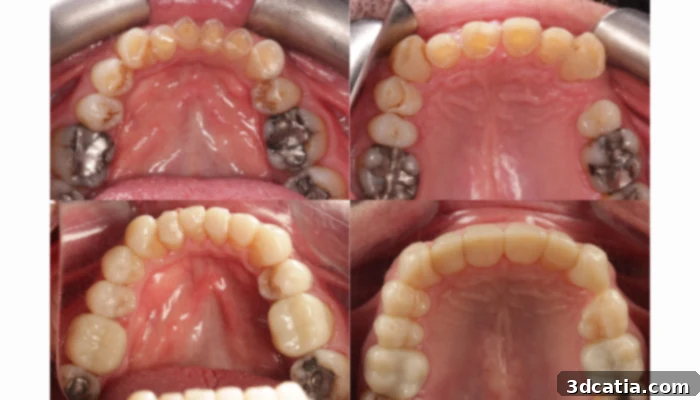
A visual representation of the patient’s extensive tooth wear before and after, demonstrating the significant restorative impact of 3D printing.
Dr. Gakhal adopted a truly patient-centered philosophy, engaging in thorough discussions to align treatment goals with the patient’s expectations and concerns. The key objectives articulated included safeguarding the remaining healthy tooth structure, meticulously restoring the occlusal vertical dimension (OVD), which refers to the natural and vital distance between the upper and lower jaws when the mouth is closed, and significantly enhancing the patient’s smile aesthetics. All these goals were pursued with a steadfast commitment to employing the most minimally invasive techniques available, thereby maximizing the preservation of natural tooth material. The case presented a unique array of clinical challenges that demanded precise planning and execution. These included severely shortened clinical crowns, the visible portions of the teeth above the gum line, which were perilously close to exposing the dental pulp. Furthermore, the patient exhibited alveolar compensation, a compensatory change in the position of the jawbone that often occurs as teeth wear down, potentially affecting the bite and overall facial structure. Other complexities involved asymmetrical gingival zeniths, meaning uneven gum heights that can detract from a harmonious smile line, and buccally positioned canines, where the canine teeth were angled outward towards the cheeks. Each of these intricate factors required careful assessment and strategic integration into the overall treatment plan to ensure a natural, functional, and aesthetically pleasing outcome that would stand the test of time.
Seamless Integration: The Digital Workflow and Advanced 3D Printing Process
The full-mouth rehabilitation process was meticulously executed through a comprehensive, fully digital workflow, embodying the pinnacle of modern dental technology. This advanced approach commenced with the creation of a diagnostic wax-up, an essential step involving a digital or physical model that precisely visualizes the proposed new tooth shapes and ideal positions. This initial blueprint allowed for careful planning and analysis. Following approval, the diagnostic wax-up was skillfully converted into a trial smile using bisacryl resin, a temporary yet highly representative material. This crucial intermediate stage enabled the patient to actively preview and experience the proposed design in their own mouth, evaluating the planned bite, overall aesthetics, and even speech articulation before any permanent work began. This “test drive” ensured complete patient satisfaction and confidence in the treatment plan. Once the trial smile received final patient approval, the finalized digital design, in the form of STL (stereolithography) files, was seamlessly transmitted to the high-performance SprintRay Pro 2 printer. This state-of-the-art 3D printer then fabricated the permanent crowns with exceptional accuracy and speed using specialized crown resin.
The post-processing phase for the 3D printed crowns was equally rigorous and detailed. It began with thorough hand-cleaning using 99% isopropyl alcohol to remove any residual resin. This was followed by a precise coating application and a final curing process to ensure maximum material strength and integrity. Each crown was then meticulously polished to achieve a natural luster and texture, mimicking the appearance of natural teeth. The final step involved precise fitting, where each crown was individually evaluated and adjusted to ensure an exact match with the prepared tooth structure. The cementation process, critical for long-term stability, involved careful surface preparation of both the tooth and the crown, followed by the application of a specialized primer. The crowns were then permanently bonded into place, with a final curing step performed under glycerine. This technique prevents the oxygen inhibition layer from forming on the resin surface during curing, ensuring an optimal, durable bond and superior long-term durability. This integrated digital workflow not only enhanced predictability and efficiency but also significantly improved the patient experience, offering a precise, customized, and durable solution for complex restorative needs.
Unlocking Superior Outcomes: The Advantages of 3D Printed Restorations
While traditional approaches to managing tooth wear often favor composite resin due to its ease of repair and minimal tooth preparation requirements, the application of 3D printed crowns in this particular case offered a spectrum of compelling advantages. This cutting-edge technology facilitated the creation of restorations with unparalleled accuracy, ensuring an exquisite level of detail and precision in every aspect. One of the most significant benefits was the superior marginal adaptation—the tight and seamless fit where the crown meets the edge of the tooth structure. This precise fit is crucial for preventing microleakage, which can lead to secondary decay and eventual restoration failure. Moreover, 3D printed crowns exhibited remarkably improved structural strength compared to conventional materials, offering enhanced durability and resistance to the significant forces associated with bruxism and everyday chewing. The fully digital workflow played an instrumental role in guaranteeing that each individual crown meticulously matched the approved trial design. This predictability in both form and function allowed for consistent and reliable aesthetic results, ensuring the patient’s smile was not only beautiful but also functionally sound. Crucially, this advanced method also maximized the preservation of the patient’s existing natural tooth structure, aligning perfectly with the principles of minimally invasive dentistry. By requiring less aggressive tooth reduction, the risk to the underlying tooth and its vitality is significantly minimized, contributing to better long-term oral health.
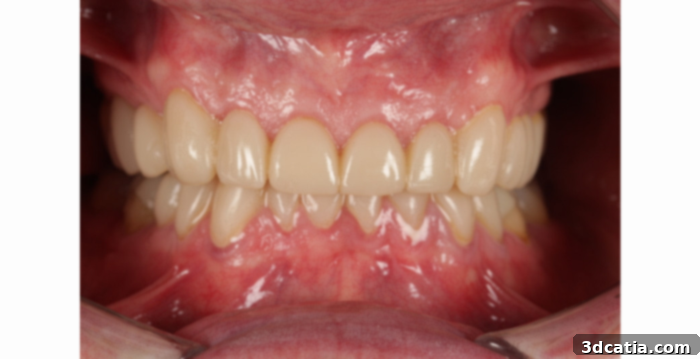
The final product showcases the transformative power of 3D printing within the dental sector, delivering aesthetic and functional excellence.
The immediate response from the patient was overwhelmingly positive, expressing profound satisfaction with the dramatic improvement in both appearance and overall comfort. To ensure the long-term success and stability of the rehabilitation, comprehensive follow-up assessments were conducted at crucial intervals: two weeks, one month, two months, and three months post-treatment. These assessments consistently confirmed that the patient had successfully adapted to the newly restored occlusal vertical dimension and the integrated restorations. The meticulous planning and execution, particularly the emphasis on preserving enamel and minimizing tooth reduction, significantly mitigated the risk of pulpal complications—such as inflammation or irritation of the tooth nerve—which are common concerns in extensive restorative cases. This conservative yet effective approach not only optimized patient comfort throughout the healing and adaptation phases but also laid a robust foundation for excellent long-term oral health and function.
Dr. Gakhal eloquently reflected on the multifaceted benefits derived from seamlessly integrating sophisticated digital workflows with SprintRay 3D printing technology, particularly in managing complex tooth wear cases. He highlighted that this advanced approach significantly enhanced collaborative efforts between the clinical team and the dental laboratory, fostering a synergistic environment where precision and communication flourished. The ability to preserve natural tooth structure emerged as a paramount advantage, contributing directly to the long-term vitality and health of the patient’s dentition. Ultimately, this integration consistently delivered predictable, durable, and exceptionally aesthetically pleasing results, elevating the standard of care for full-mouth rehabilitations. Furthermore, this specific case provided invaluable insights into the long-term performance and resilience of 3D printed restorations in challenging clinical scenarios. With the continuous evolution of materials, particularly the introduction of ceramic-dominant resins—which are advanced resins reinforced with ceramic particles for superior strength and durability—future applications are poised to offer even greater robustness. These innovations promise to maintain the existing advantages of remarkable accuracy, excellent repairability, and the enduring benefits of minimally invasive treatment protocols. While acknowledging that further extensive studies are warranted to comprehensively evaluate long-term clinical outcomes across a broader patient demographic, this case unequivocally underscores the strong clinical potential and transformative impact of 3D printed definitive restorations in modern dentistry.
What are your thoughts on the revolutionary applications of 3D printing within the dental sector? We invite you to share your insights and experiences in a comment below, or join the conversation on our LinkedIn or Facebook pages! Don’t miss out on the latest innovations and news from the world of additive manufacturing – be sure to sign up for our free weekly Newsletter to get breaking 3D printing news delivered straight to your inbox. You can also discover more compelling case studies and technological breakthroughs by visiting our official YouTube channel.
*Cover Photo Credit: VistaDent / *Photo Credits for All Images Except Graph: Guvinder Gakhal