

Revolutionizing Metal 3D Printing: New Defect-Resistant Nickel-Based Superalloys for High-Performance Applications
In a significant stride forward for advanced manufacturing, a pioneering team of researchers from UC Santa Barbara and Oak Ridge National Laboratory has successfully developed novel, defect-resistant high-performance alloys specifically engineered for metal 3D printing. This breakthrough addresses one of the most persistent challenges in additive manufacturing: designing alloys that are not only compatible with the intricate and often demanding conditions of additive processing but also offer superior properties crucial for applications in critical sectors such as energy, space, and nuclear industries. The difficulty lies in balancing printability with the ultimate performance requirements for these high-stakes environments. Nevertheless, the dedicated team has unveiled a groundbreaking class of high-strength, defect-resistant 3D printable nickel-based superalloys. These innovative materials are formulated with approximately equal parts of Cobalt (Co) and Nickel (Ni), complemented by strategic additions of Aluminum (Al), Chromium (Cr), Tantalum (Ta), and Tungsten (W).
The primary objective behind this research is to catalyze the production of high economic value metal materials for the additive manufacturing process. By doing so, the team aims to unlock unprecedented opportunities for designing innovative, geometrically complex components with significantly reduced material waste. This capability is paramount in industries where efficiency and performance are non-negotiable. The development promises to expand the horizons of what is achievable through metal 3D printing, moving beyond current limitations imposed by material availability and processing challenges. The unique composition of these new superalloys is specifically tailored to enhance printability while ensuring exceptional mechanical properties, making them ideal candidates for next-generation applications.
One of the most critical advancements embodied by these new nickel-based superalloys is their ability to effectively overcome the pervasive issue of cracking. Cracking is a common and detrimental phenomenon that frequently plagues parts fabricated using high-temperature Powder Bed Fusion (PBF) technologies, such as Laser Powder Bed Fusion (LPBF) and Electron Beam Melting (EBM). In these sophisticated processes, metal powder is meticulously melted layer by layer, utilizing a concentrated energy source like a laser or an electron beam to progressively construct the desired component. The rapid heating and cooling cycles inherent to these processes often induce significant thermal stresses, which can lead to the formation of micro-cracks or even macro-cracks, severely compromising the structural integrity and performance of the final product. The newly developed superalloys address this vulnerability head-on, ensuring a more robust and reliable manufacturing outcome.
Beyond their defect resistance, these superalloys exhibit truly impressive mechanical properties. They boast strengths in excess of 1.1 Gigapascals (GPa) in both their as-printed and post-processed forms, demonstrating remarkable structural integrity. Equally important is their tensile ductility, measured at greater than 13% at room temperature. This combination of high strength and substantial ductility is exceptionally rare in 3D printed metals, particularly those designed for high-temperature applications. High ductility ensures that components can withstand significant deformation before fracture, adding a critical layer of safety and reliability. The scientists are highly optimistic about the potential of their material, envisioning its widespread adoption in high-stress applications. This includes, but is not limited to, the manufacturing of critical aerospace engine components, where extreme temperatures and pressures are standard, and chemical-containing nuclear components, where material integrity is paramount for operational safety and longevity. The ability to print such robust materials opens doors to lighter, more efficient, and safer designs across these vital industries.
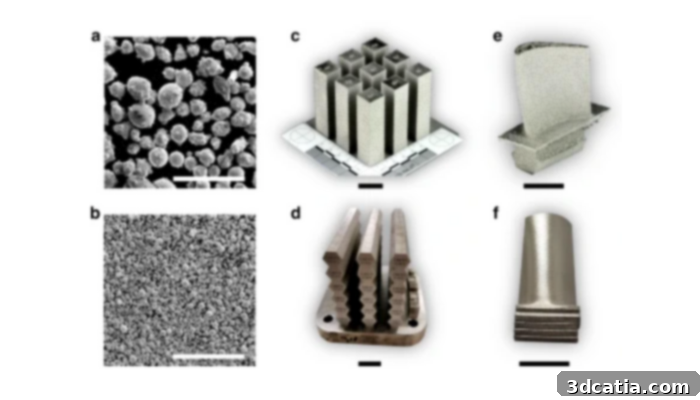
a. EBM and b. SLM printing trials c. and d. Simple bar geometries have been printed for uniaxial tensile testing e. Internal cooling channels f. thin, over-hanging platforms | Figure taken from research paper.
One of the core limitations hindering the broader adoption of additive manufacturing in specialized fields is the incompatibility of many advanced metallic alloys with the additive process. Alloys currently used in extreme heat-intensive and chemically corrosive environments, such as those found in gas turbines or nuclear reactors, were primarily designed for traditional manufacturing methods like forging or casting. As Tresa Pollock, a distinguished Professor of Materials at the College of Engineering at UC Santa Barbara and a key member of this research project, succinctly explains, “Most very high-strength alloys that function in extreme environments cannot be printed, because they crack.” This fundamental incompatibility has long restricted the transformative potential of 3D printing in these demanding sectors. The very conditions that make additive manufacturing revolutionary—rapid heating, localized melting, and swift cooling—also create intense thermal gradients and residual stresses, which can cause cracking either during the printing process itself or subsequent post-processing.
However, the promise of new designs enabled by additive manufacturing remains immense. The ability to create intricate, optimized geometries – such as lightweight lattice structures, complex internal cooling channels, or customized aerodynamic profiles – could dramatically increase performance and energy efficiency across a multitude of industries. Pollock further elaborates on the challenge of cracking: “Alloys can crack in their liquid state, when an object is still being printed, or in the solid state, after the material is taken out and given some thermal treatments. This has prevented people from employing alloys that we use currently in applications such as aircraft engines to print new designs that could, for example, drastically increase performance or energy efficiency.” The development of defect-resistant superalloys directly addresses this critical barrier, opening the door for engineers to leverage the full design freedom of additive manufacturing to create components that are not only stronger and more durable but also far more efficient than their conventionally manufactured counterparts. This leap forward is pivotal for sectors constantly seeking marginal gains in performance and sustainability.
Indeed, advances in material science and engineering are indisputably playing a pivotal role in unlocking the full potential of metal 3D printing. The success of the UC Santa Barbara and Oak Ridge National Laboratory team is a prime example of this trend. Another notable instance of such innovation was highlighted on 3Dnatives last year, with the introduction of startup 6K. This company has been rigorously working on solving similar material challenges, focusing specifically on the quality of metal powders for additive manufacturing. Recognizing the escalating demand for high-quality metal powders across critical sectors like aerospace, medical, and automotive, 6K developed a proprietary technology known as UniMelt. This revolutionary plasma-based platform enables the creation of advanced alloys and materials that are exceptionally compatible with the AM process. UniMelt-produced powders are characterized by their truly spherical shape, complete absence of porosity, and lack of satellite particles, all of which contribute to significantly better flowability and overall superior performance during the printing process. This illustrates a parallel, industry-wide effort to elevate the quality and diversity of materials available for additive manufacturing, complementing the alloy design efforts like those at UCSB/ORNL.
While the development of novel, defect-resistant materials is undeniably a cornerstone for advancing additive manufacturing, it is important to recognize that material innovation is just one facet of a multi-pronged approach to producing defect-free parts. Other crucial methods involve optimizing the printing process itself. For instance, meticulous monitoring and precise control over printing speed, laser power, and layer thickness are essential to minimize thermal stresses and prevent inconsistencies. Furthermore, the integration of advanced digital technologies, such as machine learning and artificial intelligence, is rapidly transforming defect detection and correction. These AI-powered systems can analyze real-time sensor data from the printing chamber, identify potential anomalies or defects as they occur, and even initiate corrective actions autonomously. This synergy between advanced material development and sophisticated process control, augmented by AI, represents the most comprehensive strategy for achieving the highest quality and reliability in metal 3D printed components. The future of additive manufacturing will undoubtedly be shaped by continuous innovation across all these fronts, enabling the widespread adoption of this transformative technology for even the most demanding applications.
To delve deeper into the specifics of this groundbreaking research project by UC Santa Barbara and Oak Ridge National Laboratory, including detailed methodology and comprehensive results, you can access the full scientific paper HERE. We are keen to hear your thoughts on these significant material developments shaping the metal AM market. Please share your insights and opinions in a comment below or join the conversation on our Facebook and Twitter pages! For the very latest updates in the world of 3D printing, straight to your inbox, don’t forget to sign up for our free weekly Newsletter.
*Thumbnail Photo: Osprey® metal powder produced at Sandvik’s powder plant for titanium and nickel-based superalloys (Courtesy Sandvik Additive Manufacturing)