
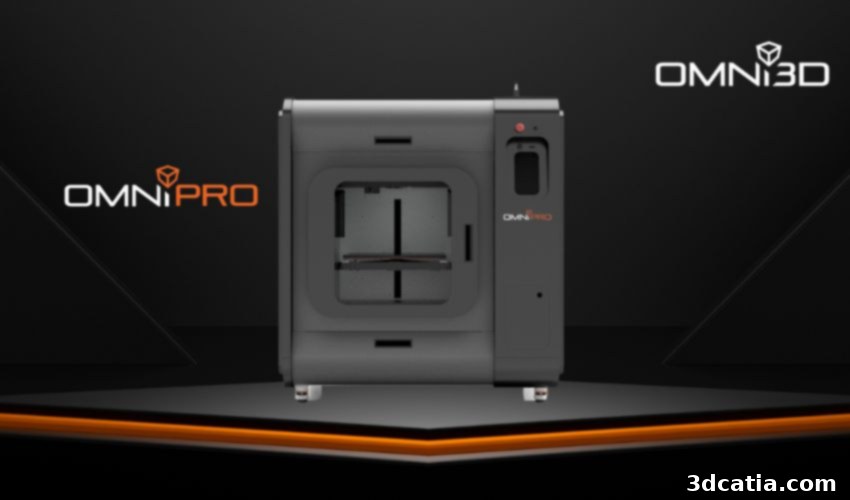
Omni3D Redefines Industrial FFF: Introducing the Omni PRO and PRO HT 3D Printers for High-Performance Applications
The additive manufacturing sector has been on a clear trajectory towards greater industrialization for several years, marking a significant evolution from its origins in the 1980s. What once began as a technology primarily for rapid prototyping has matured into a robust solution for a diverse range of applications, including the production of functional end-use parts across various industries. Among the myriad 3D printing technologies available today, Fused Filament Fabrication (FFF) continues to hold a prominent position. A recent report by Hubs this year underscored FFF’s enduring popularity, revealing that a remarkable 56% of respondents favor it, significantly outpacing alternatives like SLA, which came in second at 20%. This widespread adoption highlights FFF’s accessibility, versatility, and cost-effectiveness, even as the demand for more advanced, industrial-grade solutions intensifies.
In response to this growing industrial demand, Omni3D, a distinguished Polish manufacturer, is poised to introduce a new generation of FFF 3D printers that promise to elevate the capabilities of the technology. With the imminent launch of the Omni PRO and PRO HT 3D printers, which are highly anticipated to debut at Formnext this year, Omni3D boldly claims these machines could establish themselves as “the new standard in the world of 3D printing.” This ambitious assertion reflects a deep commitment to innovation and a clear understanding of the evolving needs of industrial users. These new offerings are designed to push the boundaries of FFF, catering to the most demanding professional applications and setting a new benchmark for performance and reliability in industrial additive manufacturing.
Omni3D has steadily built a reputation as a leader in high-temperature and professional FFF 3D printing. We have previously highlighted their contributions to the industry, recognizing their dedication to developing robust solutions for complex manufacturing challenges. In an insightful interview back in March of this year, Paweł Robak, the CEO of OMNI3D, articulated the company’s unwavering focus on the Business-to-Business (B2B) 3D printing market. He emphasized Omni3D’s core mission: to “provide tools and complete ecosystems to create the most innovative and cost-effective products.” This philosophy is clearly embodied in the design and functionality of the new Omni PRO and PRO HT printers, which are engineered to deliver unparalleled precision, speed, and material versatility for industrial applications. These latest additions to their portfolio demonstrate Omni3D’s commitment to empowering businesses with cutting-edge additive manufacturing capabilities. Robak further elaborated on this vision, stating, “Our company has been focused on developing cutting-edge 3D printing technology from the very beginning, and this introduction of a new printer – the Omni PRO and Omni PRO HT – is confirmation of our determination to achieve perfection. The collaboration of our engineering and design teams has led to the creation of a product that meets the highest expectations of our customers.” This statement underscores the rigorous development process and customer-centric approach that characterize Omni3D’s product development strategy, aiming to exceed professional users’ stringent requirements for performance, reliability, and material compatibility.
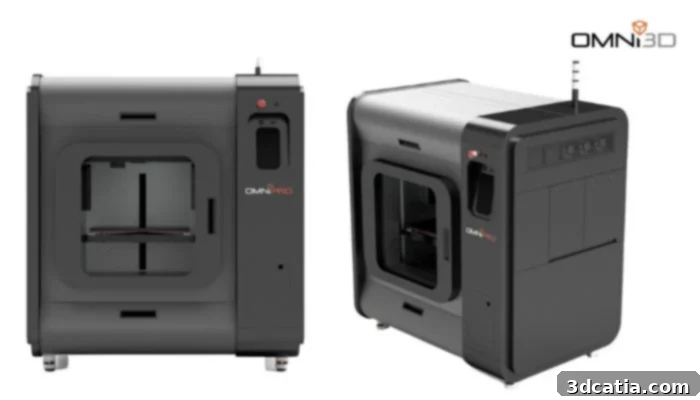
The newly launched Omni PRO 3D printer
What Can We Expect From the Omni PRO and PRO HT?
With Omni3D’s ambitious claims and steadfast commitment to industrial excellence, the critical question remains: what specific advancements do the Omni PRO and PRO HT 3D printers bring to the table? Both models are designed to meet the rigorous demands of professional manufacturing, sharing several foundational features that underscore Omni3D’s commitment to quality and usability. Both printers boast a generous build volume of 500 x 500 x 500mm, providing ample space for producing large industrial components or for batch manufacturing multiple parts simultaneously. This large build plate is a crucial feature for industrial users looking to maximize throughput and minimize the need for post-processing assembly. Furthermore, both printers are compatible with Simplify3D, a widely recognized and powerful slicing software, offering users extensive control over print parameters and ensuring optimal print quality and efficiency. They also maintain a standard filament diameter of 1.75mm, ensuring broad material compatibility, and share common Omni3D features known for reliability and precision, along with an impressive minimum layer height that allows for finely detailed parts. However, their primary distinction lies in their material capabilities, particularly their proficiency in handling high-performance polymers.
While the Omni PRO is highly capable with a range of advanced filaments such as PC (Polycarbonate), PC-CF (Polycarbonate-Carbon Fiber), PEEK (Polyether Ether Ketone), PEEK-CF (PEEK-Carbon Fiber), and PPA-CF (Polyphthalamide-Carbon Fiber), the Omni PRO HT, as its name suggests, takes high-temperature material processing to an even higher level. The Omni PRO’s material compatibility already positions it for engineering applications requiring high strength, impact resistance, and moderate heat deflection. PC-CF and PPA-CF, for instance, offer enhanced stiffness and reduced weight, making them suitable for robust jigs, fixtures, and functional prototypes. PEEK and PEEK-CF provide exceptional mechanical properties, chemical resistance, and thermal stability, crucial for demanding industrial environments. The Omni PRO HT, however, is specifically engineered to excel with ultra-high-performance polymers like ULTEM 1010 and ULTEM 9085. These materials are renowned for their outstanding mechanical strength, chemical resistance, and flame retardancy at elevated temperatures, making them indispensable for aerospace, automotive, medical, and defense sectors where performance under extreme conditions is non-negotiable.
The ability to successfully print with such high-performance materials is largely dependent on precise thermal management within the printer’s build chamber. Wojciech Wiśniewski, a 3D Printing Technologist at Omni3D responsible for rigorous machine and filament testing, elaborated on this crucial aspect: “Chamber temperature is especially important to ensure high mechanical properties of parts printed with engineering and high-performance polymers. It helps not only in creating a stronger interlayer bond, but also reduce the internal stresses within the material. Such stresses pose a significant problem in FDM/FFF 3D printing.” This explanation highlights a fundamental challenge in FFF with advanced polymers: warping and delamination due to differential cooling and internal stresses. To mitigate these issues, the Omni PRO HT is equipped with a significantly higher chamber temperature and build plate temperature capabilities, creating an optimized thermal environment that allows these demanding materials to cool uniformly, enhancing interlayer adhesion and overall part integrity. This superior thermal control ensures that parts printed with ULTEM and PEEK exhibit their full mechanical potential, free from typical FFF defects. Additionally, the Omni PRO HT is engineered for speed, boasting a maximum printing velocity of 200 mm/s and a volumetric output of 86 cm³/h. This increased speed, combined with its robust material capabilities, translates directly into higher productivity and efficiency for industrial users, making the production of complex, high-performance parts faster and more cost-effective.
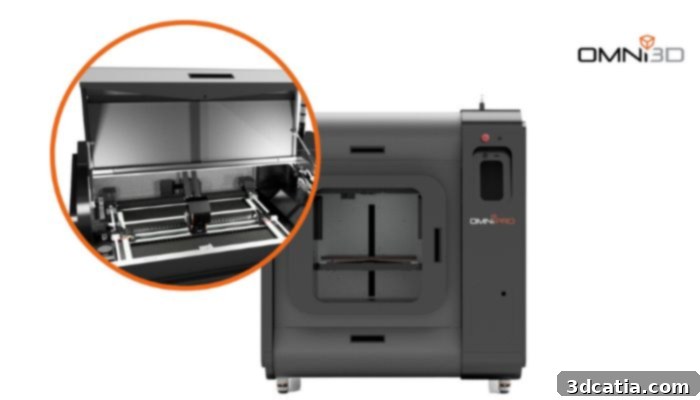
The top of the machine
Beyond their core differences in material handling and thermal capabilities, both the Omni PRO and PRO HT incorporate a suite of advanced features designed to enhance user experience, ensure print reliability, and contribute to their standout performance in the market. In addition to their impressively large working space, which supports the production of substantial components, these printers are equipped with a sophisticated cooling system specifically for the extruders. This prevents heat creep and ensures consistent material flow, even during long print jobs with challenging filaments, thereby reducing clogs and ensuring optimal extrusion. An advanced air circulation system maintains excellent temperature control within the print chamber, crucial for minimizing thermal variations that can lead to part defects and ensuring uniform properties across the printed part. Omni3D’s proprietary Filament Flow Control™ system further elevates reliability by precisely monitoring and regulating filament extrusion, preventing underextrusion or overextrusion issues. Furthermore, both machines feature automated head leveling and platform auto-leveling systems. These critical functionalities eliminate the tedious and often error-prone manual calibration processes, ensuring perfect first-layer adhesion and consistent print quality from the very first print, significantly reducing setup time and potential printing failures. These combined features translate into a truly hassle-free experience for industrial users, minimizing downtime and maximizing the efficiency of their additive manufacturing workflows.
Another significant innovation worthy of detailed mention is the integrated filament management system, featuring automatic feeders and heated chambers. Both the Omni PRO and Omni PRO HT are equipped with two filament chambers, each capable of housing up to two 3 kg spools. This provides an impressive total capacity of 12 kg of filament within the printer at any given time. This large capacity is particularly beneficial for industrial applications requiring long print cycles or batch production, significantly extending unattended operation. Each spool benefits from its individual smart feeder, which intelligently manages the filament supply. Once a filament passes through its sensor, it is precisely pushed towards the extruder, which is further equipped with both presence and flow sensors. This sophisticated system allows users to prioritize which filament spool to use first. Critically, if the active spool runs out during a print, the system automatically and seamlessly switches to the next available spool of the same material, ensuring uninterrupted production. This intelligent and automated filament handling not only reduces manual intervention but also significantly minimizes the risk of print failures due to material exhaustion, contributing to a truly seamless and highly efficient production experience vital for industrial environments.
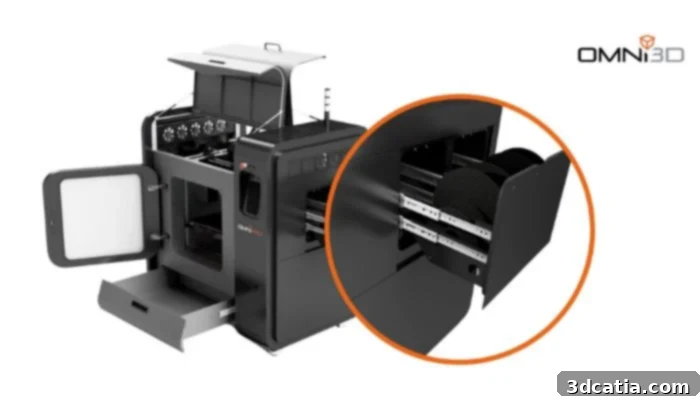
The filament chambers allow up to 4 filament spools in the machine simultaneously
What Are the Applications?
By aiming to push the boundaries of innovation in the additive manufacturing industry, Omni3D has strategically positioned its new PRO series printers to serve a diverse range of high-stakes sectors. The Omni PRO and PRO HT are expected to be particularly transformative for industries such as defense, aerospace, and railway, where the demand for high-performance, precision-engineered components is paramount. These sectors often require parts that can withstand extreme temperatures, significant mechanical stresses, and harsh operating environments, making the advanced material capabilities of the Omni PRO HT, in particular, invaluable. For instance, in aerospace, these printers can produce lightweight, structurally sound components for aircraft interiors or even functional prototypes for propulsion systems using materials like ULTEM, which offers excellent flame retardancy and strength-to-weight ratio. The defense sector can leverage these machines for rapidly prototyping specialized tools, jigs, or even low-volume production of end-use parts that require specific material properties for mission-critical applications. In the railway industry, parts requiring high durability, wear resistance, and the ability to operate effectively in varying temperatures can be efficiently manufactured. Paweł Robak further emphasized the real-world impact of Omni3D’s technology, stating, “I’m very proud that our systems are well implemented and helps such clients as Airbus, BAE Systems or NAVAL Group who are using them for the most advanced applications in the 3D printing industry.” This direct endorsement from leading global players like Airbus, BAE Systems, and NAVAL Group, renowned for their stringent quality and performance requirements, provides compelling evidence of the Omni PRO series’ capabilities and reliability in truly advanced industrial contexts.
Though still newly launched, there are a number of interesting applications being seen with the Omni PRO and Omni PRO HT 3D printers
Adam Wilczyński and Piotr Skotarczyk, the principal designers behind the Omni PRO, provided deeper insight into the foundational philosophy guiding its development. They concluded, “Our goal with Omni PRO was to build a machine that can meet various user requirements. From our experience with previous Omni printers, we knew that a lot of customers, once they have a 3D printer, try to utilize it in different areas of their business. Therefore, we wanted to design a machine that can flawlessly print from a wide range of materials. However, we focused not only on improving the temperature parameters but also on accuracy, speed, reliability and ergonomics. To achieve this, Omni PRO is built with industrial grade components and has some smart custom features that we as engineers and users find helpful. As a name suggests, Omni PRO is designed for professionals from different industries to help them overcome limitations of traditional production processes, whether it’s prototyping or low-volume production.” This statement encapsulates Omni3D’s holistic approach, recognizing that a truly industrial 3D printer must offer more than just raw power. It must combine advanced material processing with unparalleled precision, rapid production capabilities, robust operational reliability, and user-friendly ergonomics. By incorporating industrial-grade components and intelligent custom features, Omni3D has ensured that the Omni PRO series is not only powerful but also durable, easy to operate, and consistently delivers high-quality results. These printers are positioned to empower professionals to tackle complex design challenges, accelerate product development cycles, and produce cost-effective, customized parts that were previously difficult or impossible with traditional manufacturing methods. The Omni PRO and PRO HT are more than just 3D printers; they are comprehensive solutions designed to unlock new possibilities in prototyping, tooling, and low-volume production for industries striving for innovation and efficiency. You can discover more about these groundbreaking printers on Omni3D’s official website HERE, or experience their official launch at Formnext 2023, where Omni3D will be showcasing their innovations at Booth C02 in Hall 12.1. This highly anticipated event offers an excellent opportunity to witness these machines in action and speak directly with the experts behind their development.
What are your thoughts on the newly launched Omni PRO and PRO HT 3D printers? Do you believe they live up to the promise of setting a new standard for industrial FFF? Will you be attending Formnext to experience these cutting-edge machines firsthand? We invite you to share your insights and opinions in a comment below or engage with us on our LinkedIn, Facebook, and Twitter pages! Don’t miss out on the latest advancements and breaking news in additive manufacturing—remember to sign up for our free weekly Newsletter here, delivering the most relevant 3D printing updates straight to your inbox! You can also explore our extensive library of videos and insights on our YouTube channel for a visual deep dive into the world of 3D printing.
*All Photo Credits: Omni3D