
TU Delft Pioneers Photosynthetic Living Material: 3D Bioprinting Algae for Sustainable Innovation
At the prestigious Delft University of Technology (TU Delft), a groundbreaking team of researchers has unveiled a revolutionary advancement in material science. Utilizing the cutting-edge techniques of bioprinting and harnessing the inherent power of algae, they have successfully created a novel photosynthetic and ecological living material. This innovative creation involves the precise deposition of living microalgae onto a robust bacterial cellulose scaffold. The synergy between these two organic compounds has yielded a remarkable living material capable of self-sustenance through photosynthesis. This means it can “feed” itself and regenerate simply by using light, offering a paradigm shift in sustainable material development. Even a small sample of this new 3D printed material holds immense potential for diverse applications, including the development of artificial leaves, which could be particularly beneficial in environments where natural vegetation struggles to thrive, such as in the challenging conditions of space. This pioneering research at TU Delft underscores the transformative power of bioprinting in forging a path towards truly sustainable and self-renewing solutions.
The exploration of advanced materials for 3D printing is rapidly evolving, moving beyond inert polymers and metals towards smart, responsive, and even living composites. These innovative materials are crucial in determining the mechanical, chemical, and aesthetic properties of final products, pushing the boundaries of what additive manufacturing can achieve. A growing number of researchers and innovators are increasingly looking to nature for inspiration, recognizing that billions of years of evolution offer invaluable lessons in efficiency, resilience, and sustainability. Bioprinting, in particular, stands at the forefront of this biomimetic approach, enabling the precise placement of living cells and biological matter to create functional tissues and materials. Earlier breakthroughs in this field have included the development of a recyclable and edible foam used to print components for astronaut Thomas Pesquet’s mission. This foam, derived from a naturally occurring polymer synthesized by bacteria, showcased remarkable resistance to vibrations, highlighting the robust nature of bio-inspired materials. Now, the focus has shifted to algae, another powerful natural resource, to engineer a material that is not only robust and durable but also inherently sustainable. This project from TU Delft serves as yet another compelling example of how bioprinting can be leveraged to create living materials with profound implications for a multitude of critical applications across various industries, from medicine to aerospace.
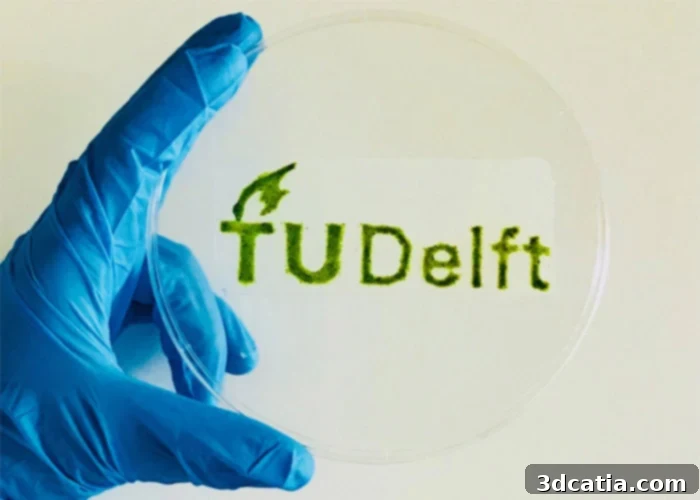
A sample of the bio-printed material showcasing the innovative integration of living algae (photo credits: TU Delft)
Central to this innovation is the clever integration of two distinct biological components. The research team specifically employed a non-living bacterial cellulose as the foundational scaffold. This compound, naturally produced and secreted by various bacteria, is highly valued in biomaterial science for its exceptional properties. Bacterial cellulose boasts remarkable flexibility, making it adaptable to various shapes and forms, while also possessing significant mechanical strength and the ability to retain its intricate shape even under diverse environmental stresses. These characteristics make it an ideal “envelope” or structural matrix for the delicate living organisms it supports. Its biocompatibility and biodegradability further enhance its suitability for ecological applications, ensuring that the material is not only functional but also environmentally benign throughout its lifecycle.
Onto this resilient bacterial cellulose, the researchers meticulously deposited layers of a specialized bio-ink. This bio-ink was uniquely formulated with living microalgae, carefully suspended to maintain their viability and photosynthetic activity. Microalgae are single-celled organisms renowned for their high photosynthetic efficiency, converting sunlight into chemical energy much faster than many terrestrial plants. The deposition process was achieved using a sophisticated FDM (Fused Deposition Modeling) 3D printer, modified to handle biological materials with the precision required for cellular structures. FDM technology, typically used for thermoplastics, was adapted to extrude the bio-ink layer by layer, accurately positioning the microalgae within the cellulose scaffold. The challenge here lies in ensuring that the living cells remain undamaged and functional throughout the printing process, a feat that requires meticulous control over temperature, pressure, and extrusion speed. This careful orchestration of a non-living structural support with living, photosynthesizing components is where the true innovation lies, as it paves the way for materials that can interact with their environment in unprecedented ways.
The groundbreaking aspect of this research emerges from the synergistic reaction between these two integrated materials. By fusing the microalgae with the bacterial cellulose, the TU Delft researchers have successfully engineered a truly living material. This novel composite inherits the essential photosynthetic quality of the microalgae, allowing it to convert light energy into chemical energy, alongside the superior mechanical strength and structural integrity of the bacterial cellulose. This unique combination creates a material that is not only self-sustaining but also exceptionally durable. Kui Yu, a doctoral student who played a pivotal role in this transformative work, eloquently explains the core principle: “We created a material that can produce energy simply by placing it into the light. The biodegradable nature of the material itself and the recyclable nature of microalgal cells make it a sustainable living material.” This statement encapsulates the profound implications of their discovery. The resulting material is not only exceptionally robust and durable but also inherently environmentally friendly. Its biodegradable properties ensure that it can naturally decompose without harming ecosystems at the end of its lifecycle, while the recyclable nature of the microalgal cells presents a pathway for resource efficiency. Furthermore, the ease of production, leveraging established 3D printing techniques and readily available biological components, makes this innovation highly scalable and economically viable for future widespread adoption. This self-sustaining characteristic positions it as a frontrunner in the next generation of sustainable materials, offering a compelling alternative to traditional manufacturing processes that often rely on non-renewable resources.
One of the most promising applications identified by the research team is the creation of highly efficient artificial leaves. These bio-printed structures are designed to accurately mimic the complex behavior of natural plant leaves. At their core, artificial leaves replicate the vital process of photosynthesis, a biological marvel that transforms sunlight, water, and carbon dioxide (CO2) into oxygen and usable energy, primarily in the form of carbohydrates (sugars). In natural plants, these sugars are stored and can be converted into various forms of biomass or even serve as a feedstock for biofuels, thus producing sustainable energy. Similarly, these artificial counterparts could generate energy, potentially acting as miniature bio-reactors, offering localized power generation in remote areas or even powering small devices. This capability renders artificial leaves an invaluable asset, particularly in environments hostile to traditional plant growth, and opens doors to new forms of sustainable architecture and product design.
Consider, for instance, the immense challenges associated with establishing human colonies or research outposts in space. The absence of suitable soil, atmosphere, and natural light cycles makes plant cultivation incredibly difficult and resource-intensive. Current space missions rely heavily on resupply missions from Earth for food, oxygen, and other essentials, incurring astronomical costs and logistical complexities. The new material developed by TU Delft presents a revolutionary solution. By sending bio-printed artificial leaves into space, future astronauts could potentially grow plants directly on-site, producing fresh food, generating breathable oxygen, and even synthesizing valuable compounds from the available CO2 and light. This would represent a considerable saving in both time and cost, drastically reducing reliance on Earth-based supply chains and paving the way for truly self-sustaining off-world habitats. This technology could facilitate long-duration missions to Mars or beyond, making humanity’s expansion into the cosmos more feasible and less dependent on Earth’s finite resources. The ability to locally generate resources would significantly enhance astronaut safety and mission autonomy.
Furthermore, the ability of these materials to efficiently convert carbon dioxide, a major greenhouse gas and driver of climate change, into useful oxygen and energy has profound implications for terrestrial applications. It opens up exciting possibilities for large-scale carbon capture technologies, where entire surfaces or structures could be engineered to absorb CO2 from the atmosphere, effectively purifying the air. Imagine facades of buildings acting as giant air filters, or bio-reactors that convert industrial emissions into biomass or oxygen. This offers a tangible solution in the global effort to mitigate the effects of global warming and promote a healthier planetary environment. Beyond CO2 reduction, these materials could contribute to sustainable energy grids by acting as biological fuel cells, producing clean energy through biochemical processes. Their adaptability also suggests potential in environmental remediation, such as purifying water or soil through targeted biological reactions. The overall impact on reducing humanity’s ecological footprint could be immense, fostering a more circular and regenerative economy.
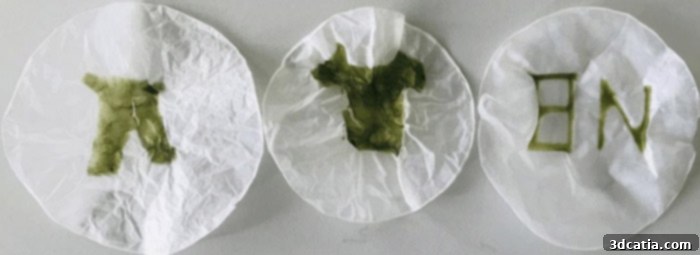
Microalgae 3D bioprinted on bacterial cellulose after one month of incubation, demonstrating the viability and growth of the living material (photo credits: TU Delft)
Beyond the immediate applications, this research inspires a profound re-evaluation of our relationship with manufactured objects. Elvin Karana, a key participant in the project, poses a thought-provoking question that delves into the philosophical and design implications: “What if our everyday products were alive: could sense, grow, adapt, and eventually die?” This is not merely a hypothetical scenario confined to speculative design; as this unique collaborative project vividly demonstrates, it is increasingly within the realm of scientific possibility. The concept of “living products” opens up entirely new avenues for design, where products could repair themselves, respond to environmental stimuli, or even evolve over time. Imagine self-healing architectural elements, responsive textiles that adapt to temperature changes, or packaging that composts itself after use, actively contributing to nutrient cycles. Such materials could drastically reduce waste, extend product lifecycles, and introduce unprecedented levels of environmental integration, moving us towards a future where our objects are dynamic partners rather than static commodities. The TU Delft team expresses a clear hope that their article will ignite fresh dialogues between the design and scientific communities, bridging disciplines that traditionally operate in silos. They envision inspiring new investigative directions for future photosynthetic living materials, fostering innovations that could redefine sustainability, resource management, and even our understanding of life itself in engineered systems. This convergence promises a future where our creations are not just functional, but living, dynamic components of a circular economy.
In conclusion, the pioneering work at TU Delft represents a significant leap forward in the field of sustainable materials and bioprinting. By successfully engineering a photosynthetic living material from bioprinted algae and bacterial cellulose, researchers have laid the groundwork for innovations that could address some of humanity’s most pressing challenges, from climate change mitigation through carbon capture to enabling long-duration space missions with self-sustaining life support systems. The potential of these biodegradable, self-regenerating materials is vast, promising a future where products are not merely consumed but actively contribute to a healthier planet. This groundbreaking development reaffirms the power of interdisciplinary research and the boundless potential of biomimicry in driving technological progress, offering a beacon of hope for a more sustainable and technologically advanced future.
For those eager to delve deeper into the specifics of this remarkable achievement, further information is readily available in the official press release from TU Delft, which can be accessed HERE.
*Thumbnail photo credits: iStock / greenleaf123
What are your thoughts on this revolutionary new living material developed using advanced bioprinting techniques? We invite you to share your insights in a comment below or join the conversation on our vibrant Facebook and Twitter pages! Don’t miss out on the latest advancements and news in the world of 3D printing; remember to sign up for our free weekly Newsletter, delivering all the essential updates directly to your inbox!