
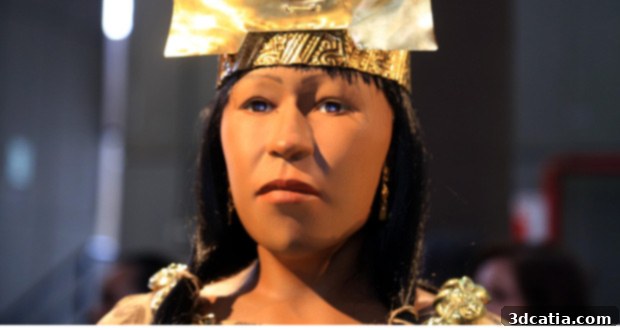
Unveiling Ancient Peru’s Power: The Lady of Cao’s Face Reconstructed with 3D Printing
History has taken a fascinating leap forward, offering an unprecedented glimpse into the life of an ancient female leader who commanded respect in Peru some 1,700 years ago. Thanks to the groundbreaking application of 3D printing technology, scientists have successfully reconstructed the face of the enigmatic Lady of Cao, a discovery that has captivated archaeologists and historians worldwide since her unearthing in 2006. Her mummified remains were found nestled within the ruins of a pyramid complex near the modern-day city of Trujillo, providing an extraordinary window into the advanced Moche civilization that once flourished along Peru’s arid northern coast.
The journey to bring the Lady of Cao’s visage back to life was a meticulous and demanding endeavor. Following the initial discovery of her remarkably preserved mummified remains by a dedicated team of Peruvian archaeologists, a multidisciplinary group of experts converged. This team, comprising forensic anthropologists, archaeologists, and 3D imaging specialists, worked tirelessly over ten months. Their collaborative efforts harnessed a powerful combination of cutting-edge technologies: state-of-the-art 3D laser scanning captured the intricate details of her skull, forensic facial reconstruction techniques applied scientific principles to anatomical structures, and extensive reference was made to photographs of contemporary women from the El Brujo region, the very area where the Lady of Cao once lived and ruled. This meticulous fusion of science and art ultimately allowed the team to resurrect the face of this ancient potentate, connecting the past to the present in a profoundly visual manner.
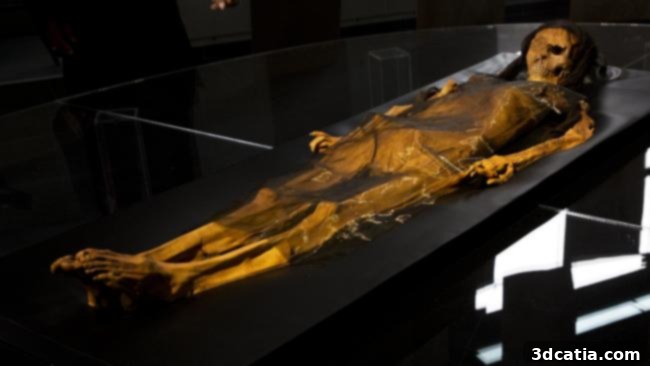
Lady of Cao’s mummified remains offered a rare window into Moche civilization.
A Collaborative Feat: Technology Meets Ancient History
The success of this ambitious project was a testament to international and inter-organizational collaboration. The El Brujo Archaeological Complex, the primary research and conservation entity for the archaeological site, joined forces with the Wiese Foundation, a non-profit organization dedicated to Peru’s cultural heritage, and FARO Technologies, a global leader in 3D measurement, imaging, and realization solutions. This powerful alliance provided the necessary resources and technical expertise. By carefully analyzing her cranial structure and other skeletal remains, the team was able to recreate her distinct facial features, characterized by an oval shape and prominent high cheekbones, which we can now observe with remarkable clarity. This synergy between historical preservation and advanced technological application highlights a new era in archaeological exploration and cultural heritage management.
The unveiling of the Lady of Cao’s reconstructed face was met with widespread excitement, underscoring the profound impact of such discoveries. Salvador del Solar, who served as Peru’s Minister of Culture at the time of the announcement, eloquently articulated the significance of this achievement. “We are privileged to announce this strange combination of the future and the past,” he stated, capturing the essence of the project. “Technology has allowed us to see the face of a political and religious leader from a culture from the past.” His words perfectly encapsulated the convergence of ancient history with modern innovation, emphasizing how technological advancements are not merely tools for efficiency but powerful instruments for historical understanding and cultural connection. This reconstruction goes beyond a mere visual representation; it symbolizes a bridge across millennia, connecting contemporary society with its ancestral roots.
Thanks to 3D printing, researchers were able to recreate the face of this ancient leader, offering a new perspective on Moche royalty.
Redefining History: The Impact of a Female Leader
The discovery and subsequent facial reconstruction of the Lady of Cao represent a monumental milestone in the preservation and documentation of Peruvian history. Dating back more than 1,300 years, her existence provides invaluable insights into the Moche civilization, a pre-Incan culture renowned for its sophisticated artistry, intricate irrigation systems, and complex social structures. This finding offers the people of Peru a tangible link to their distant past, allowing them to visualize a leader from an era often shrouded in mystery. Alongside her remains, archaeologists uncovered numerous artifacts, including weapons, ceremonial items, and elaborate textiles, which collectively paint a richer picture of daily life, warfare, and ritual practices during her time. These accompanying discoveries further enhance our understanding of the cultural context in which she lived and ruled.
Perhaps one of the most significant contributions of the Lady of Cao’s discovery is its profound impact on our understanding of women’s roles in ancient societies. Prior to her unearthing, a prevailing belief held that men were the exclusive holders of positions of power and authority within the Moche hierarchy. However, the opulent nature of her burial – adorned with golden crowns, nose rings, and a lavish burial shroud, alongside an array of weapons – unequivocally indicates her status as a high-ranking ruler, possibly even a warrior priestess. This revelation fundamentally challenges previous historical assumptions, shedding new light on the influential roles women could attain in ancient Peruvian civilizations. The Lady of Cao stands as a powerful symbol, inspiring generations by demonstrating that female leadership was not only possible but actively embraced and revered in certain ancient cultures. Her story provides a compelling counter-narrative to traditionally male-dominated historical interpretations, encouraging a re-evaluation of gender dynamics in pre-Columbian societies.
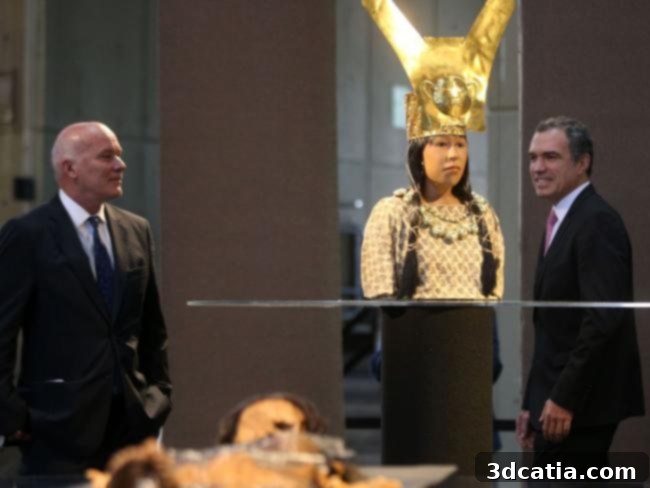
Peru’s Foreign Commerce and Tourism Minister Eduardo Ferreyros and Peru’s Minister of Culture Salvador del Solar, proudly present a replica of The Lady of Cao’s face at the Ministry of Culture in Lima, Peru, symbolizing national heritage and technological advancement.
The Enduring Legacy of the Lady of Cao
While the Lady of Cao’s life was tragically cut short, with scientists speculating that her demise was due to complications during childbirth, her legacy endures and continues to grow. Her mummified remains, preserved with incredible detail due to the arid conditions of the desert, provide invaluable biological data. Studies of her bones and tissues not only offer clues about her health and diet but also contribute to a broader understanding of disease patterns and medical practices in ancient Moche society. This latest finding is instrumental in helping archaeologists and historians piece together the intricate mosaic of the Peruvian people’s past. Each discovery at El Brujo, particularly those related to the Lady of Cao, adds another layer to our comprehension of a sophisticated civilization that thrived millennia ago. By uncovering these fragments of history, the project fosters a deeper sense of cultural identity and shared heritage among Peruvians, bringing them all closer through a profound and tangible connection to their ancestral history.
The advanced techniques employed in the Lady of Cao’s facial reconstruction, particularly the role of 3D printing and scanning, underscore the transformative power of modern technology in archaeological research. These tools not only facilitate detailed analysis of delicate ancient remains without causing damage but also enable the creation of highly accurate replicas that can be safely displayed and studied by the public and researchers alike. This accessibility is crucial for educational purposes, allowing students and visitors to engage directly with history in a way that traditional museum exhibits might not permit. The process of digitally archiving and then physically reproducing such historical artifacts also ensures their preservation for future generations, safeguarding cultural heritage against the ravages of time and environment. The Lady of Cao project serves as a shining example of how technology can bridge the gap between ancient mysteries and contemporary understanding, breathing new life into historical narratives and inspiring a renewed appreciation for human ingenuity across different eras.
The resurrection of the Lady of Cao’s face with 3D printing technology is more than just a scientific achievement; it’s a powerful cultural moment, reigniting interest in ancient civilizations and demonstrating the endless possibilities when innovation meets history. What do you think of this incredible achievement and the insights it provides into ancient female leadership? Let us know your thoughts and engage in the conversation by leaving a comment below or by reaching out to us on our Facebook and Twitter pages. To stay informed about all the latest advancements and groundbreaking applications in the world of 3D printing, don’t forget to sign up for our free weekly Newsletter, delivering the most relevant news directly to your inbox!