
Revolutionizing Air Mobility: How 3D Printed Microvanes Enhance C-17 Globemaster III Fuel Efficiency and Operational Range
The pursuit of enhanced aerodynamic efficiency is a constant in aviation, particularly for large transport aircraft like the C-17 Globemaster III. Reducing drag is paramount as it directly translates into significant improvements in fuel consumption, extended operational ranges, and even increased aircraft speed. In a groundbreaking development, additive manufacturing, commonly known as 3D printing, is proving to be a key enabler in this endeavor. The United States Air Force (USAF), through its Air Force Operational Energy and Air Mobility Command, is currently in the final stages of evaluating the integration of innovative 3D printed microvane drag reduction technology onto its vital C-17 Globemaster III fleet.
The C-17 Globemaster III, a formidable military transport aircraft, has been a backbone of USAF operations since its introduction in 1995. Although the production of new C-17s concluded in 2015, these aircraft remain indispensable assets, crucial for global troop transportation, strategic airlift, and humanitarian missions. Given their continued importance and extensive service life, the USAF is committed to continuously optimizing the performance of its existing C-17 fleet. This commitment drives initiatives aimed at extending their utility and efficiency, making the introduction of advanced solutions like microvanes critically important for maintaining strategic superiority and operational readiness.

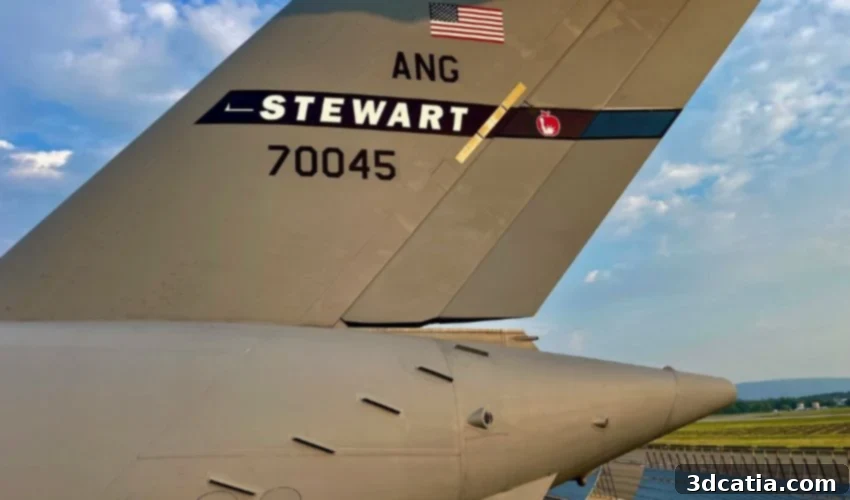
A C-17 Globemaster III with microvanes successfully installed waiting on the flight line at Steward Air National Guard Base
Unlocking Efficiency with 3D Printed Microvanes: A Detailed Look
So, what exactly are these game-changing devices? The 3D printed microvanes are precision-engineered aerodynamic components, typically measuring around 4 x 16 inches. Their design is reminiscent of a slender blade, crafted to strategically redirect airflow. A series of approximately a dozen such microvanes are meticulously attached to the aft section of the C-17’s exterior, specifically near the cargo door area, utilizing a robust adhesive bonding for secure placement. This innovative project is the culmination of extensive research and development, fostered through a collaborative partnership between the Air Force Research Laboratory, leading private industry partners specializing in additive manufacturing, and the Air Force Lifecycle Management Center. This interdisciplinary effort highlights the strategic importance of leveraging diverse expertise to bring advanced technologies from concept to operational reality.
The results achieved from the implementation of these 3D printed microvanes have been nothing short of astonishing and immensely promising. C-17 Globemaster III aircraft outfitted with this technology are demonstrating a consistent one-percent reduction in aerodynamic drag when compared to their unmodified counterparts. While a one-percent reduction might seem modest at first glance, its implications for an aircraft of the C-17’s scale and operational tempo are profound. This seemingly small improvement translates directly into significantly enhanced fuel efficiency, empowering the aircraft to extend its mission range without requiring additional fuel stops. The key to this success lies in the microvanes’ ability to mitigate the aerodynamic drag generated by the unique design of the cargo door section, a known source of airflow turbulence. By smoothing the airflow and delaying flow separation, the microvanes minimize energy loss. With such a substantial impact on fuel consumption across an entire fleet, the widespread adoption of 3D printed microvanes is projected to yield annual savings exceeding $14 million for the USAF, representing a significant return on investment and a tangible contribution to defense sustainability.
Roberto Guerrero, the Deputy Assistant Secretary of the Air Force for Operational Energy, Safety, and Occupational Health, underscores the strategic importance of these advancements. He eloquently states, “Every gallon of fuel saved strengthens our readiness and operational effectiveness.” This statement encapsulates the multifaceted benefits that extend far beyond mere financial savings. By integrating modern, cutting-edge technologies like microvanes into established, legacy aircraft, the Air Force not only achieves millions in fuel cost reductions but also critically enhances its operational capabilities. This proactive approach is essential for maintaining a competitive edge in an era characterized by intensifying global competition, ensuring that the USAF remains agile, efficient, and prepared for future challenges. The ability to optimize existing assets through additive manufacturing demonstrates a forward-thinking strategy for military modernization.
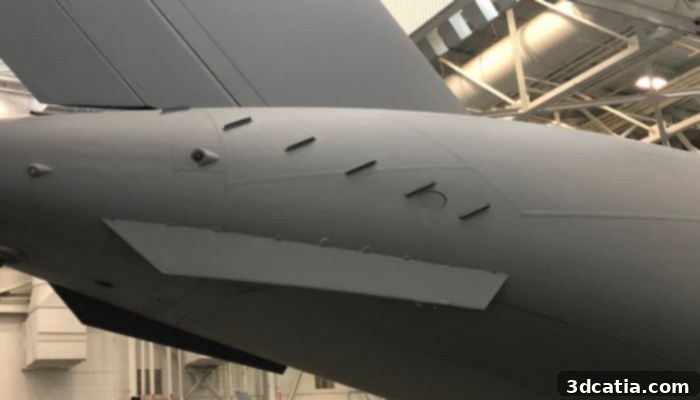
A close up of the 3D printed drag reducers at back of a plane
Scaling Up: From Assessment to Fleet-Wide Deployment and International Interest
The implementation roadmap for these innovative microvanes is meticulously planned. Currently, six C-17 aircraft have been modified as part of the Logistics Service Assessment (LSA), which represents the critical final evaluation phase preceding a full, fleet-wide deployment. According to a recent press release from the USAF, this six-month LSA will officially commence once two additional aircraft have undergone the microvane modification. The overarching objective is to seamlessly integrate microvane technology across the entire C-17 fleet, maximizing the benefits of drag reduction and fuel efficiency. Furthermore, the impact of this project is not confined to the United States alone. The substantial financial savings realized and the notable increase in operational capability have garnered considerable international attention, with both Canada and the United Kingdom expressing strong interest in incorporating these 3D printed microvanes onto their respective C-17 fleets, highlighting the universal appeal of such an effective and cost-efficient upgrade.
The USAF further emphasizes that the deployment of these 3D printed drag reducers offers strategic advantages that go beyond mere fuel savings. They are expected to significantly alleviate logistical constraints, enabling extended mission distances and thus contributing to superior operational readiness in complex environments. The reduction in fuel consumption, facilitated by the microvanes, is anticipated to bolster the ability to sustain critical operations in contested airspace and geographical regions. This enhancement directly contributes to a more robust and resilient supply chain, essential for projecting power and maintaining presence globally. Ultimately, this pioneering project represents a monumental leap forward in optimizing the performance and longevity of legacy aircraft, showcasing additive manufacturing as a vital tool for military modernization and efficiency.
In his concluding remarks, Roberto Guerrero thoughtfully reflects on the broader implications of this success: “This collaboration highlights how partnerships drive forward our mission objectives. It’s about ensuring that we remain agile and capable in a rapidly evolving global environment. What’s more, through recent legislation, we can use the savings realized by this technology to fund other initiatives that increase combat capability.” This statement not only underscores the power of synergy between government, research institutions, and private industry but also points to a sustainable model where technological innovation directly fuels further investment in combat readiness and strategic development, creating a virtuous cycle of advancement within the Air Force.
What are your thoughts on these innovative 3D printed drag reducers and their potential to transform military aviation? How else do you foresee the USAF leveraging the capabilities of additive manufacturing for future projects or existing fleets? We encourage you to share your insights and comments below or engage with us on our LinkedIn, Facebook, and Twitter pages! For those interested in delving deeper into the applications of 3D printing within the aerospace and defense sectors, be sure to explore our dedicated resource page HERE. Don’t miss out on the latest advancements and news by signing up for our free weekly Newsletter here, delivered straight to your inbox! Additionally, you can discover all our insightful videos and content on our YouTube channel.
*All Photo Credits: USAF