
Top 5 3D Printing Innovations: Weekly Video Roundup of Additive Manufacturing Applications
Welcome to our weekly Sunday special, where we dive into the most exciting developments and practical applications in the world of 3D printing. This week, we’ve curated a compelling collection of five videos showcasing how additive manufacturing is pushing boundaries across various industries, from aerospace engineering to competitive sports and efficient production. Discover how essential post-processing enhances professional parts, witness students leveraging 3D printing for record-breaking rocket designs, and explore the power of on-demand manufacturing partnerships with Siemens. We’ll also see how companies like Cobb Tuning integrate Markforged technology for robust tooling and how USA Luge gains a competitive edge with advanced 3D printing solutions. Join us for an insightful journey into the cutting-edge of 3D printing. Happy Sunday and happy watching!
Top 1: Mastering Post-Processing for Professional 3D Printed Parts
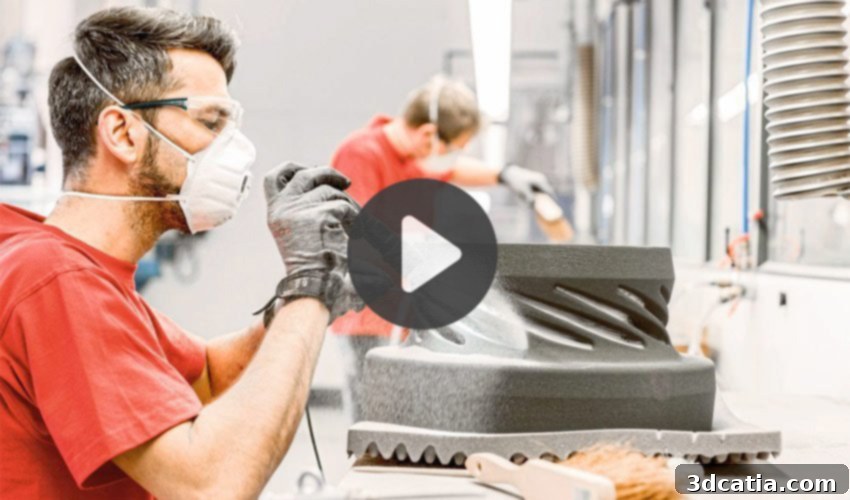
For anyone deeply involved in additive manufacturing, whether as a hobbyist or a professional, the understanding that the printing process is often just the beginning is crucial. Achieving a functional, aesthetically pleasing, and durable final product frequently necessitates a critical post-processing stage. Hawk Ridge Systems, a renowned U.S.-based company specializing in comprehensive 3D printing and design solutions, sheds light on this vital phase. Their insightful video explores a range of techniques designed to finalize 3D printed parts, enhancing their performance and appearance to meet stringent professional standards.
The video delves into several common post-processing methods, including painting, tinting, and steam smoothing. Painting allows for custom coloration and protective coatings, opening up vast possibilities for visual appeal and environmental resistance. Tinting, often applied to translucent or transparent materials, can impart vibrant colors while maintaining light-transmitting properties. Steam smoothing, a particularly effective technique for materials like ABS, significantly improves surface finish by creating a smooth, glossy exterior, reducing layer lines and enhancing part strength. Beyond these, other crucial techniques not explicitly detailed but often employed include support structure removal, sanding, polishing, infiltration to improve mechanical properties, and heat treatment to relieve internal stresses. Understanding and correctly applying these post-processing steps are paramount to transforming raw 3D prints into high-quality, end-use parts, expanding their utility across diverse industrial applications and ensuring they meet the exact specifications required by demanding professions.
Top 2: Swiss Students Propel Innovation with 3D Printed Rocket Parts
Innovation in aerospace is not solely the domain of large corporations; it thrives in academic environments, particularly within programs like the one offered by ARIS to students at Swiss universities. Each year, ARIS challenges students to embark on ambitious aerospace projects, pushing the boundaries of design and engineering within tight timelines. This compelling video highlights the incredible achievements of ARIS PICCARD, a dedicated student group tasked with designing and building a hybrid rocket in less than a year. Their efforts culminated in a record-breaking launch, with their rocket soaring over 6 kilometers into the sky.
To achieve such a feat and rapidly iterate through multiple prototypes, the students strategically leveraged the power of 3D printing. For initial testing and many functional components, they opted for Fused Deposition Modeling (FDM), a versatile and accessible additive manufacturing process known for its speed and cost-effectiveness in producing complex geometries. This allowed for quick design modifications and validation. For more structurally demanding parts, such as the crucial hinge mechanism of the rocket’s hatch, the team turned to Selective Laser Sintering (SLS). SLS is a sophisticated powder bed fusion technology that enables the production of incredibly lightweight, strong, and intricate components, allowing for the integration of multiple functions into a single part. This capability is critical in aerospace where weight reduction and part consolidation are paramount for performance. The successful application of both FDM and SLS demonstrates the transformative potential of 3D printing in educational and research settings, empowering the next generation of engineers to achieve extraordinary goals. Dive deeper into their journey and the technical specifics in the video below!
Top 3: Empowering Businesses with Additive Manufacturing On Demand
One of the most significant and transformative advantages offered by additive manufacturing, and specifically 3D printing technologies, is the unparalleled ability to produce parts swiftly and, crucially, on demand. This paradigm shift from traditional manufacturing methods empowers businesses to respond with unprecedented agility to market fluctuations and specific client requirements. The third video in our roundup spotlights a powerful partnership between Kaizen PLM and Siemens, illustrating how they are collaboratively bringing on-demand 3D printed parts to a global customer base with incredibly diverse and often urgent needs.
Kaizen PLM, in collaboration with Siemens’ extensive expertise, leverages a vast and specialized network of professionals within the additive manufacturing industry. This network comprises skilled designers, engineers, and production facilities equipped with state-of-the-art 3D printing technology, capable of handling a wide array of materials and technical specifications. When a critical component is needed, or a specific part goes missing from a supply chain, this innovative partnership ensures that the required item can be designed, produced, and delivered significantly faster than conventional manufacturing and logistics would allow. This model drastically reduces lead times, minimizes inventory overheads, and offers unparalleled customization opportunities. It enables businesses to avoid costly downtime, accelerate product development cycles, and maintain lean operational structures by only producing parts exactly when and where they are needed. The video provides a fascinating look into the seamless process behind this efficient, demand-driven additive manufacturing ecosystem, showcasing its profound impact on modern industrial operations.
Top 4: Real-World Applications: Using Benchmarks for Additive Manufacturing Success
In the fast-paced world of technological innovation, it’s common for companies to make ambitious claims about the transformative potential of their products. However, discerning whether these promises genuinely align with specific business needs can be a challenge. Our fourth video presents a compelling case study, featuring Markforged and Cobb Tuning, a company renowned for crafting high-performance enhancement components for automotive enthusiasts. This segment explains precisely why Cobb Tuning chose to integrate the Markforged platform for their durable production tooling, moving beyond mere prototyping to streamline their manufacturing processes effectively.
Cobb Tuning had already embraced 3D printing for rapid prototyping and initial product development, recognizing its benefits in accelerating design iterations. However, their highly dynamic product release cycle demanded a solution that could not only keep pace but also provide robust, functional tools for production. Traditional tooling methods often involve long lead times, high costs, and limited design flexibility, which were significant bottlenecks for Cobb Tuning’s agile operations. By adopting Markforged’s composite 3D printing technology, known for producing incredibly strong and stiff parts, Cobb Tuning gained the ability to produce custom jigs, fixtures, and other production aids in-house, on demand. This strategic shift resulted in substantial cost savings, dramatically reduced lead times for new tooling, and the flexibility to create highly optimized, application-specific tools. The video vividly demonstrates how leveraging Markforged’s additive manufacturing capabilities enabled Cobb Tuning to overcome production challenges, enhance efficiency, and maintain a competitive edge in a demanding market, proving that the right technology, benchmarked against real-world needs, can truly revolutionize manufacturing workflows.
Top 5: USA Luge Gains a Competitive Edge with Stratasys 3D Printing Technology
While this next video might be a little older than our typical weekly features, its relevance, especially in honor of the recent Winter Olympics, makes it a timeless insight into the power of 3D printing in elite sports. Luge, a high-octane winter sport, involves athletes hurtling down an icy track on a specialized sled at extreme speeds, often reaching over 90 miles per hour. In a sport where outcomes are measured to the thousandth of a second, every fractional advantage, every ergonomic detail, and every aerodynamic improvement can be the difference between victory and defeat. This intense demand for precision and performance led USA Luge to embrace cutting-edge technology.
To stay ahead of the fiercely competitive international field, USA Luge strategically turned to 3D printing, specifically leveraging Fused Deposition Modeling (FDM) technology from Stratasys. Stratasys’ FDM printers are renowned for their ability to produce highly durable, functional parts from a wide range of engineering-grade thermoplastics. For USA Luge, this meant the capability to rapidly prototype and test various sled components, including customized handles, aerodynamic fairings, and ergonomic fittings tailored precisely to individual athletes. The iterative design process enabled by FDM allowed their engineers to experiment with numerous configurations, quickly identify optimal designs for speed and control, and produce bespoke parts that perfectly matched the unique body mechanics of each luge competitor. This level of customization and rapid development is virtually impossible with traditional manufacturing methods. By integrating Stratasys 3D printing into their development workflow, USA Luge has been able to fine-tune their equipment, enhance athlete comfort and performance, and ultimately gain that crucial competitive edge necessary to excel on the global stage. Discover the full story behind their technological advantage in the video from Stratasys below.
What were your thoughts on this week’s collection of transformative 3D printing videos? Have you had personal experience with any of these innovative post-processing techniques, or perhaps utilized additive manufacturing for demanding applications like aerospace components or robust tooling? We’d love to hear your insights and experiences! Share your comments below or connect with us on our social media platforms: Linkedin, Facebook, and Twitter. Don’t miss out on the latest advancements and news in the additive manufacturing industry – make sure to sign up for our free weekly Newsletter here, delivering the freshest 3D printing updates directly to your inbox. You can also explore our entire library of captivating videos by visiting our official YouTube channel. Stay informed and inspired!