
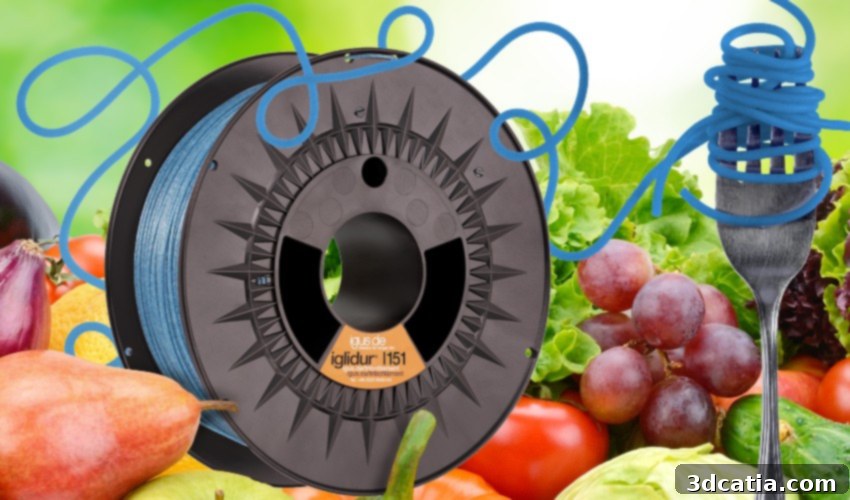
Advancing Food Safety with igus: Innovations in Food-Grade 3D Printing Plastics for Hygienic Processing
In today’s globalized food supply chain, ensuring public health and safety is paramount. From primary food processing facilities to bustling supermarket aisles, the omnipresence of germs and pathogens necessitates rigorous hygiene standards. Regulatory bodies like the EU and the US Food and Drug Administration (FDA) have established comprehensive guidelines to minimize the risk of contamination and disease transmission. Beyond operational and product hygiene protocols, there’s a growing demand for innovative materials – particularly plastics – that not only meet these stringent standards but also facilitate the detection of any potential material residues in food products. These advanced materials play a crucial role in safeguarding both consumers and the environment.
Addressing this critical need, igus GmbH, a global leader in energy chain systems and polymer plain bearings, has dedicated significant resources to developing high-performance, food-grade plastics. Their extensive range of materials includes specialized polymers designed for direct contact with food, making them ideal for use in modern food processing machinery and production environments. To delve deeper into igus’s pioneering work with 3D printing polymers for food applications, we had the opportunity to speak with Tom Krause, Head of Additive Manufacturing at igus, in an illuminating interview.
3DN: Can you briefly introduce yourself and your connection to 3D printing?

My name is Tom Krause, and I lead the Additive Manufacturing business unit at igus GmbH. My journey with additive manufacturing began in 2013, initially as a personal interest. Soon after, I brought this passion to igus, focusing on the development of self-lubricating plain bearing materials specifically tailored for 3D printing. This quickly evolved into a core part of our business. Today, at our facility in Cologne alone, we additively manufacture an impressive volume of over 150,000 wear parts annually. These include a diverse range of components such as plain bearings, durable plastic gears, and precise drive nuts. Recognizing the global demand and the efficiency of local production, our additive manufacturing capabilities expanded significantly in 2019, with igus subsidiaries in the USA and China also commencing local production of these long-lasting plastic components using 3D printing technology.
3DN: The igus material range includes highly specialized food-grade plastics. Could you explain what truly sets these materials apart from conventional alternatives?
At igus, our entire focus revolves around what we term “motion plastics.” These are high-performance tribo-polymers specifically engineered for dynamic, moving applications. Our product portfolio is incredibly diverse, encompassing components like plain bearings, gear wheels, innovative drive nuts, specialized sliders, robust energy chains, and even cost-effective robotic solutions. This broad range highlights the versatility and adaptability of our materials. What fundamentally distinguishes all igus plastics, including our advanced 3D printing materials, is their inherent self-lubricating property and their exceptional wear resistance—they are up to 50 times more abrasion-resistant than many standard 3D printing materials available on the market. This unique combination of properties is our core differentiator in the additive manufacturing landscape. For our food-grade plastics, we build upon these foundational characteristics. The critical additional distinction is that these materials are also fully compliant with stringent food safety regulations, specifically the FDA guidelines in the United States and the EU 10/2011 regulation across Europe. This dual compliance ensures that our components can be safely and reliably integrated into food processing machinery worldwide, eliminating the need for external lubricants and significantly reducing the risk of contamination while maintaining optimal performance.
3DN: This year, igus introduced a notable addition to its lineup: the blue, food-compliant iglidur I151 tribofilament. What specific advancements or differences does this material offer?
The iglidur I151 represents a significant evolution, building upon the proven success of our existing iglidur I150 material. The iglidur I150 is widely recognized as our best-selling tribofilament, celebrated for its exceptional ease of processing coupled with remarkable wear resistance. It already meets the demanding food regulations under EU 10/2011, making it a reliable choice for many applications within the European market. However, with the iglidur I151, we’ve expanded its compliance to include FDA approval. This is a crucial distinction, particularly for manufacturers operating or selling their products outside the EU, where FDA compliance is often a mandatory requirement. The ability to meet both EU 10/2011 and FDA standards significantly broadens the global applicability of this material, offering greater flexibility and market access for our customers.
Furthermore, a key characteristic of iglidur I151 is its distinctive blue coloration. This is not merely an aesthetic choice but a deliberate functional feature, as blue is the universally recognized color required in the food processing industry. The blue hue greatly enhances the optical detectability of any detached plastic residues in food products. Should a tiny fragment of the material somehow break off during operation, its bright blue color makes it immediately noticeable during visual inspection, significantly reducing the risk of unnoticed contamination. This critical feature underscores our commitment to providing materials that not only perform exceptionally but also enhance the safety protocols in food manufacturing environments.
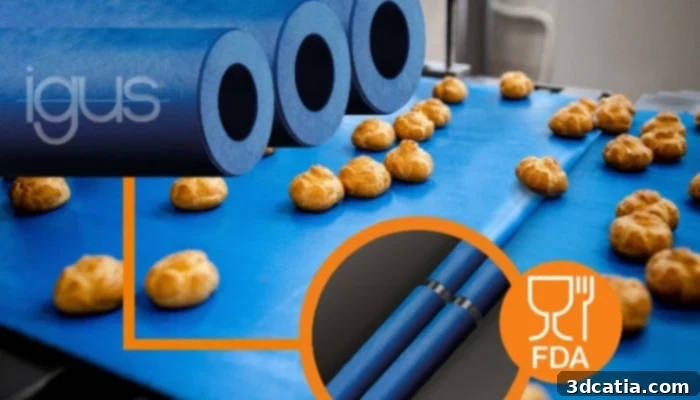
The iglidur I151 is FDA-compliant. (Picture credits: igus)
3DN: What specific applications can igus’s iglidur I151 tribofilament be utilized for? Can you provide some concrete examples of its impact?
The iglidur I151 tribofilament truly excels in demanding environments, particularly within food processing plants. Its exceptional combination of food conformance, effortless processing characteristics, and superior wear resistance makes it an ideal choice for a wide array of components that require durability and hygiene. We see it being particularly valuable for the production of essential moving parts such as plain bearings, precision gears, robust drive nuts, custom grippers, and virtually any other wear-resistant element critical to the smooth operation of food processing machinery. Imagine its application in bottling lines, packaging equipment, conveyor systems, or even mixing and stirring apparatus where traditional materials might fail or pose contamination risks.
Beyond new machine construction, iglidur I151 offers immense benefits to operators of existing food processing facilities. Its compatibility with 3D printing means that critical spare parts can be produced quickly and efficiently on-site. This capability drastically reduces machine downtimes, which are incredibly costly in the food industry, and ensures continuous production flow while maintaining strict hygiene standards. For instance, if a unique gear or bearing fails on a Sunday, it can be printed overnight and installed by Monday morning, avoiding prolonged operational halts. To further support manufacturers in this rapid prototyping and production, igus provides intuitive CAD configurators. These tools empower engineers to quickly generate accurate 3D models of custom parts, streamlining the design-to-production workflow and enabling swift, localized manufacturing of tailor-made components.
3DN: What specific considerations should users keep in mind regarding the storage and printing of food-grade plastics like iglidur I151?
When working with food-grade plastics, particularly for 3D printing, vigilance regarding contamination and proper material handling is paramount to ensuring both print quality and safety compliance. The primary consideration is to prevent the filament from becoming contaminated at any point. This means that all tools, surfaces, and printer components that come into contact with the filament—from the spool holder to the extruder and nozzle—must be meticulously clean and free of any residues from other plastics, oils, or foreign particles. It’s often advisable to dedicate specific tools or cleaning procedures solely for food-grade materials.
Beyond cleanliness, dry storage is absolutely crucial for filaments, especially hygroscopic polymers like those used in 3D printing. Plastics can absorb moisture from the ambient air, and this absorbed moisture can severely degrade the material during the heating and melting process in the printer’s nozzle. When moist filament is extruded, the water rapidly vaporizes, leading to air inclusions, bubbles, and inconsistencies in the printed part. This phenomenon, known as hydrolysis, can compromise the mechanical integrity, surface finish, and overall quality of the final component. For food-grade parts, such imperfections are unacceptable as they can create crevices where bacteria might harbor or lead to premature part failure. Therefore, storing filaments in sealed, airtight containers with desiccant packets is highly recommended. Drying the filament before printing, often in a dedicated filament dryer or a standard household convection oven, helps remove absorbed moisture. A good rule of thumb for drying temperature is to select a temperature that is below the maximum application temperature of the plastic to prevent degradation, but also low enough not to damage the plastic spool itself. Following the manufacturer’s specific recommendations for drying times and temperatures will ensure optimal material performance and print quality.
3DN: Does igus plan to develop other food-grade plastics in the future?
Absolutely. Innovation is a cornerstone of igus’s philosophy, and we are continuously investing in research and development to expand our portfolio of advanced plastics and optimize our manufacturing processes. Our aim is to make our 3D printing offering even more versatile and attractive to a broader range of industries, especially within the demanding food processing sector. One of our immediate next projects is the development of new materials that can withstand even higher application temperatures. This is crucial for expanding our suitability into areas of food processing that involve pasteurization, sterilization, or other high-temperature cleaning cycles, where current materials might have limitations.
Furthermore, a significant goal for us is to enhance the predictability and reliability of our materials. We are actively working on expanding and refining our existing service life calculators, which are invaluable tools for engineers. By incorporating more detailed data and sophisticated algorithms, we aim to make these calculators even more precise for 3D printed bearings and 3D printed gears. This improved predictability allows our customers to design with greater confidence, accurately forecast component lifespan, optimize maintenance schedules, and ultimately achieve greater operational efficiency and cost savings. This commitment to both material innovation and predictive engineering ensures that igus remains at the forefront of providing durable, safe, and highly reliable solutions for the food industry.
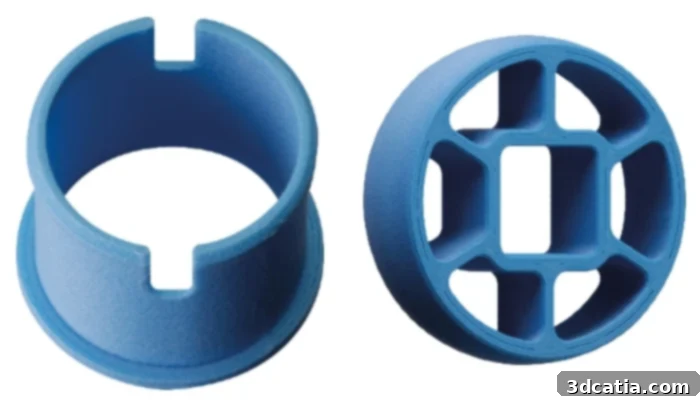
Parts printed with the iglidur I151 (Photo credit: igus)
3DN: Do you have any last words for our readers?
To conclude, I would like to emphasize a critical point for all our readers: while not every single component in every construction requires the extraordinary wear-free properties of igus’s Tribo plastics, their value becomes undeniable in applications involving significant movement and friction. In such scenarios, investing in these advanced, self-lubricating polymers is not just a choice, but a strategic decision that makes your application considerably more durable and reliable. The longevity and consistent performance of parts made from our materials can significantly reduce maintenance, minimize unexpected breakdowns, and ensure continuous operation—factors that are paramount in competitive industries. After all, even the most beautifully engineered and innovative idea loses its utility and impact if its physical components fail prematurely. Choosing the right material for moving parts ensures that your innovations endure and perform as intended, for a much longer time.
Have you already integrated igus’s food-grade plastics into your operations? We’d love to hear about your experiences! Share your insights in a comment below or connect with us on our Facebook, Twitter, and LinkedIn pages. Don’t miss out on the latest advancements in 3D printing technology—sign up for our free weekly Newsletter here to get all the news delivered straight to your inbox!
*Thumbnail Photo Credits: igus