
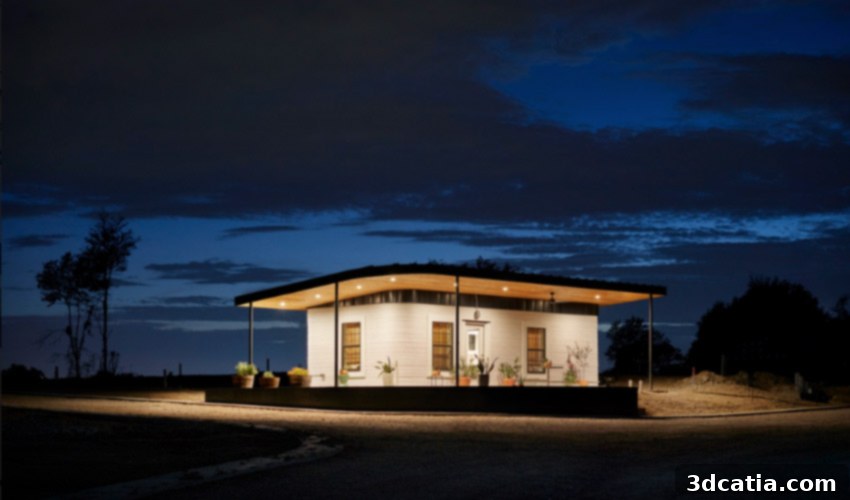
ICON’s Vision: Revolutionizing 3D Printed Homes on Earth and Beyond – An Exclusive Interview with CTO Alex Le Roux
The 3D printing construction sector has experienced unprecedented growth and innovation in recent months, capturing global attention. With a burgeoning demand for advanced methods to deliver more resilient, affordable, and rapidly constructed homes, the future of this industry appears exceptionally promising. At the forefront of this transformative movement is ICON, a U.S.-based pioneer dedicated to pushing the boundaries of construction technology. ICON integrates cutting-edge 3D printing robotics, sophisticated software, and advanced materials to redefine how structures are built, not just on Earth, but also in the challenging environments of space.
To delve deeper into the company’s ambitious goals, current groundbreaking projects, and the immense benefits offered by additive manufacturing technologies in construction, we had the exclusive opportunity to connect with Alex Le Roux, the esteemed CTO and Co-Founder of ICON. His insights shed light on the journey, challenges, and future direction of a company poised to leave an indelible mark on humanity’s built environment.
Meet Alex Le Roux: Pioneering Large-Scale 3D Printing
“My name is Alex Le Roux, and I am the co-founder and CTO of ICON,” Alex begins. “Together with my visionary partners, Evan Loomis and Jason Ballard, we established ICON in 2017 with a shared goal: to revolutionize the construction industry.” Alex’s journey into the world of 3D printing began during his college years, where he became deeply immersed in the technology. This early fascination quickly evolved into a professional passion, leading him to found his first company focused specifically on large-scale additive manufacturing. “I was absolutely captivated by the complex yet exhilarating problem of designing and building a giant robot capable of 3D printing an entire house,” he explains. “It was a truly tall order and a significant engineering challenge, but from the very beginning, I believed it was a pursuit well worth undertaking, one that could fundamentally change how we build.”

Alex Le Roux, Co-founder and CTO of ICON
The mission of ICON, since its inception, has been to develop and deploy advanced construction technologies that serve to advance humanity. This involves leveraging the power of 3D printing robotics, sophisticated software platforms, and proprietary advanced materials to create a new paradigm for building. A landmark achievement came swiftly in March 2018, when ICON successfully printed the first permitted, 3D printed home in Austin, TX, in collaboration with the housing nonprofit, New Story. This milestone not only proved the viability of their technology but also underscored its potential for addressing global housing shortages. “Since that pivotal moment, we have proudly 3D printed nearly 20 homes across various locations around the world,” Alex notes, “and we have dozens more innovative projects currently in the pipeline, demonstrating the escalating adoption and impact of our technology.”
The Genesis of ICON: From Research to Revolution
The foundational idea for ICON stemmed from an exhaustive research project Alex undertook in 2014. His objective was to gain a comprehensive understanding of all 3D printers available on the market at that time. What he discovered was a clear limitation: while small-scale printers offered fascinating possibilities, their application in addressing large-scale societal needs, such as housing, was inherently restricted. “I began to hypothesize that if we could scale these printers up by a factor of 100, entirely new and incredibly interesting opportunities would naturally emerge,” Alex recounts. This profound insight ignited a multi-year mission. He embarked on developing his own large-format 3D printer from the ground up, a journey that ultimately led to the creation of the groundbreaking Vulcan 3D printer. This innovative system was dramatically unveiled during SXSW 2018 in Austin, TX, alongside the U.S.’s first permitted, 3D printed home, a moment that marked a significant turning point for both ICON and the wider construction industry.
Introducing the Vulcan 3D Printer: Speed, Scale, and Simplicity
The Vulcan 3D printer stands as a testament to ICON’s commitment to innovation and efficiency. “The Vulcan is essentially a robust, gantry-style printer,” Alex explains. “It is engineered to print homes up to an impressive 2,000 square feet using our proprietary, high-performance material, which we’ve named Lavacrete.” This specialized concrete-based material is formulated for strength, durability, and printability, making it ideal for the rapid construction process. The printer boasts an impressive operational speed, ranging between 4 and 8 inches per second in the horizontal direction. This allows for remarkable efficiency: “It can effortlessly print the entire wall structure of a 500 square foot home in just 24 hours of continuous print-time,” Alex highlights. What truly sets the Vulcan apart is its user-friendly interface. The entire printer system is controlled via an intuitive smartphone application, designed to be operated efficiently by a single individual. On a typical job site, ICON employs a small, dedicated team of 3-4 members who oversee the printing process and manage the crucial Magma material delivery system, ensuring seamless and synchronized operations from start to finish.
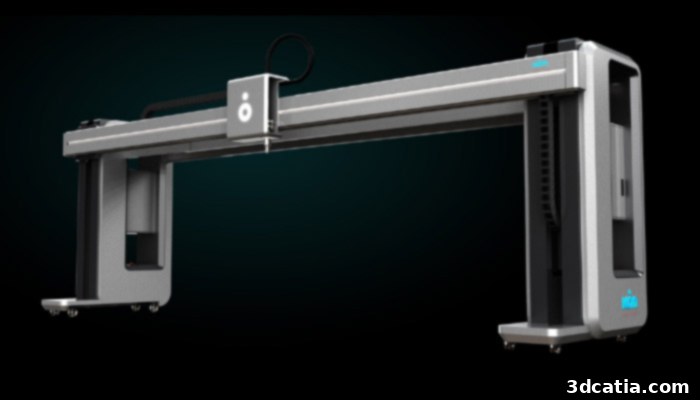
The Vulcan II concrete 3D printer in action
The Magma Material Delivery System: Precision and Adaptability
Complementing the Vulcan printer is ICON’s equally innovative Magma material delivery system. “Magma is the intelligent backbone that supplies the Vulcan with its printable material,” Alex clarifies. This advanced machine is designed to accept massive 3,000 lb bulk bags of “Lavacrete,” ICON’s specially engineered cementitious mix. Once loaded, Magma precisely mixes in a proprietary recipe of admixtures and water. Critically, the quantities of these components are dynamically adjusted based on real-time environmental conditions, such as temperature and humidity, to ensure optimal material consistency and performance. The Magma system is in constant communication with the Vulcan printer, intelligently determining exactly when more material is needed. It then, with incredible precision, feeds the required Lavacrete mixture to the printer using a high-powered pump, guaranteeing an uninterrupted and smooth printing process. This closed-loop system highlights ICON’s dedication to automation and consistency in 3D printed construction.
Beyond Earth: ICON’s Ambitious NASA Project for Lunar Habitats
From the very earliest days of ICON’s founding, the concept of off-world construction has been an intrinsic part of its long-term vision. This audacious goal became more concrete early on, as Alex elaborates: “In our initial stages, we proudly participated in NASA’s 3D Printed Habitat Centennial Challenge, collaborating with the esteemed Colorado School of Mines. This experience solidified our commitment to space exploration.”
ICON embraced this ambitious project with NASA because of a deep-seated belief that their core expertise and revolutionary products are exceptionally well-suited for the rigorous demands of lunar exploration and future off-world construction efforts. The challenges of building on the Moon or Mars are immense, yet ICON sees them as opportunities to push the boundaries of technology and human ingenuity.
A cornerstone of their approach is the conviction that large-scale 3D printing using indigenous regolith – the loose dust and rock found on the lunar or Martian surface – offers the ideal solution for constructing extraterrestrial habitats and infrastructure. “This method is crucial because it eliminates the prohibitive cost and logistical nightmare of shipping traditional building materials from Earth to the lunar or Martian surface via rockets,” Alex explains. This innovative approach to construction has the potential to dramatically lower off-planet construction costs, not by a small margin, but by many orders of magnitude. Such a reduction is not merely advantageous; it is an absolute necessity if humanity is to realistically establish sustainable infrastructure and thriving habitats on the lunar surface and eventually on Mars, paving the way for long-term human presence in space.
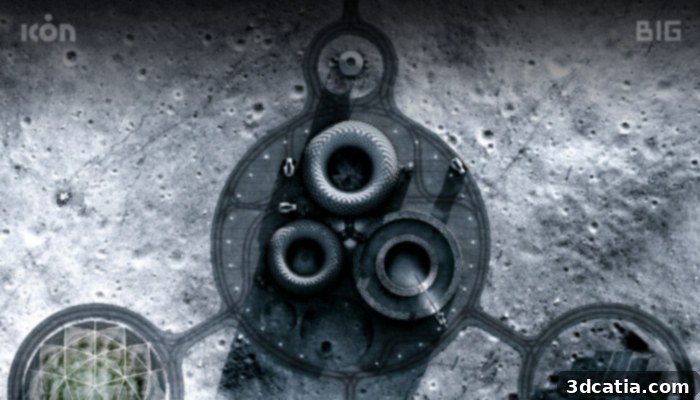
ICON believes that its expertise and products are well-suited for exploration of the Moon and off-world construction efforts | Image via ICON
Furthermore, ICON firmly believes that the very space-age technologies and solutions developed to address the unique challenges of building in space can also provide invaluable insights and tools to solve critical challenges faced by humanity right here on Earth, from sustainable housing to disaster relief.
The Leap from Terrestrial to Lunar 3D Printing
The transition from 3D printing on Earth to constructing on the Moon represents an enormous leap in technological and engineering complexity. “The Moon is an incredibly unforgiving and challenging environment,” Alex emphasizes. “It experiences extreme temperature variations of up to 500 degrees Fahrenheit, features craters that are thousands of feet deep, is bathed in harsh radiation, and is blanketed by electrically charged, super abrasive dust — all existing within the hard vacuum of space.” These conditions are vastly different from anything encountered on Earth, requiring a fundamental rethinking of every aspect of construction.
Adapting ICON’s Earth-based printing capabilities for lunar operations necessitates a myriad of significant changes. This spans everything from the selection and development of entirely new materials, designed to withstand the brutal lunar environment, to overhauling operational protocols to function autonomously and reliably in a vacuum and under extreme conditions. “There are countless differences and formidable challenges that stand before us,” Alex admits, “but at ICON, we are absolutely prepared and excited to tackle each and every one of them.”
Among these challenges, the print-head technology emerges as arguably the most critical hurdle to overcome for building a printer capable of operating effectively on the Moon or Mars. This specialized print-head must possess the unprecedented ability to reliably convert powdered regolith – the lunar soil – into a robust, solid structural material. Critically, this transformation must occur with minimal, if any, addition of additives transported from Earth, all while operating flawlessly in the near-total vacuum of space and without any direct human involvement. The development of such a print-head requires breakthroughs in material science, robotics, and automation, representing the cutting edge of off-world construction innovation.
ICON’s Vision for the Next Five Years: Global Impact and Space Frontier
Looking ahead, Alex articulates an ambitious yet grounded vision for ICON’s trajectory over the next half-decade. “In five years, our aspiration is to see our solutions scaling globally, making a tangible difference in people’s lives all around the world,” he states with conviction. This involves expanding the reach of their transformative technology, actively working to get Vulcan printers into the hands of developers, builders, and architects across continents. The goal is to dramatically increase the number of 3D printed homes, thereby contributing significantly to alleviating the global housing supply shortage and providing sustainable, affordable options for communities in need.
Beyond sheer volume, ICON also aims to empower the architectural community, offering them unprecedented design freedom and the ability to realize innovative, complex structures that might be challenging or impossible with traditional construction methods. Simultaneously, a core objective remains to continually lower overall construction costs, making high-quality housing more accessible to everyone. And, as Alex concludes, with a nod to their most audacious project, “Through all these efforts, we aim to get one significant step closer to realizing our ultimate dream: establishing a permanent human presence on the Moon, built with ICON technology.” This dual focus on Earth-bound solutions and space exploration defines ICON’s unique and impactful path forward.
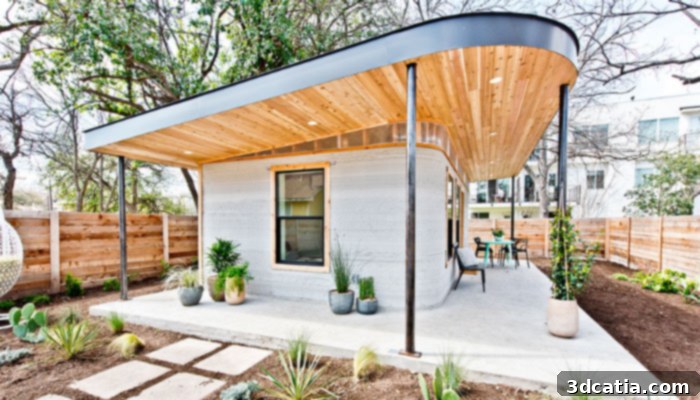
The first permitted 3D printed home by ICON in Austin, Texas | Image via ICON
Join the Future of Construction
For those inspired by ICON’s mission and innovative spirit, Alex has a final message: “We are actively expanding our team and are currently hiring for a number of critical positions across various departments.” These roles include opportunities in mechanical engineering, software engineering, field operations, and marketing. “If you are passionate about working on giant robots that print homes, whether on Earth or in the vast expanse of outer space, we encourage you to explore our career openings HERE.”
What are your thoughts on ICON’s groundbreaking work in 3D printing construction and their ambitious plans for off-world habitats? We’d love to hear your perspective in a comment below or engage with us on our Facebook and Twitter pages! Don’t miss out on the latest news and innovations in additive manufacturing – sign up for our free weekly Newsletter and get all the updates delivered straight to your inbox!