
Hyperflesh: Unmasking the Ultra-Realistic Art of Landon Meiert and 3D Printing
Since 2016, American artist Landon Meiert has captivated audiences worldwide with his extraordinary ultra-realistic masks, marketed and manufactured under his renowned brand, Hyperflesh. His creations blend meticulous artistry with cutting-edge technology, pushing the boundaries of what’s possible in mask making. Over recent months, Meiert has generated an immense social media buzz, particularly after a video featuring his chillingly lifelike masks of figures like Vladimir Putin, Donald Trump, and Kim Jong-un went viral. This single video exploded across platforms, racking up an astounding 60 million views in a mere 48 hours, cementing Hyperflesh’s status as a global sensation.
Beyond political satirization, Landon Meiert, a sculptor, artist, and the visionary founder of Hyperflesh, has also masterfully recreated iconic characters from pop culture. Among his celebrated works is an eerily accurate rendition of Heisenberg from the acclaimed series *Breaking Bad*, demonstrating his versatility and broad appeal. As his artistic journey has evolved, Meiert has seamlessly integrated advanced 3D modeling software and 3D printing techniques into his workflow. This technological embrace allows him to infuse even greater precision and intricate detail into his already meticulous work, resulting in creations that are not only works of art but also command prices reaching up to $5,000. The sheer level of lifelikeness achieved by Hyperflesh masks often evokes a powerful, almost disorienting sense of the “uncanny valley,” where the realism is so profound it becomes unsettlingly familiar yet distinctly artificial.
Witnessing the viral impact of his videos and hearing the widespread acclaim surrounding his brand, we were compelled to delve deeper into the mind of the artist himself. Our goal was to understand the intricate process behind these awe-inspiring masks and to uncover the secrets to achieving such an unparalleled degree of realism. Join us as we explore the fascinating world of Hyperflesh and Landon Meiert’s innovative approach to art.
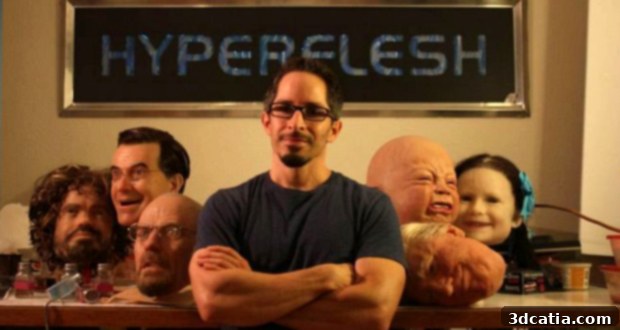
Landon Meiert alongside some of his incredible Hyperflesh masks.
The Genesis of Hyperflesh: A Sculptor’s Lifelong Journey
3DN: Could you tell us a little bit about your professional development and how you came up with the idea for Hyperflesh?
My artistic inclinations have been a constant throughout my entire life. After graduating from college with an art degree, I found mask making to be an incredibly compelling and fertile ground for exploring some of my more surreal artistic ideas. I was particularly fascinated by the bizarre juxtaposition of a familiar, yet fundamentally “wrong” face placed upon a human body. This visual dissonance created a powerful effect that truly resonated with everyone who encountered them. My masks weren’t just objects; they evoked a visceral reaction, creating a sort of “mid-day nightmare” for those who witnessed someone wearing them. The experience was designed to be both fascinating and slightly unsettling, prompting viewers to question their perceptions of reality. I’ve been dedicated to creating these unique pieces for the last 16 years, and more recently, this passion culminated in the creation of the Hyperflesh brand, which has allowed me to bring these surreal visions to a wider audience.

The iconic Trump, Putin, and Kim Jong-un masks by Landon Meiert, which became a viral sensation.
The Meticulous Craft: From Concept to Digital Masterpiece
3DN: What creative process do you use to create your masks?
My creative process is highly iterative and begins long before any sculpting takes place. Once a particular subject or personality sparks my interest, the first crucial step is to gather extensive reference material. The internet proves to be an invaluable resource for this, allowing me to collect a vast array of images from various angles and under different lighting conditions. I also find video footage extremely helpful, as it provides dynamic insights into facial expressions, movements, and subtle mannerisms that still images might miss. This comprehensive visual library is essential for capturing the nuances and unique characteristics that define each individual’s appearance.
With my reference material thoroughly compiled, I transition into the digital sculpting phase, primarily utilizing ZBrush – a powerful digital sculpting software renowned for its ability to simulate traditional sculpting methods. I begin by starting with what I metaphorically call a “virtual ball of clay.” Using ZBrush’s versatile Move tool, I push and pull this digital clay, gradually forming the basic anatomical shape of the individual’s head and facial structure. This initial blocking out establishes the fundamental proportions and contours. From this foundational shape, I then employ a sophisticated combination of various ZBrush tools to meticulously refine and add layer upon layer of intricate details. This includes everything from the primary forms like eye sockets and cheekbones, to secondary details such as wrinkles, skin folds, and subtle asymmetries, and even tertiary details like pore structures and hair follicles. The precision and flexibility afforded by digital sculpting allow me to achieve an astonishing level of fidelity, bringing my subjects to lifelike realism.

3D Printing: Revolutionizing Mask Prototyping and Production
3DN: What do you think are the benefits of using 3D printing in sectors such as yours?
For many creative and manufacturing sectors, 3D printing offers undeniable advantages, particularly in prototyping and model making. It has become an indispensable tool for rapid iteration and testing design concepts. For my work, specifically, the benefits of incorporating computer sculpting (like ZBrush) and subsequent 3D printing are manifold and profound. The most significant advantages are the drastic reduction in process time and the substantial cost savings. In traditional mask making, creating a physical clay sculpt, then making a mold from that sculpt, and finally casting the piece, is an incredibly labor-intensive and time-consuming endeavor. Any changes require going back to the physical sculpt, which can be messy and inefficient.
With 3D printing, once the digital sculpt is perfected in ZBrush, I can directly print a high-resolution master model. This eliminates numerous manual steps, accelerates the prototyping phase dramatically, and allows for precise replication of the digital detail. If I need to make an adjustment, I simply modify the digital file and print a new version, a process that is far quicker and more cost-effective than resculpting by hand. This efficiency not only speeds up my workflow but also enables me to experiment more freely with design iterations, ensuring the final product meets my exacting standards for hyper-realism without incurring prohibitive costs or time delays. The ability to capture and reproduce such intricate details from the digital realm directly into a physical form is truly transformative for the art of mask making.

The Future of Hyperflesh: Expanding Horizons and New Creations
3DN: Does Hyperflesh have any future plans?
Absolutely, the world of Hyperflesh is constantly evolving with exciting new projects on the horizon. Currently, a significant portion of my time is dedicated to fulfilling various custom orders. These bespoke commissions present unique and exhilarating challenges, as they require not only technical precision but also a deep understanding of the client’s vision and the subject’s characteristics to achieve that signature Hyperflesh realism. Each custom order is a fresh opportunity to push the boundaries of my craft and bring new faces to life.
In addition to these custom pieces, I’m also enthusiastic about working on a new project that promises to be another crowd-pleaser: a Tony Stark mask. Bringing such an iconic character from pop culture to life in the Hyperflesh style requires a careful balance of recognizable features and artistic interpretation. Fans can anticipate another incredibly detailed and lifelike creation that embodies the essence of the character. For those eager to follow my progress, see my other completed projects, and stay updated on upcoming masks, I encourage everyone to visit my official website. It’s the best place to witness the full breadth of Hyperflesh’s artistic journey and see what new “mid-day nightmares” are on the horizon.
Landon Meiert’s Advice: Embrace the Digital Frontier
3DN: Any last words for our readers?
My message to anyone contemplating the adoption of new technologies, especially in creative fields, is straightforward and emphatic: if you’ve been waiting to make the leap to 3D printing – do it. Don’t hesitate. For me, integrating this technology into my artistic process has been nothing short of splendid. It has not only streamlined my workflow and opened up new avenues for creative expression but has also allowed me to achieve levels of detail and efficiency that were previously unattainable. 3D printing has truly revolutionized how I bring my visions to life, making complex artistic endeavors more accessible and manageable. It’s a tool that empowers artists and creators to realize their full potential, and I wholeheartedly recommend embracing its capabilities.
Check out his masks in action below, and prepare to be amazed by the sheer realism:
What are your thoughts on Landon Meiert’s Hyperflesh masks and his groundbreaking use of 3D printing in art? We’d love to hear from you! Let us know in a comment below or join the conversation on our Facebook and Twitter pages. Don’t forget to sign up for our free weekly Newsletter, ensuring you receive all the latest news and innovations in the world of 3D printing delivered straight to your inbox!