

As major athletic brands expand their use of additive manufacturing, the 3D-printed footwear market is evolving from lifestyle and aesthetic-focused designs toward true high-performance athletic applications. TPM3D today announced a milestone: industrial-scale integration of selective laser sintering (SLS) with high-performance PEBA elastomers for footwear manufacturing.
Companies such as Zellerfeld have shown that fully 3D-printed shoes can reach mainstream consumers. Yet many in the industry have pointed to a persistent “performance ceiling.” Current 3D-printed midsoles and components often use DLP, SLA, or FDM technologies that deliver striking designs but can struggle to meet the mechanical demands of professional athletics because of limited fatigue resistance and suboptimal energy return. TPM3D says combining SLS with PEBA materials addresses these limitations by delivering more consistent mechanical behavior and improved dynamic performance.
Why SLS PEBA?
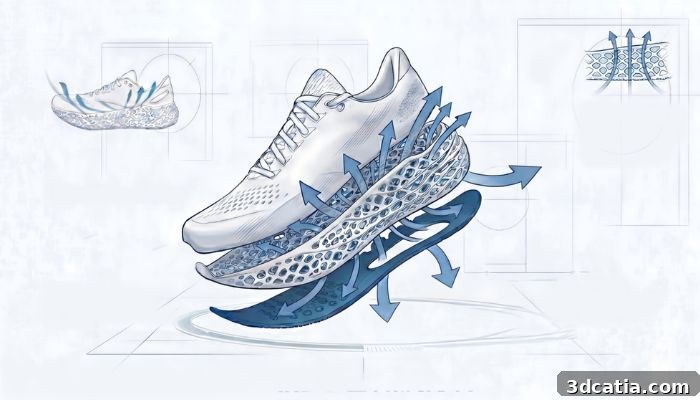
TPM3D describes its SLS PEBA process as delivering superior performance consistency compared with common resins and TPU-based materials. PEBA offers a favorable balance of elasticity, fatigue resistance, and energy return—properties that matter for performance footwear where cushioning, rebound, and longevity determine real-world utility.
Because SLS uses unsintered powder to support parts during production, it eliminates the need for dedicated support structures. This enables designers to explore complex lattice geometries, zoned cushioning, and optimized topological midsole designs that are difficult or impossible with conventional molding or subtractive methods. TPM3D also applies proprietary post-processing to enhance mechanical uniformity and overall part performance.
The company highlights three primary advantages of its SLS PEBA approach:
- Reduced weight without sacrificing structural strength
- Improved energy return and shock absorption suitable for high-intensity athletic use
- Manufacturing scalability through standardized, repeatable digital workflows
Closing the Durability Gap
Durability and long-term mechanical degradation remain major challenges for 3D-printed midsoles in demanding sports contexts. TPM3D says it has targeted that durability gap through engineering, material selection, and testing. In internal trials, the company reports that SLS PEBA parts show a compression set in the 22–26% range and no irreversible deformation after 200,000 dynamic flex cycles. These results indicate a significant step toward stability and longevity for 3D-printed performance components.
“We are shifting the industry from model-based design to true mechanical design through precise micro-structural control,” states the TPM3D R&D team.
If broadly reproducible, this level of mechanical resilience could move 3D-printed footwear beyond lifestyle and niche products and into scalable performance athletic applications.
Manufacturing and Sustainability
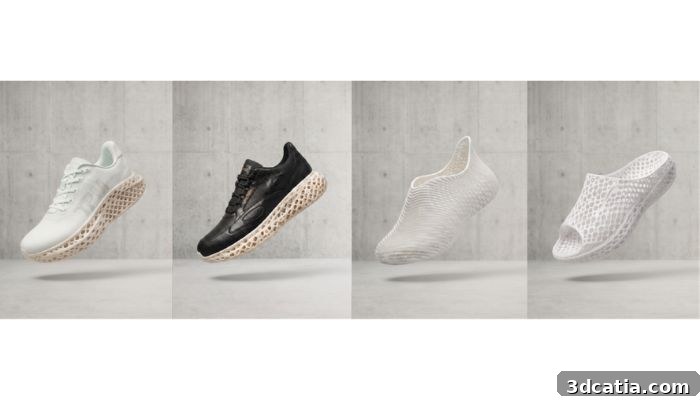
Beyond mechanical performance, TPM3D highlights advantages of SLS PEBA for manufacturing agility and sustainability. The digital, tooling-free workflow reduces lead times, eliminates mold costs, lowers minimum order quantities, and enables localized, on-demand production and faster prototyping.
Sustainability benefits cited include the ability to recycle and reuse unused SLS powder, avoidance of toxic additives or organic solvents in the sintering process, and the potential to crush and reprocess end-of-life SLS-printed components into new raw material. These traits can reduce material waste and the environmental footprint associated with traditional footwear supply chains.
- Unused SLS powder can be recycled and reused, reducing waste
- The sintering process does not require toxic additives or organic solvents
- End-of-life components can potentially be crushed and reprocessed into new material
Looking Ahead
TPM3D was founded by Luan Zhao (Mark), who brings more than two decades of experience in additive manufacturing and product design. Since 1999 the company has focused on advancing SLS technologies and industrial-scale manufacturing processes. As major athletic brands increasingly explore 3D-printed components for both performance and supply chain benefits, TPM3D positions itself as an end-to-end supplier aiming to scale SLS-based footwear production for commercial markets.
For readers interested in TPM3D’s technologies, contact information is available from the company. The development reflects a broader industry shift: moving from visually driven 3D-printing experiments toward mechanically validated, production-ready solutions for athletic footwear.
*All Photo Credits: TPM3D