
Honeywell Achieves Landmark: FAA-Certified 3D Printed Flight-Critical Engine Part Revolutionizes Aerospace Manufacturing
The aerospace industry is undergoing a profound transformation, driven by the increasing integration of 3D printing technologies, also known as additive manufacturing (AM), into critical production processes. Major players, from BAE Systems in collaboration with Stratasys to Lufthansa establishing its dedicated AM center, and the US Air Force working with GE Additive, are leveraging this innovative approach. The core motivations are clear: significantly reduce lead times, curb manufacturing costs, and unlock the capability to produce complex parts that are challenging or impossible to fabricate using conventional methods. Among these pioneering entities, Honeywell stands out for its early and persistent commitment to metal additive manufacturing, a journey that began as far back as 2007. Today, the international conglomerate 3D prints hundreds of diverse aircraft components, continually pushing the boundaries of what’s possible. Their extensive experience includes collaborations with leading AM companies such as SLM Solutions and Velo3D, cementing their position at the forefront of this technological shift. This sustained effort has recently culminated in a significant milestone: Honeywell has successfully 3D printed the first FAA (Federal Aviation Administration) certified, flight-critical engine part, marking a pivotal moment for both the company and the broader additive manufacturing landscape in aeronautics.
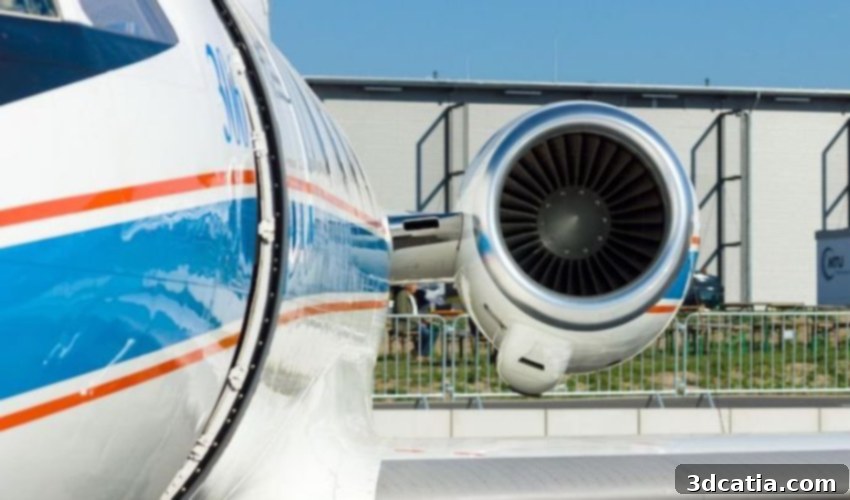
This groundbreaking component, designated as the #4/5 bearing housing, is an indispensable element of the ATF3-6 turbofan engine. This particular engine powers the Dassault Falcon 20G, a maritime patrol aircraft primarily utilized by the French Navy for crucial patrol and search-and-rescue missions. The ATF3-6 engine’s design dates back to the 1960s, a testament to its enduring legacy. However, with only approximately a dozen of these aircraft still actively flying today, the supply chain for their components has become increasingly complex and economically prohibitive. Sourcing and replacing traditional engine parts for such low-quantity, legacy fleets presents immense challenges, as the cost of manufacturing new tooling and production runs for a handful of parts is exorbitant. This is precisely where the transformative power of additive manufacturing technology becomes indispensable. It offers an agile and efficient solution, enabling the rapid 3D printing of these critical parts in smaller, precise quantities, thereby circumventing the need for costly and time-consuming conventional tooling. This capability ensures the continued operational readiness of essential aircraft like the Dassault Falcon 20G, extending their service life and providing vital support for their missions.
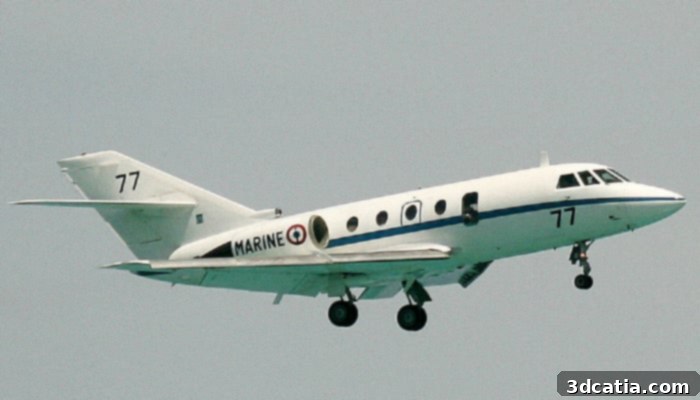
The Dassault Falcon 20G aircraft (Photo: Dassault Aviation)
The impact of this innovation on operational efficiency and supply chain resilience is profound. Jon Hobgood, Vice President of Manufacturing Engineering at Honeywell Aerospace, underscored the necessity of this advanced approach. “Though there aren’t many in service, Honeywell is responsible for supporting and maintaining these engines. We had to find a way to address these supply chain issues and keep these aircraft flying,” Hobgood explained. He further highlighted the dramatic improvements in production timelines facilitated by additive manufacturing: “We were able to use our expertise in additive manufacturing to produce the qualified part much faster, reducing our lead time from approximately two years to two weeks.” This remarkable reduction in lead time—from a span of two years to just two weeks—is a game-changer. It not only ensures that essential aircraft remain operational but also demonstrates the immense potential of 3D printing to revolutionize maintenance, repair, and overhaul (MRO) operations across the aerospace sector. This efficiency gain translates directly into cost savings, reduced downtime for aircraft, and enhanced readiness for critical missions.
The #4/5 bearing housing’s classification as a “flight-critical” part by regulatory bodies like the FAA is not an arbitrary designation. A malfunction or failure of this component could have catastrophic consequences, jeopardizing the safety of passengers and crew and causing irreparable damage to the aircraft. Consequently, such safety-critical parts are subjected to an unparalleled level of scrutiny and must undergo rigorous testing and approval processes by organizations like the Federal Aviation Administration before they can be cleared for use on any aircraft. Honeywell has dedicated significant resources and expertise to collaborating closely with the FAA on the development and certification of multiple additively manufactured components. This particular #4/5 bearing housing holds the distinction of being the first component to receive approval under the FAA’s delegated authority, a testament to the robust qualification processes established by Honeywell and the FAA’s confidence in their additive manufacturing capabilities. This delegated authority streamlines the certification process by empowering qualified companies like Honeywell to certify certain parts internally, under strict FAA oversight, accelerating the adoption of new technologies while maintaining the highest safety standards.
This landmark achievement signifies far more than just the certification of a single part; it represents a fundamental shift in how aerospace components can be manufactured and certified for flight. Jon Hobgood emphasized the broader implications of this success: “This is a major milestone for Honeywell because it demonstrates the maturity of our additive manufacturing operations and paves the way for us to print more certified, flight-critical parts in the future.” He further elaborated on the industry-wide significance, stating, “It also is a major win for the additive industry, as flight-critical parts face heavy scrutiny and high standards for qualification and installation on aircraft, but this shows it can be done.” This success story serves as a powerful validation of additive manufacturing’s capabilities, proving that it can meet the exceptionally stringent requirements of the aerospace sector for parts that are essential for safe flight. It will undoubtedly accelerate the adoption of 3D printing for other critical applications, fostering innovation and resilience across the global aviation supply chain. The ability to produce complex, high-performance parts on demand, with reduced lead times and costs, addresses long-standing challenges in aircraft maintenance and manufacturing, particularly for aging fleets and specialized components. This breakthrough not only reinforces Honeywell’s leadership in the field but also inspires other manufacturers to explore and invest in additive solutions, knowing that FAA-certified flight-critical parts are now a tangible reality.
The implications of Honeywell’s accomplishment extend beyond immediate supply chain fixes for legacy aircraft. It opens doors to entirely new design paradigms for future aircraft, allowing engineers unprecedented freedom to optimize parts for weight, performance, and fuel efficiency. By leveraging the geometric complexities achievable only through additive manufacturing, components can be consolidated, lighter structures can be created, and performance characteristics can be enhanced in ways previously impossible with traditional subtractive manufacturing methods. This heralds a new era of innovation where parts can be designed not just for manufacturing, but for optimal function and lifecycle performance, potentially leading to more sustainable and efficient aviation. The trust built through rigorous FAA certification processes for parts like the #4/5 bearing housing will pave the way for a more widespread integration of AM across various aircraft systems, from propulsion and structural components to interiors and beyond. This milestone is a clear signal that additive manufacturing is maturing from a prototyping tool to a robust and reliable production method for even the most demanding aerospace applications.
What are your thoughts on Honeywell’s pioneering use of 3D printing technologies for flight-critical aerospace components? Do you believe this will rapidly accelerate the adoption of additive manufacturing across the industry? We invite you to share your perspectives and comments below, or join the conversation on our Facebook and Twitter pages! For all the latest news and developments in the world of 3D printing, remember to sign up for our free weekly Newsletter and receive curated updates directly in your inbox.