
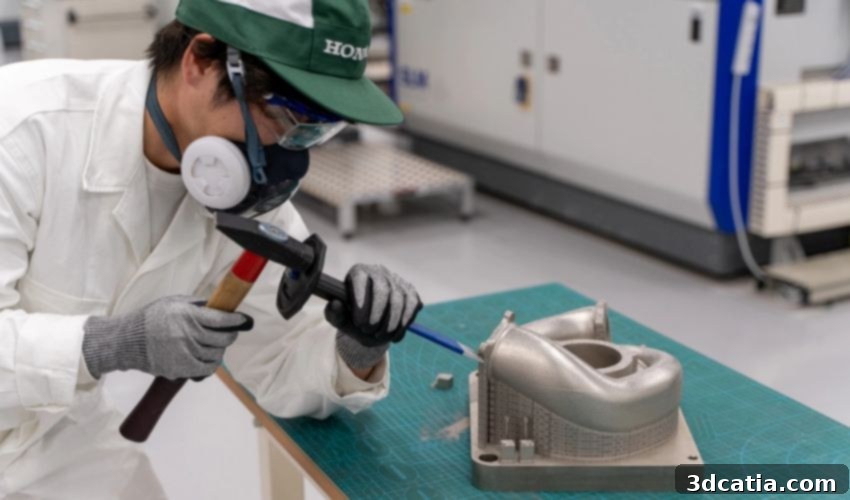
Revolutionizing Manufacturing: Honda’s Strategic Adoption of 3D Printing and Laser Powder Bed Fusion for Enhanced Efficiency
In the rapidly evolving landscape of modern manufacturing, Japanese automotive giant Honda has once again demonstrated its commitment to innovation, recently unveiling how it leverages advanced additive manufacturing technologies to significantly boost operational efficiency. At the core of their strategy is Laser Powder Bed Fusion (LPBF), a sophisticated metal 3D printing technique renowned for its ability to produce intricate geometries that are simply unattainable through conventional methods like casting and forging. This makes LPBF an ideal solution for rapid prototyping, creating unique one-off items, or manufacturing small batches of highly diverse products with exceptional precision.
Despite its transformative potential, LPBF, like any cutting-edge technology, presents a unique set of challenges. To proactively address and overcome these hurdles, Honda’s dedicated research and development facilities have strategically integrated deformation prediction simulation technology. This forward-thinking approach allows them to anticipate and mitigate potential inefficiencies, ensuring a smoother and more reliable production process from concept to final product.
Optimizing the LPBF Process: Honda’s Innovations
Honda’s pursuit of excellence in LPBF involves meticulous optimization across several critical aspects of the process. One of the primary areas where Honda’s facilities have made significant strides is in refining gas circulation within the LPBF chamber. During the metal fusion process, an inert gas is continuously circulated to maintain an oxygen-free environment. This is crucial not only for preventing oxidation but also for efficiently removing fumes and metal spatters generated as the laser melts the metal powder. Failure to effectively manage these byproducts can lead to voids, defects, and ultimately compromise the structural integrity and quality of the finished part.
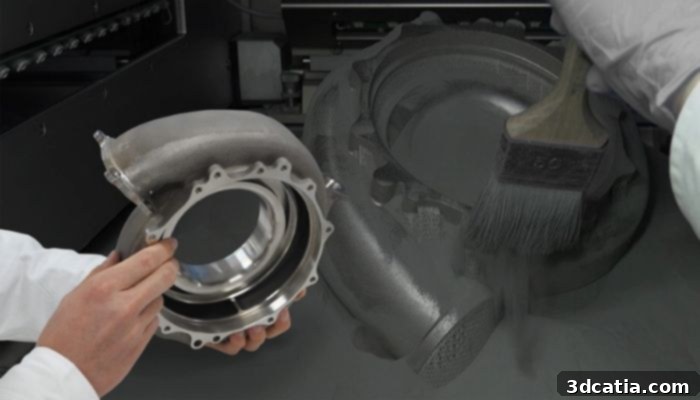
A precision part from Honda, meticulously crafted using LPBF technology.
Addressing Gas Flow Challenges in Larger Builds
Honda’s engineers identified that as the build area within the LPBF chamber increases, it becomes more susceptible to external disturbances and inconsistencies in gas flow. Specifically, on the ‘downwind’ side of the chamber, where the inert gas flow speed tends to be slower, fumes and metal spatters are less effectively removed. This often results in localized modeling problems and compromised material quality in these particular areas. To counteract this, Honda’s team developed a sophisticated monitoring system utilizing a high-speed camera to meticulously check the spatter removal status for each individual layer. This layer-by-layer analysis provides critical insights into the real-time performance of the gas circulation.
By comparing the spatter removal efficiency with precise wind speed distribution data, measured via advanced wind speed sensors, Honda can pinpoint the exact root causes of any inconsistencies. This comprehensive data-driven approach empowers them to accurately optimize the inert gas flow speed and determine precise, uniform conditions across the entire modeling area. Such fine-tuned control is paramount for achieving consistent material properties and minimizing defects, regardless of the part’s size or complexity.
Ensuring Material Integrity: Layer-by-Layer Quality Control
Honda’s commitment to quality extends beyond gas circulation. They apply a rigorous method of trial-and-error combined with extensive data collection to continually refine other crucial aspects of the LPBF process. This includes taking detailed pictures of each layer as it’s built to monitor the melting state, alongside recording critical parameters such as temperature and laser output. This holistic data enables the team to gain a deeper, more comprehensive understanding of the complex interplay between the material properties, laser dynamics, and gas flow, paving the way for further process optimization.
Upon the completion of a 3D printed part, the Honda team subjects it to thorough testing, including assessments of its tensile strength. A primary objective is to produce parts with seamless layers, ensuring no internal gaps or weaknesses. If the laser power is insufficient during the fusion process, the individual ‘beads’ (where metal powder melts and solidifies) can be too small. This results in inadequate layer thickness and can create detrimental voids within the part, severely impacting its mechanical properties. Through diligent, real-time monitoring and post-production analysis, Honda can precisely adjust and optimize their processes, guaranteeing the production of consistently high-quality, structurally sound components.
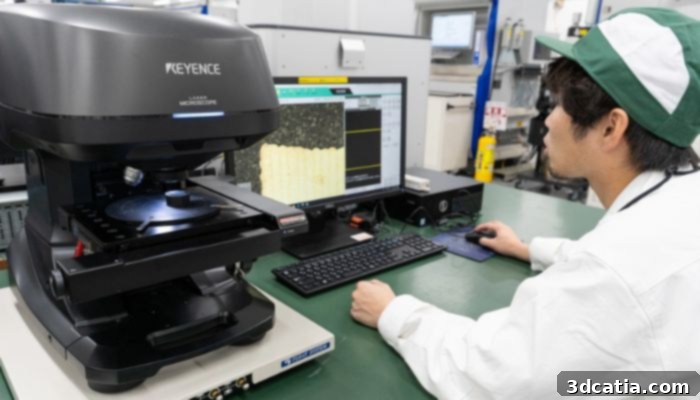
A critical part undergoing rigorous testing to ensure internal quality and structural integrity.
Honda’s Enduring Commitment to 3D Printing
Honda’s recent advancements are not an isolated endeavor but rather a continuation of its long-standing history of embracing and advocating for additive manufacturing technologies. The company’s journey with 3D printing dates back to at least 2016 when it successfully 3D printed components for its innovative Micro Commuter vehicle. This commitment deepened in 2020, with updates to the vehicle incorporating lightweight metal crankshafts, showcasing the company’s continuous effort to integrate AM into core components. Furthermore, 2023 saw Honda making significant headlines for strategically investing in Seurat Technologies, an AM company specializing in producing metal parts at scale, further solidifying its position as a pioneer in industrial additive manufacturing. This latest revelation from Honda spotlights two distinct yet equally impactful applications: high-performance Formula 1 parts and custom-fitted handlebars for wheelchair racers.
Revolutionizing Formula 1 Components with Additive Manufacturing
In the hyper-competitive world of Formula 1 racing, every gram of weight and every fraction of a second count. Here, weight optimization and unparalleled part strength are not just advantageous; they are absolutely critical for performance. Since 2020, Honda has expertly leveraged additive manufacturing to rapidly produce unique, high-performance parts characterized by complex geometries and exceptionally thin walls. This capability allows for unprecedented design freedom and iterative improvements that are impossible with traditional manufacturing.
A prime example is the fabrication of F1 pistons. Traditionally, these vital components were forged from aluminum. Now, through metal 3D printing, Honda can produce pistons from iron. While iron typically has a higher specific gravity than aluminum, implying it would be heavier, the design freedom afforded by AM allows engineers to create optimized internal structures. This enables them to fabricate iron parts that are not only significantly lighter than their conventionally manufactured counterparts but also possess the superior strength and durability required to withstand the immense combustion pressures within an F1 engine. This strategic material substitution, facilitated by AM, enhances performance without incurring a weight penalty.
Another critical F1 component benefiting from LPBF is turbine housings. These were previously manufactured using precision casting, a process that limits design complexity and often requires extensive post-processing. By transitioning to additive manufacturing, Honda now produces these housings using Inconel, a highly heat-resistant nickel-based superalloy perfectly suited for the extreme temperatures found in turbochargers. The adoption of AM for both turbine housings and pistons has allowed Honda to meet and even exceed stringent dimensional standards, all while significantly shortening production times and realizing substantial cost reductions in their high-performance racing division.
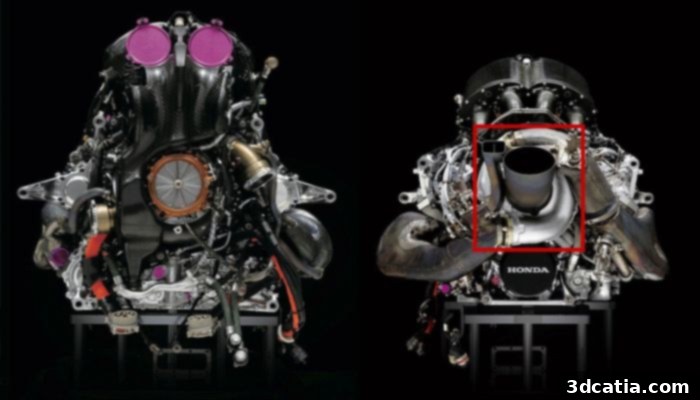
A meticulously 3D printed turbine housing area, demonstrating complex geometries.
Empowering Athletes: Customized Wheelchair Racer’s Handlebars
Beyond the demanding world of motorsports, Honda also applies its 3D printing expertise to enhance human performance in other arenas, specifically in the production of racing wheelchairs. Using additive manufacturing, Honda creates custom aluminum handlebars for these specialized wheelchairs. The revolutionary aspect of these handlebars lies in their unparalleled ability to be precisely customized to the individual athlete. In traditional manufacturing, handlebars were often welded together, making personalization a challenging and labor-intensive process, often resulting in compromises for the athlete.
With additive technology, Honda can design and produce handlebars that are not only perfectly tailored to the unique biomechanics and preferences of specific athletes but are also weight-optimized through sophisticated internal mesh grips. This intricate design, which significantly reduces weight while maintaining strength and improving grip, would be impossible to achieve with conventional manufacturing techniques. This exemplifies a profound shift: instead of athletes having to adapt to generic equipment, the equipment is meticulously adapted to the athlete, leading to enhanced comfort, improved control, and ultimately, superior performance. This human-centric design philosophy, powered by AM, underscores Honda’s commitment to innovation that truly benefits individuals.
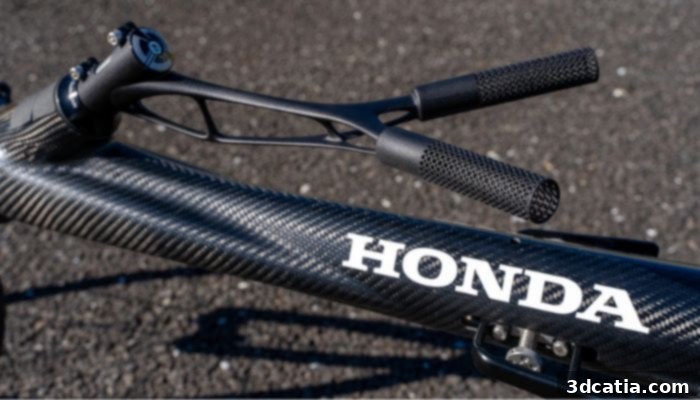
Custom-designed and 3D printed handlebars for a wheelchair racer, optimized for performance.
To achieve the ultimate in performance and efficiency for the wheelchair handlebars, Honda employed topological optimization. This advanced computational design technique ensures that only the absolutely necessary material is used, resulting in structures that are incredibly efficient, lightweight, and strong, free from any superfluous components. These highly customized handlebars and the advanced F1 car parts represent just two compelling examples of how the iconic Honda brand is strategically leveraging additive manufacturing. It is clear that as AM technology continues to evolve, many more groundbreaking use cases are sure to emerge from Honda’s innovative labs. To delve deeper into Honda’s extensive work with additive manufacturing, interested readers can explore further details by clicking here.
What are your thoughts on Honda’s ingenious application of 3D printing technology? We encourage you to share your insights in a comment below or join the conversation on our LinkedIn, Facebook, and Twitter pages! For more comprehensive coverage on the transformative role of 3D printing in the automotive and transport sectors, feel free to click here. And don’t forget to sign up for our free weekly Newsletter here to receive the latest 3D printing news directly in your inbox! You can also explore all our insightful videos on our YouTube channel.
*All Image Credits: Honda