

Nanoscribe Quantum X: Pushing the Boundaries of Microfabrication with Advanced 3D Printing
The realm of microfabrication stands as a rapidly evolving frontier within additive manufacturing, promising to unlock an extensive array of groundbreaking applications across numerous industries. While this specialized segment is characterized by a select group of innovators, the past few months have witnessed these key players unveiling cutting-edge solutions that are increasingly capturing global attention. Among these pioneers, Nanoscribe, a leading manufacturer of high-precision 3D printers, recently made significant waves with the introduction of its newest system: the Quantum X. This innovative 3D printer is specifically engineered for the intricate microfabrication of prototypes and masters, seamlessly integrating into industrial production workflows. At its core, the Quantum X leverages Nanoscribe’s revolutionary, patent-pending Two-Photon Grayscale Lithography (2GL) technology, enabling the precise production of incredibly tiny, highly complex objects with unparalleled efficiency.
The Nanoscribe Quantum X represents a monumental leap in microfabrication capabilities, delivering an unprecedented combination of high speed, complete design freedom, and exquisite precision. This triumvirate of features empowers users to craft exceptionally small yet profoundly intricate structures that were previously challenging or impossible to achieve. As with all advancements in 3D printing, a primary objective of the Quantum X is to provide users with tangible benefits, including dramatically shorter design iteration cycles and significantly more cost-effective manufacturing processes. Nanoscribe highlights that this sophisticated system is particularly well-suited for the creation of refractive microoptics and multi-level diffractive optical elements (DOEs). This translates to the ability to produce functional micro lenses with features as minuscule as 200 microns, opening doors for innovation in sectors ranging from telecommunications and medical devices to consumer electronics and advanced sensing technologies.

Micro-optics directly printed on a two-inch wafer without the need for additional lithography steps or mask fabrication | Image: Nanoscribe
Unveiling the Power of Two-Photon Grayscale Lithography (2GL)
Central to the Quantum X’s capabilities is Nanoscribe’s proprietary 2GL technology, a groundbreaking approach that masterfully blends the principles of additive microfabrication with ultra-fast voxel size tuning. This innovative methodology sets the Quantum X apart, allowing for a level of detail and complexity that redefines what is possible in micro-scale 3D printing. As detailed on Nanoscribe’s official website, the essence of 2GL lies in its sophisticated control mechanism: “Quantum X controls the voxel size along one scanning plane using synchronized laser power modulation at high speeds. In this manner, complex shapes are produced and variable feature heights are achievable within one scan field. Discrete and accurate steps as well as essentially continuous topographies can be printed on up to six-inch wafer substrates without the need for additional lithography steps or mask fabrication.”
This technical explanation underscores the profound advantages of 2GL. Traditional two-photon polymerization often relies on fixed voxel sizes, which can limit the achievable geometries and necessitate multiple processing steps for varying feature heights. In contrast, 2GL’s dynamic control over voxel size through high-speed laser power modulation means that the printer can essentially “paint” structures with varying levels of detail and height within a single scan. This adaptability allows for the creation of intricate, multi-level designs, ranging from perfectly discrete steps to smoothly continuous topographies, all within the same print job. The ability to print directly onto wafer substrates up to six inches in diameter is a game-changer for industrial applications, eliminating the time-consuming and costly requirements for intermediate lithography steps or the fabrication of complex masks. This direct-write capability streamlines the manufacturing process, significantly reducing both development cycles and overall production costs, while simultaneously enhancing geometric design freedom.
Designed for Industrial-Scale Microfabrication
Beyond its cutting-edge technology, the Quantum X is fundamentally engineered for robust industrial production. This focus on manufacturing scalability is evident in several key features. The system accommodates special wafers that are compartmentalized into different cells, each capable of holding specific resins. This design ingeniously facilitates the fabrication of multiple, distinct parts or arrays of identical components in a single, uninterrupted run, dramatically improving throughput and efficiency. With an impressive entire build area of 50 x 50 mm, the Quantum X provides ample space for batch production, allowing for the concurrent printing of numerous micro-scale devices on a single wafer.
To further streamline and optimize small-series production, Nanoscribe has integrated advanced automation and monitoring capabilities into the Quantum X. These include automatic calibration, a crucial feature that ensures consistent print quality and reduces the need for manual intervention, thereby minimizing setup times and potential errors. Furthermore, the system offers real-time monitoring of print jobs, which can be conveniently managed through a remote control interface. This allows operators to oversee the printing process from anywhere, ensuring continuous operation and immediate response to any issues. Complementing this, the manufacturer has thoughtfully incorporated three distinct live-view cameras, providing multiple perspectives for operators to vigilantly monitor printing jobs in real-time. This comprehensive monitoring suite enhances process control, facilitates quality assurance, and enables swift troubleshooting, all of which are paramount for maintaining high yield and reliability in demanding industrial environments.
Overcoming Limitations and Driving Innovation
Dr. Michael Thiel, co-founder and CSO of Nanoscribe, articulates the transformative nature of the Quantum X, stating, “Beer’s law imposes strong limitations on today’s maskless lithography devices. Quantum X features two-photon grayscale lithography, which overcomes these limitations and offers unprecedented design freedom and ease-of-use. Our customers are working at the cutting edge of microfabrication.” Dr. Thiel’s insight highlights a critical challenge in conventional maskless lithography: the inherent limitations imposed by Beer’s law, which often restricts the achievable feature size and complexity due to light absorption. By leveraging two-photon grayscale lithography, the Quantum X bypasses these restrictions, granting engineers and researchers unparalleled freedom in designing and fabricating intricate microstructures.
This unprecedented design freedom, coupled with enhanced ease-of-use, directly translates into accelerated innovation across a multitude of high-tech sectors. For instance, in the **medical industry**, the Quantum X enables the creation of highly specialized micro-sensors for diagnostics, advanced lab-on-a-chip devices for rapid analysis, and sophisticated drug delivery systems that operate at the cellular level. Its precision also makes it ideal for crafting miniature surgical tools and prosthetics that require extreme accuracy. In the realm of **electronics**, this technology facilitates the development of next-generation components, including advanced packaging solutions, high-density interposers, and innovative micro-electromechanical systems (MEMS) with improved performance. The capability to print complex optical elements also opens new avenues for high-frequency components and integrated photonic circuits, essential for faster and more efficient data transmission.
For **telecommunications**, the ability to rapidly produce precise refractive microoptics and diffractive optical elements is invaluable for fiber optics components, optical switches, and components for augmented and virtual reality (AR/VR) systems, where miniaturization and optical performance are paramount. Furthermore, in **fundamental research and development**, the Quantum X serves as an indispensable tool, allowing scientists to rapidly prototype novel micro-devices and conduct experiments that push the boundaries of materials science, physics, and biology. The system’s capacity to integrate micro-optics directly onto existing devices or wafers also reduces assembly complexity and improves system performance, marking a significant step towards truly integrated micro-systems.
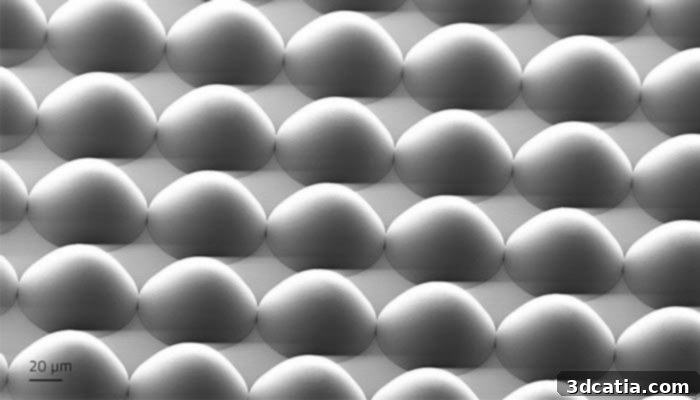
Microlens array fabricated by Nanoscribe Quantum X | Image: Nanoscribe
Nanoscribe: Leading the Charge in Micro-Scale Additive Manufacturing
Nanoscribe continues to solidify its position as a global leader and innovator in high-precision additive manufacturing. With the Quantum X, the company is not merely introducing a new product; it is offering a paradigm shift in how micro-scale structures are designed, prototyped, and mass-produced. Their dedication to pushing the technological envelope ensures that their customers, who are themselves at the forefront of scientific and industrial advancement, have access to the most sophisticated tools available. The Quantum X is a testament to this commitment, providing a robust, reliable, and versatile platform for creating the next generation of micro-devices that will power future technologies.
The impact of such advanced microfabrication tools cannot be overstated. By enabling the creation of intricate, high-performance components at the micro-scale with unprecedented speed and precision, the Quantum X will undoubtedly accelerate research, development, and commercialization across critical sectors. It empowers innovators to transcend previous manufacturing constraints, bringing previously theoretical designs into tangible reality and fostering a new era of miniaturization and functional integration. As Nanoscribe continues to innovate, the potential applications for their 2GL technology and systems like the Quantum X will only continue to expand, shaping the future of micro-optics, micro-electromechanical systems, and beyond.
What are your thoughts on the groundbreaking capabilities of the Nanoscribe Quantum X and the future of microfabrication? We invite you to share your insights and comments on our Facebook and Twitter pages! Don’t miss out on the latest advancements and news in the world of 3D printing; sign up for our free weekly Newsletter, delivered directly to your inbox!