
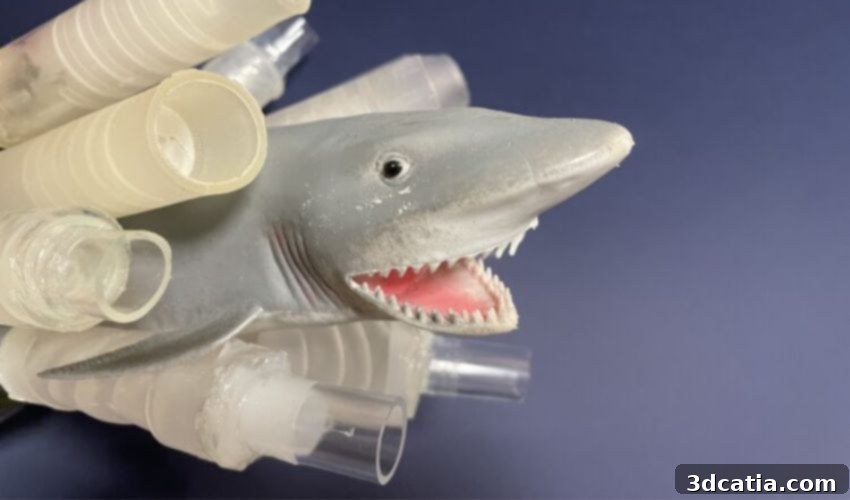
Unlocking One-Way Fluid Flow: Biomimicry of Shark Intestines for Advanced 3D Printed Pipes
In the vast realm of scientific inquiry, groundbreaking solutions often emerge from the most unexpected corners of nature. Sometimes, the answers to complex engineering challenges aren’t found in advanced laboratories alone, but rather, in the intricate anatomy of creatures like sharks. This fascinating intersection of biology and engineering was precisely the focus of a remarkable study conducted by a team of visionary researchers at the University of Washington. Their mission was to delve into a peculiar hypothesis: could pipes designed with internal structures mimicking shark and ray intestines effectively promote asymmetric flow, essentially creating a one-way path for liquids without any moving parts? This intriguing question was sparked by a 2021 publication that proposed “shark intestines may operate as Tesla valves,” a concept the University of Washington team was eager to rigorously test and validate. The foundational research behind this pioneering work received crucial funding from esteemed organizations including the National Science Foundation, the Washington Research Foundation, and the Fulbright Foundation, underscoring its potential impact.
The lead author of the study, Ido Levin, articulated the core motivation behind their deep dive into this subject. “Flow asymmetry in a pipe with no moving flaps has tremendous technological potential, but the mechanism was puzzling,” Levin explained. The challenge lay in dissecting the complex natural design: “It was not clear which parts of the shark’s intestinal structure contributed to the asymmetry and which served only to increase the surface area for nutrient uptake.” This critical distinction was paramount to translating biological inspiration into functional engineering designs. Understanding the precise anatomical features responsible for unidirectional flow was the first hurdle in harnessing nature’s ingenuity for practical applications. Their work aimed to demystify these biological marvels and replicate their efficiency in engineered systems.
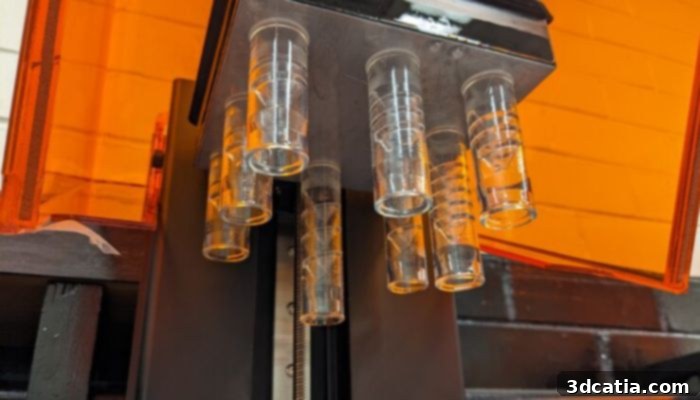
These are eight of the research team’s pipes with various interior helices, demonstrating the diverse designs explored in the study (photo credits: Ido Levin/University of Washington)
The Natural Blueprint: Shark and Ray Intestines as Bio-Inspired Valves
Traditional fluid systems, including many biological ones like the human digestive tract, often rely on moving flaps or valves to control the direction of liquid flow. While effective, these mechanical components are prone to wear, failure, and can even lead to problematic backflow under certain conditions. In stark contrast, the digestive systems of sharks and rays present an elegant, maintenance-free solution. Their intestines feature remarkable helical structures – intricate spiral folds that coil around a central cylindrical lumen. These biological spirals are ingeniously designed to propel digested food in a single direction down the digestive tract, preventing regurgitation without any active, moving parts. This passive yet highly effective mechanism fascinated the researchers at the University of Washington, who sought to replicate this natural efficiency in engineered pipes.
The core hypothesis was whether biomimetic pipes, precisely modeled after these fascinating natural structures, could indeed achieve significant flow asymmetry. The moment of truth arrived during their initial experiments. “The first measurement of flow asymmetry was a ‘Eureka’ moment,” Levin recounted, capturing the exhilaration of scientific discovery. “Until that instant, we didn’t know if our idealized structures could reproduce the flow effects seen in sharks.” This pivotal finding confirmed their intuition: the helical designs held the key to revolutionizing passive fluid control. This breakthrough opened the door to exploring the full potential of these shark-inspired geometries in various technological applications.
Achieving Breakthroughs Through Additive Manufacturing
How was this achievement accomplished? The Power of 3D Printing in Biomimicry
The creation of these complex, biomimetic pipes would have been incredibly challenging, if not impossible, with traditional manufacturing methods. The University of Washington’s press release, while not specifying the exact 3D printing technology used, strongly implied the application of VAT photopolymerization, a common and highly effective method for producing intricate designs with excellent resolution. This category of additive manufacturing, encompassing techniques like Stereolithography (SLA) or Digital Light Processing (DLP), is ideally suited for fabricating geometries with fine internal details, precise dimensions, and smooth surface finishes, all of which are critical for fluid dynamics studies.
The research team embarked on a systematic exploration, using 3D printing to create various “biomimetic” pipes from rigid materials. This initial phase was crucial for understanding how different physical parameters of the internal helices influenced flow asymmetry. They meticulously varied key design elements, including the pitch of the helix (how steeply it coils), the internal hole radius, the tilt angle of the helical structures, and the total number of turns within the pipe. This iterative process of design, print, and test, enabled by the unparalleled design freedom of additive manufacturing, allowed them to systematically optimize their prototypes for maximum unidirectional flow.
Through rigorous experimentation and precise fine-tuning of these geometrical elements, the researchers achieved a significant milestone. They successfully engineered prototypes whose flow asymmetry not only matched but *exceeded* that of the renowned Tesla Valve. The Tesla Valve, famously designed by Nikola Tesla in 1920, is an ingenious one-way fluidic device celebrated for its ability to direct flow preferentially in one direction without any moving parts. Surpassing this benchmark was a testament to the effectiveness of the shark-inspired designs. Once this superior performance was established with rigid materials, the University of Washington team pushed the boundaries further by printing the pipes using the softest printable polymers available on the market. This crucial step aimed to more closely mimic the highly “deformable” nature of actual biological intestines, which are significantly softer and more flexible than rigid plastics. The results from this phase were nothing short of astounding: the pipes printed with these soft, compliant materials performed at least seven times better than all previously measured Tesla valves, demonstrating an unprecedented level of flow asymmetry for a passive fluidic device. This remarkable improvement highlighted the critical role of material properties, alongside geometric design, in achieving optimal unidirectional flow.
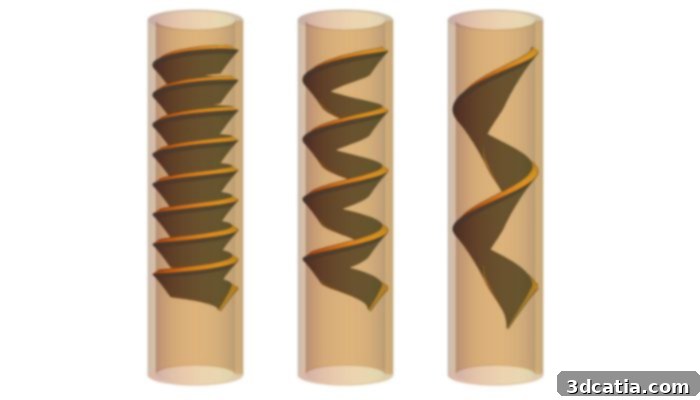
The various types of intricate helical structures designed and tested in the pipes’ interiors, showcasing the geometric diversity explored (photo credits: Ido Levin)
Future Prospects and the Enduring Power of Biomimicry
Despite the monumental achievements, the research team acknowledges that there is still immense potential for these biomimetic models to advance. Naroa Sadaba, one of the dedicated researchers on the team, pointed out the existing gap: “Actual intestines are still about 100 times softer than our soft material, so there is plenty of room for improvement.” This highlights an exciting frontier in materials science and additive manufacturing – the development of even softer, yet durable, printable polymers that can truly mimic the biological environment. Overcoming this material challenge could unlock even greater efficiencies and open new avenues for application.
Sarah Keller, another pivotal researcher in the study, eloquently expressed the team’s gratitude for their natural muse. She emphasized that the discovery of the helical design’s incredible potential was directly attributable to studying sharks. “Biomimicry is a powerful way of discovering new designs,” Keller stated, reflecting on the journey. “We never would have thought of the structures ourselves.” This sentiment underscores the profound value of looking to nature for inspiration, particularly in the field of biomimicry, where millions of years of evolution offer optimized solutions to myriad engineering problems.
Transformative Applications Across Industries
The type of innovative piping designs developed by the University of Washington team holds the promise of a truly diverse range of applications across numerous sectors. Alshakim Nelson, an expert specializing in the development of new types of polymers, recognized the broader implications for material science: “Chemists were already motivated to develop polymers that are simultaneously soft, strong and printable.” The discovery of these shark-inspired fluidic diodes significantly amplifies that motivation. “The potential use of these polymers to control flow in applications ranging from engineering to medicine strengthens that motivation.”
Imagine the possibilities: in **medicine**, these passive one-way valves could revolutionize drug delivery systems, microfluidic devices for diagnostics, or even non-invasive surgical tools, ensuring precise and controlled fluid movement within sensitive biological environments. In **industrial engineering**, they could enhance the efficiency of pumps, reduce energy consumption in HVAC systems, or improve chemical processing, where precise fluid directionality without moving parts is critical for safety and performance. For **microfluidics**, the ability to manage incredibly small volumes of liquid with such precision could open doors to new lab-on-a-chip technologies and advanced sensor designs. The elegant simplicity and robust performance of these biomimetic designs offer a compelling alternative to traditional mechanical valves, promising increased reliability, reduced maintenance, and enhanced functionality in countless scenarios.
To delve deeper into the intricate details of this fascinating study and its implications, we encourage you to read the comprehensive University of Washington’s official press release here. The journey from shark anatomy to advanced 3D printed technology is a testament to the boundless innovation possible when science embraces nature’s wisdom.
What are your thoughts on the incredible potential of biomimicry for additive manufacturing designs? We’d love to hear your insights and predictions in a comment below, or join the conversation on our LinkedIn, Facebook, and Twitter pages! Don’t miss out on the latest advancements and sign up for our free weekly newsletter here to receive all the breaking 3D printing news directly to your inbox! You can also explore our extensive library of insightful videos on our YouTube channel for more content on additive manufacturing and related technologies.
*Cover Photo Credit: Sarah L. Keller/University of Washington