
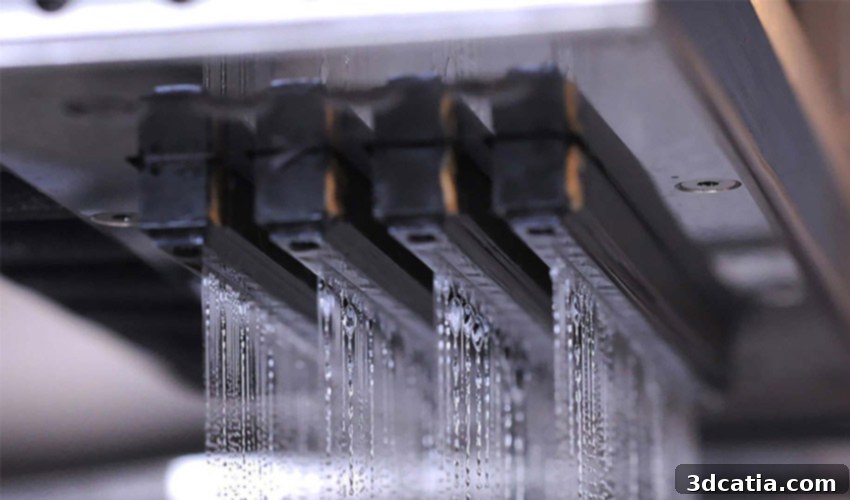
Groundbreaking Boron Carbide-Aluminum Cermets: A New Era for 3D Printed Neutron Shielding
In a significant leap forward for advanced materials and additive manufacturing, researchers at the Oak Ridge National Laboratory (ORNL), the largest U.S. Department of Energy science and energy laboratory, have pioneered a revolutionary method for designing and producing ceramic-metallic parts. Utilizing a sophisticated powder bonding machine from industry leader ExOne, the ORNL team has successfully developed a patent-pending process that allows for the seamless absorption of boron carbide (B4C) into aluminum alloys. This breakthrough is particularly impactful given that boron carbide is celebrated as one of the hardest materials available on the market, surpassed only by diamond and cubic boron nitride.
This innovative development addresses a critical need for high-performance materials capable of operating under extreme conditions, offering a unique combination of strength, lightness, and crucial neutron-absorbing capabilities. The collaboration between a leading national laboratory and a pioneer in 3D printing technology underscores the power of synergy in driving material science forward, promising to open new avenues for applications in industries ranging from aerospace and defense to nuclear energy and medical diagnostics.
The journey to commercialization for this cutting-edge technology began in 2019 when ExOne, a recognized specialist in the powder bonding process across various material types including metal, sand, and ceramics, secured an R&D license to further develop this groundbreaking manufacturing process. ExOne has long been at the forefront of binder jetting technology, continuously pushing the boundaries of what’s possible with additive manufacturing. Their expertise in precisely binding powdered materials proved instrumental in bringing ORNL’s concept to fruition. Two years later, reflecting the immense potential and robust progress made, this license has been strategically extended to encompass commercial use. This pivotal extension is poised to unlock unprecedented prospects for a wide array of additive manufacturing users, enabling the creation of previously unattainable components with superior performance characteristics. ExOne’s ongoing commitment to innovation led them to collaborate with ORNL on this method, which fundamentally transforms materials by enabling infiltration into a part during its post-processing treatment, effectively creating a new class of composite materials.
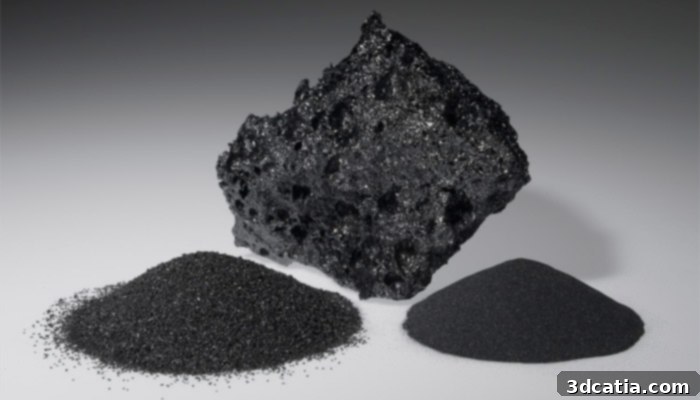
Boron carbide is one of the hardest materials on the market, integral to this new composite.
Leading this transformative research project at ORNL was David C. Anderson, whose team meticulously engineered the process. Anderson highlighted the success in developing a method to design parts predominantly composed of boron carbide (B4C). Boron carbide, in its pure form, is renowned not only for its exceptional hardness but also for its remarkable ability to absorb neutrons, coupled with its inherent strength and lightweight nature. These characteristics make it a prime candidate for high-demand applications. The critical innovation came in the subsequent infiltration stage, where these boron carbide structures were permeated with aluminum. This strategic infiltration transforms the final boron carbide component into a sophisticated cermet – a composite material ingeniously combining the attributes of both ceramics and metals. In this specific context, the aluminum acts as the metallic matrix, providing ductility and toughness, while the boron carbide serves as the ceramic reinforcement, imparting extreme hardness, wear resistance, and the invaluable neutron absorption capability. This synergistic combination yields a material that transcends the limitations of its individual constituents, offering enhanced performance for a multitude of industrial challenges.
The implications of this research are profound and far-reaching. This groundbreaking work enables the design and manufacturing of parts that are not only exceptionally light and strong but, most importantly, possess superior neutron-absorbing capabilities. The ORNL team enthusiastically asserts that this innovative cermet material will prove invaluable in the fabrication of critical components across various high-tech sectors. Potential applications include, but are not limited to, the manufacturing of advanced neutron imaging components, precision collimators, and robust shielding equipment essential for deflecting or absorbing harmful energy and radiation. The researchers further emphasize the broader societal benefits, pointing out that this infiltrated boron carbide composite could significantly enhance protection for both the environment and human health from various forms of radiation exposure. This breakthrough marks a substantial advancement in developing safer and more efficient solutions for radiation management, underpinning critical infrastructure and ensuring the safety of personnel in high-radiation environments.
Boron carbide’s inherent properties, particularly its high neutron capture cross-section, make it an ideal candidate for such applications. By integrating it into an aluminum matrix through additive manufacturing, the researchers have created a material that not only retains these crucial properties but also gains the benefits of metal fabrication, such as improved mechanical integrity and ease of shaping into complex geometries. This fusion is especially important for parts like collimators, which require intricate internal structures to precisely control particle beams, and for shielding, where consistent material density and form are paramount to effective radiation attenuation. The ability to 3D print these components offers unprecedented design freedom, allowing for optimized internal structures and reduced material waste, leading to more efficient and cost-effective solutions for neutron management and radiation protection.

ExOne 3D printed collimators demonstrating the advanced capabilities of the new boron carbide-aluminum cermet (photo credits: Genevieve Martin/ORNL)
For ExOne, a global leader in binder jet 3D printing, this development represents a significant expansion of its already diverse range of compatible materials. The commercialization of the boron carbide-aluminum infiltration process through ExOne’s technology opens up new market segments and strengthens their position as an innovator in industrial additive manufacturing. The company proudly announced, “The new B4C material also means that we can now offer our customers a 3D printing method for a metallic material that is lighter than bronze, while offering superior hardness and functional properties. This advancement is particularly exciting as it provides a solution for industries seeking both weight reduction and enhanced performance.” This comparison to bronze is crucial, as it highlights the material’s potential in applications where traditional heavy metals might be used, but where weight savings are critical, such as in aerospace or automotive sectors. ExOne’s robust suite of metal 3D printers, including well-known models like the Innovent+®, M-Flex®, X1 25Pro®, and X1 160Pro™, are already fully capable of producing objects from this innovative cermet. This compatibility demonstrates ExOne’s readiness for immediate commercial deployment and underscores the versatility of their platform, which currently supports 3D printing with over 22 different materials. This expanded material portfolio ensures that ExOne customers can leverage the benefits of additive manufacturing for an even broader spectrum of high-performance applications, solidifying the company’s commitment to continuous innovation and delivering advanced solutions to the global manufacturing landscape.
The collaboration between ORNL and ExOne exemplifies how public-private partnerships can accelerate the development and adoption of advanced manufacturing technologies. By combining ORNL’s deep scientific expertise in materials and processes with ExOne’s industrial capabilities in binder jetting, this project has successfully bridged the gap between fundamental research and practical application. The ability to 3D print complex parts with boron carbide-aluminum cermets not only reduces manufacturing lead times and costs but also enables the creation of custom geometries and optimized designs that are impossible with conventional manufacturing methods. This will have a transformative impact on industries requiring bespoke components with specific radiation shielding or neutron absorption profiles, providing engineers with unprecedented flexibility and control over material properties at the part level. Further details on this exciting innovation are available directly from ExOne’s official announcements, offering deeper insights into the technical specifications and commercial availability of these advanced ceramic-metallic components. You can find more information HERE.
The development of 3D printable boron carbide-aluminum cermets represents a pivotal moment for materials science and additive manufacturing. It highlights the immense potential of composite materials to address complex engineering challenges and opens new frontiers for radiation protection, advanced imaging, and lightweight structural components. This innovation will undoubtedly inspire further research into new material combinations and processing techniques, pushing the boundaries of what advanced manufacturing can achieve. What are your thoughts on these groundbreaking ceramic and metal composite materials and their potential impact on future technologies? We encourage you to share your insights in a comment below or join the conversation on our Facebook and Twitter pages! For the very latest updates on 3D printing news and advancements, be sure to sign up for our free weekly Newsletter here, delivered straight to your inbox!