
Revolutionizing 3D Printing: How Holograms Boost Volumetric Additive Manufacturing Efficiency and Resolution
The landscape of additive manufacturing is continuously evolving, with researchers constantly seeking innovative methods to enhance speed, precision, and energy efficiency. A groundbreaking study by a team of scientists from EPFL (École Polytechnique Fédérale de Lausanne) and the University of Southern Denmark is poised to redefine the capabilities of 3D printing. Their research delves into perfecting tomographic volumetric additive manufacturing (TVAM), a method distinct from traditional layer-by-layer approaches. While TVAM promises significant time savings by projecting laser beams onto a rotating resin tray to solidify an entire volume simultaneously, it has historically struggled with inefficiencies and high energy consumption. However, this pioneering team appears to have discovered a revolutionary solution: directly projecting a hologram onto the moving resin tray. This ingenious method holds the potential to dramatically impact the additive manufacturing market by overcoming TVAM’s inherent limitations, paving the way for faster, more precise, and more sustainable 3D printing.
For several years, volumetric 3D printing, also known as tomographic 3D printing, has been a topic of immense interest within the additive manufacturing community. This innovative technique operates fundamentally differently from conventional layer-by-layer methods, such as FDM or SLA. Instead of building an object one thin layer at a time, volumetric printing repeatedly projects a series of light patterns, or “projections,” into a vat filled with transparent liquid photopolymer resin. These patterns are projected from various angles as the resin vat or the light source rotates. The cumulative dose of light at specific points within the resin causes it to solidify, creating an entire three-dimensional shape in a single, rapid operation. This capability to “freeze” a defined volume of material, rather than superimposing layers, offers unprecedented speed. Beyond the remarkable acceleration of the printing process, users of volumetric 3D printing are also freed from the cumbersome and often wasteful necessity of printing support structures. In this method, the liquid resin itself acts as a natural support, much like the powder bed in Selective Laser Sintering (SLS), eliminating post-processing steps and material waste associated with removing supports.
Understanding the Challenges of Volumetric Additive Manufacturing
Despite its compelling advantages in speed and support-free production, tomographic volumetric additive manufacturing has faced certain limitations that have hindered its widespread adoption and performance. One of the primary challenges lies in its light efficiency. In conventional TVAM setups, only a small fraction—often as little as one percent—of the coded light projected into the resin vat actually contributes effectively to the solidification of the desired part. The vast majority of the light is scattered, absorbed inefficiently, or simply doesn’t reach the precise points required for curing. This inefficiency necessitates the use of extremely powerful light sources to guarantee a minimum level of curing and achieve acceptable results, leading to significant energy consumption. Furthermore, the scattering of light within the resin can compromise the spatial resolution of the printed object, making it difficult to produce intricate details and fine features with consistent accuracy. This trade-off between speed, energy consumption, and resolution has been a critical hurdle for TVAM technology.
The Holographic Solution: A Leap Forward in 3D Printing
To address these significant challenges, the researchers at EPFL and the University of Southern Denmark developed an innovative approach: projecting a hologram directly onto the rotating resin tray. This method fundamentally changes how light interacts with the resin. Instead of simple 2D projections, the holographic technique utilizes complex light patterns that can be precisely controlled in three dimensions. The impact of this innovation was immediately clear: the team found that this not only drastically reduced the amount of energy required for curing but also substantially increased the overall resolution of the printed objects. Christophe Moser, who leads the research team, elaborates on the underlying principle:
All pixel inputs are contributing to the holographic image in all planes, which gives us more light efficiency as well as better spatial resolution in the final 3D object, as the projected patterns can be controlled in the projection depth.
Moser’s explanation highlights a crucial advantage: in traditional volumetric methods, light from each projection contributes only partially to the final object, with much of it being wasted. With holography, every ‘pixel’ or element of the projected light pattern actively contributes to building the 3D image across multiple depths within the resin. This targeted and coherent delivery of light significantly boosts light efficiency, meaning less raw optical power is needed to achieve the desired curing effect. Furthermore, the ability to control these projected patterns not just in 2D but also in terms of their depth of penetration and focus allows for unprecedented precision. This results in superior spatial resolution, enabling the creation of intricate geometries and finer details that were previously difficult or impossible to achieve with conventional TVAM.
HoloTile Technology: Enhancing Precision and Speed
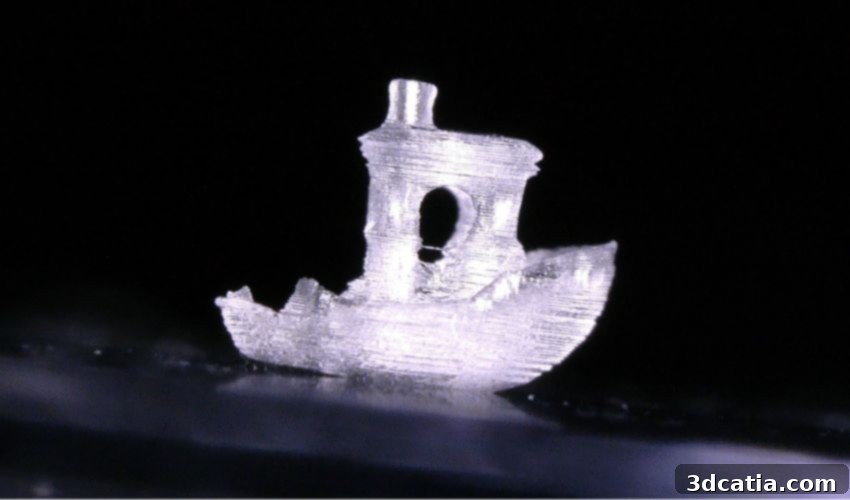
The EPFL team leverages a specialized method called HoloTile to generate these advanced holograms. HoloTile is instrumental in enabling them to reproduce complex 3D parts with exceptional fidelity and accuracy. This technology allows for the dynamic and precise manipulation of light fields, ensuring that the energy is delivered exactly where and when it’s needed to solidify the resin. The practical implications of this holographic approach are staggering. So far, the team has successfully 3D printed a variety of standard benchmark parts, including a benchy (a miniature boat often used to test 3D printer performance), cylinders, and spheres. What makes these demonstrations truly remarkable is not just the quality, but the speed and efficiency with which they were produced: each part was printed in less than 60 seconds. Moreover, this was achieved using an astonishing 25 times less optical power compared to other existing volumetric printing methods. This drastic reduction in energy consumption not only translates to lower operational costs but also positions holographic volumetric printing as a far more sustainable and environmentally friendly additive manufacturing technology.
Key Advantages of Holographic Volumetric Printing
- Unprecedented Speed: By solidifying entire volumes in seconds, holographic TVAM significantly outpaces traditional layer-by-layer methods and even improves upon existing volumetric techniques.
- Superior Energy Efficiency: The targeted light delivery dramatically reduces the power required, lowering operational costs and environmental impact.
- Enhanced Resolution: Precise control over light projection depth allows for the creation of intricate details and complex geometries with higher accuracy.
- Support-Free Manufacturing: The liquid resin naturally supports the printed object, eliminating the need for and waste associated with external support structures.
- Reduced Material Waste: Without supports, less resin is consumed per part, contributing to more sustainable manufacturing.
- Potential for Isotropic Properties: Since the object is formed volumetrically rather than layer-by-layer, it can exhibit more uniform mechanical properties in all directions, which is crucial for functional parts.
Future Outlook and Transformative Applications
While the initial results are incredibly promising, the researchers acknowledge that the process still requires further optimization to unlock its full potential. One of the primary goals for future development is to eliminate the need for rotating the resin tank. Removing this mechanical component would simplify the printing setup considerably, reduce maintenance requirements, and further decrease energy consumption by removing the power needed for rotation. This step would make the technology even more robust and accessible for various applications.
In terms of applications, the team has identified particularly compelling potential within the biomedical field. The ability to print complex 3D shapes with high resolution and speed, combined with minimal energy input, makes holographic volumetric printing an ideal candidate for delicate biological structures. Maria Isabel Alvarez-Castaño, an EPFL student and lead author of the study, articulates this vision: “We are interested in using our approach to build 3D complex shapes of biological structures, allowing us to bio-print, for example, life-scale models of tissues or organs.” This capability could revolutionize tissue engineering, enabling the creation of realistic organ models for drug testing, disease modeling, and eventually, for regenerative medicine applications such as creating scaffolds for tissue growth or even printing functional organoids. The precision offered by holography could also be vital for developing microfluidic devices, targeted drug delivery systems, and highly customized prosthetics and implants. Beyond biomedicine, this technology could also find applications in micro-robotics, complex optical components, rapid prototyping for consumer goods, and the production of highly customized, high-performance parts for various industries. Click HERE to find out more about this exciting research directly from EPFL.
The development of holographic volumetric additive manufacturing marks a significant milestone in the evolution of 3D printing. By addressing the core challenges of efficiency and resolution that have previously limited TVAM, this research opens up exciting new possibilities for manufacturing complex, high-precision objects at unprecedented speeds and with dramatically reduced energy footprints. As the technology continues to mature, its transformative potential, particularly in critical fields like biomedicine, is immense. This innovative blend of optics and materials science promises a future where 3D printing is not just faster and more efficient, but also more versatile and sustainable, driving forward a new era of manufacturing capabilities.
What do you think of this innovative 3D printing method developed by EPFL and the University of Southern Denmark? Do you believe holographic volumetric printing will become the new standard in additive manufacturing? Let us know your thoughts and predictions in a comment below or join the conversation on our LinkedIn, Facebook, and Twitter pages! Don’t forget to sign up for our free weekly Newsletter here, to receive the latest 3D printing news straight to your inbox! You can also find all our insightful videos on our YouTube channel, showcasing cutting-edge advancements in the world of additive manufacturing.
*All Image Credits: LAPD EPFL