
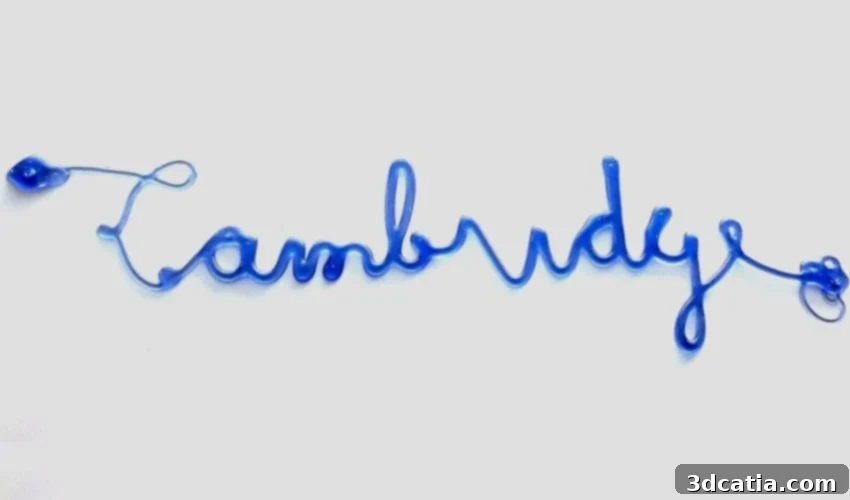
Jackson Pollock’s Drip Painting Technique Revolutionizes 3D Printing at Harvard: Harnessing Fluid Dynamics for Advanced Manufacturing
Jackson Pollock, an undisputed titan of 20th-century American art, fundamentally reshaped the landscape of contemporary art. Renowned globally for his abstract expressionism, Pollock distinguished himself through his pioneering drip painting technique. While his signature paint drips might appear to be random, chaotic splashes, the artistic process was, in fact, far more deliberate and controlled than often perceived. Pollock masterfully manipulated the flow of paint, applying it to canvases with calculated precision and allowing gravity to guide the colors into desired, intricate patterns. This innovative artistic approach has now found an unexpected and groundbreaking application: scientists at Harvard University’s Soft Math Lab have drawn inspiration from Pollock’s method to develop a novel 3D printing technology, marking a remarkable convergence of art and advanced engineering.
Traditional extrusion-based 3D printing, a prevalent method in additive manufacturing, typically mandates that the printer nozzle remain mere millimeters away from the build plate. This strict proximity is crucial for maintaining the stability of the material flow and preventing common printing errors such as warping, stringing, or inaccurate deposition. The underlying challenge stems from the principles of fluid dynamics: when liquids are extruded or allowed to fall from a significant height, they become inherently more unstable. These instabilities often manifest as the liquid stream folding, coiling, or breaking up, making precise control exceedingly difficult. However, Pollock, through his artistic genius, demonstrated an uncanny ability to control these fluid streams in his painting techniques, even from a distance. This observation sparked a pivotal question for the Harvard research team: could Jackson Pollock’s seemingly unconventional techniques be leveraged to enable faster, more accurate 3D printing of complex objects and intricate shapes from a greater, more flexible height?
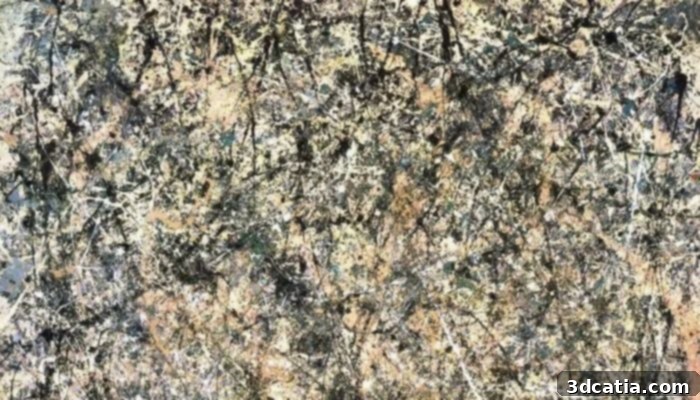
Jackson Pollock’s “Number 1 (Lavender Mist), 1950” exemplifies his masterful control of drip painting. (Image credits: Wikimedia Commons)
“Traditionally, in fluid dynamics and material extrusion, we go to great lengths to avoid instabilities like folding and coiling,” commented Gaurav Chaudhary, a key member of the Harvard research group. “Our novel approach, however, was to develop a technique that could actively take advantage of these very instabilities, transforming them from obstacles into tools for precision manufacturing.” To effectively translate Jackson Pollock’s intuitive ‘liquid rope trick’ into a quantifiable and repeatable process for 3D printing, the research group significantly benefited from the profound expertise of the study’s distinguished leader, L. Mahadevan. Mahadevan’s extensive work provided the foundational understanding necessary to bridge the gap between artistic expression and scientific application, particularly concerning the behavior of viscous fluids.
Mahadevan, an acclaimed Indian-American biologist and mathematician, possesses a rich history of investigating the mathematical properties governing a vast array of natural objects and materials. His previous research spans diverse phenomena, including the intricate mechanics of insect wings, the fascinating movement of fungi, and the complex formation of liquid droplets. Crucially, it was Mahadevan who, more than two decades ago, offered a seminal explanation and attributed a scientific rationale to the fluid dynamics inherent in Pollock’s methods. This deep understanding of how fluids behave under various conditions, particularly when subjected to gravity, proved invaluable. The Harvard researchers capitalized on this insight, ingeniously combining the principles of physics with advanced AI programming to adapt Pollock’s distinctive drip paint method into a framework for rapid and highly precise 3D printing. This interdisciplinary approach represents a significant leap forward in additive manufacturing, pushing the boundaries of what’s possible with modern fabrication techniques.
It is important to clarify the objective of this pioneering research. The team’s aim was emphatically not to develop new, AI-driven art inspired by Jackson Pollock using complex algorithms, nor was it to replicate his specific artistic style for aesthetic purposes. Rather, the primary focus was on reverse-engineering the artist’s career-defining technique – his masterful control over fluid dynamics – and repurposing it for practical application in additive manufacturing. The core hypothesis was that by understanding and mimicking Pollock’s method of dispensing viscous liquids from a height, they could dramatically facilitate the fast and accurate 3D printing of highly complex shapes, even when the printing nozzle operates at a greater distance from the printing plate. This would overcome a long-standing limitation in many traditional 3D printing processes, opening doors to new design possibilities and material handling capabilities across various industries.
“If you examine how traditional 3D printers function, you typically provide them with a pre-defined path from point A to point B, and the nozzle diligently deposits material precisely along that specified trajectory,” Chaudhary further elaborated. “However, Pollock’s revolutionary approach of throwing or dripping paint from a significant height introduced an entirely different dynamic. Even if his hand followed a specific trajectory, the paint itself didn’t strictly adhere to that path due to the substantial acceleration it gained from gravity. This meant that a relatively small, controlled motion from his hand could result in a much larger, more expansive splatter or deposition of paint. By intelligently harnessing this technique, we can effectively print much larger lengths or areas than the physical movement range of the nozzle itself, precisely because we gain this invaluable ‘free acceleration’ from gravity. This principle is key to achieving efficiency and scale in additive manufacturing, potentially revolutionizing how large-scale and intricate objects are produced.”
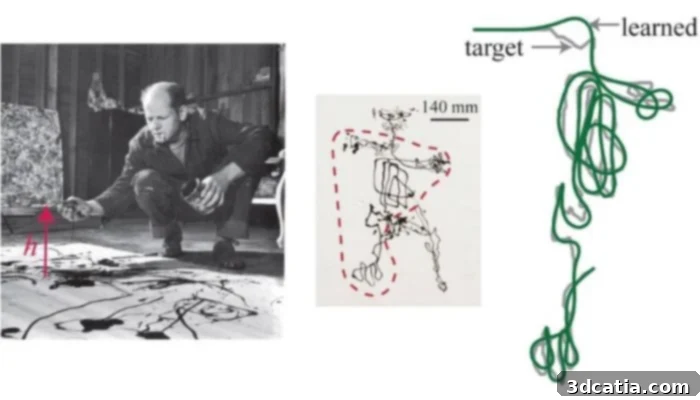
Pollock intuitively experimented with fluid dynamics in his artistic projects. Artificial intelligence and machine learning now enable machines to learn and imitate this controlled drip style for manufacturing. (Image credits: SEAS Harvard)
Achieving successful and precise printing from a greater distance, however, hinges on the ability to exert sophisticated control over the dripping liquid as it exits the nozzle of a 3D printer. To effectively ‘teach’ the nozzle this intricate control, the Harvard researchers employed a cutting-edge approach: deep reinforcement learning (DRL) machine learning. DRL represents a powerful algorithmic methodology designed for iterative performance improvement, where an agent learns optimal actions by interacting with its environment and receiving feedback. “With deep reinforcement learning, the model is not simply executing pre-programmed instructions; it actively learns from its mistakes and progressively refines its strategy, becoming more and more accurate with each successive trial,” explained Chaudhary. Through this adaptive method, the nozzle repeatedly engages with the printing environment, dispensing a viscous filament. Based on the repeated outcomes and perceived ‘errors’ or ‘successes’ of these tests, the DRL algorithm continuously adjusts and improves its printing strategy, leading to a highly optimized and precise control system capable of handling the inherent instabilities of falling fluids.
A relatable visualization for understanding this innovative drip method is akin to the process of meticulously applying icing onto cookies or decorating a cake. Indeed, the researchers themselves utilized chocolate syrup to decorate cookies and print various complex shapes, serving as an accessible yet effective demonstration of their method’s capabilities. While the initial studies predominantly employed simple, common liquids, the research team emphasizes the profound future potential of this approach. It can foreseeably be extended to a wide array of more complex materials, including various liquid polymers for industrial applications (e.g., aerospace, automotive), thick pastes for construction or intricate crafts, and even diverse foodstuffs for personalized food manufacturing. This expansion could unlock entirely new horizons in 3D printing, enabling applications ranging from biomedical device fabrication to customized culinary creations. The ability to precisely manipulate viscous fluids from a distance opens up unprecedented possibilities for design and material processing across numerous sectors, promising increased efficiency and design freedom.
Concluding the significance of their work, Mahadevan summarized, “Harnessing fundamental physical processes for achieving functional, engineered outcomes is not only a hallmark of intelligent behavior but also lies at the very heart of effective engineering design. This intriguing example, where artistic intuition meets scientific rigor, suggests once again that a deeper understanding of the evolution of the first – natural and artistic processes – can profoundly help us become better at the second – designing and building for the future.” This interdisciplinary triumph underlines the power of looking beyond conventional boundaries to drive innovation. It serves as a testament to how insights from seemingly disparate fields, like abstract art and fluid mechanics, can converge to create revolutionary technologies that push the frontiers of modern manufacturing. For those interested in delving further into the specifics of this groundbreaking Harvard project, additional details and insights can be found HERE.
What are your thoughts on this fascinating Jackson Pollock-inspired 3D printing method currently under research at Harvard University? We invite you to share your insights and comments below, or join the conversation on our Linkedin, Facebook, and Twitter pages! Don’t miss out on the latest advancements in additive manufacturing – subscribe to our free weekly Newsletter here to receive top 3D printing news directly in your inbox. You can also explore all our insightful videos on our dedicated YouTube channel.
*Cover photo credits: Soft Math Lab/Harvard SEAS