
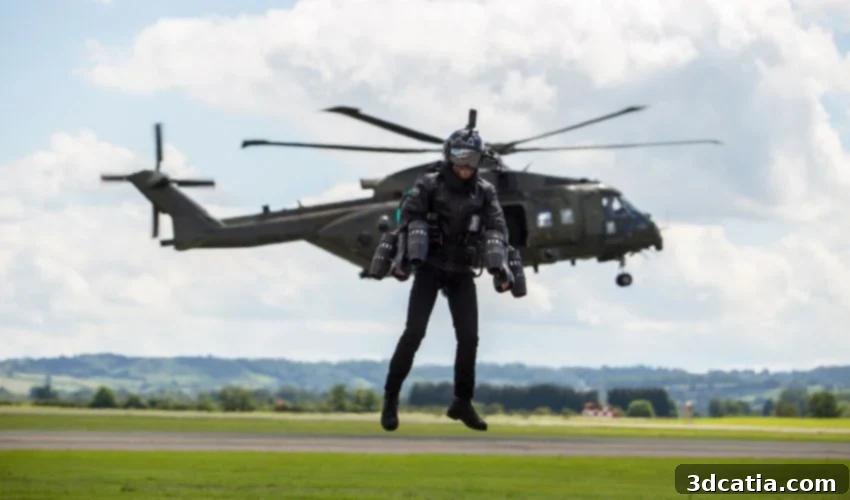
Soaring to New Heights: How 3D Printing Powers Gravity Industries’ Revolutionary Jet Suits
The long-held dream of human flight has finally become a reality, not in some distant future, but here and now. What once seemed like science fiction is being brought to life by innovative companies like Gravity Industries, harnessing the transformative power of additive manufacturing. Imagine the thrill of soaring through the skies, unencumbered by traditional aircraft. This incredible experience is no longer limited to an exclusive few; Gravity Industries offers flight training and experiences, allowing individuals to don their groundbreaking Jet Suit and defy gravity. This revolutionary wearable technology, the result of extensive research and development, relies heavily on advanced 3D printing technologies, which proved to be a clear winner in numerous rigorous tests. To delve deeper into this fascinating intersection of human ambition and cutting-edge technology, we recently sat down with Sam Rogers, Gravity Industries’ chief designer, to discuss the journey, the technology, and the future of personal flight.
3DN: Can you introduce yourself and explain your involvement with additive manufacturing?
“I’m Sam Rogers, and I lead the design efforts for the Gravity Jet Suit,” Sam began. “My journey into the world of advanced manufacturing began long before Gravity Industries. I had the privilege of working on some of the very first 3D printed copper rocket engines, components critical for space shuttles. This involved intricately designing combustion chambers and turbo pumps, ensuring they were optimally tailored for the unique capabilities of 3D metal printing. This experience provided invaluable insights into the precision, complexity, and performance potential of additive manufacturing. It was this expertise and passion that ultimately led me to join Gravity Industries in its formative stages. Here, we’ve taken the principles of advanced 3D printing and applied them extensively, culminating in our fully 3D printed Jet Suit. Additive manufacturing isn’t just a part of our process; it’s fundamental to the very existence and evolution of our designs.”

The innovative team behind Gravity Industries, pioneering personal flight.
3DN: How did the Gravity Industries adventure begin, and what inspired such a groundbreaking project?
“The Gravity Industries adventure truly took flight in 2016,” Sam explained, “when our founder, Richard Browning, embarked on a daring personal quest. His initial motivation was simple yet profound: to explore the limits of human-augmented propulsion. Driven by the sheer pleasure of the challenge and a deep curiosity, he wanted to see if a human’s innate sense of balance and sophisticated control system could be effectively applied to control thrust generated by turbojet engines mounted directly onto the limbs. This wasn’t about building a machine that flew; it was about extending the human body’s capabilities. The early days involved a rapid series of experimental iterations. Richard started by mounting engines in various configurations – first on the legs, then on the back, and finally, strategically on the arms. Each configuration presented unique challenges and learning opportunities regarding stability, control, and power distribution. Through this relentless process of experimentation, refinement, and an unwavering commitment to innovation, he progressively arrived at the ingenious and now iconic design of the Jet Suit we proudly fly today. It’s a testament to human ingenuity and the power of iterative design.”
3DN: What specific materials and technologies do you utilize in manufacturing the Jet Suit, and what does the process entail?
“The manufacturing process for the Jet Suit is a true showcase of modern additive manufacturing capabilities,” Sam elaborated. “At its core, the Jet Suit is almost entirely 3D printed. We primarily work with high-performance polymers like polypropylene and nylon, alongside robust aluminum alloys. For the polymers, we extensively use Selective Laser Sintering (SLS), and for metal components, Direct Metal Laser Sintering (DMLS). Our team has rigorously experimented with nearly every 3D printing process available on the market – FDM, SLA, PolyJet, and more. However, SLS consistently emerged as the clear winner for our specific requirements. The primary reasons for SLS’s triumph lie in its unparalleled design flexibility, allowing us to create complex, organic geometries that would be impossible with traditional manufacturing. Furthermore, its ability to produce parts with excellent surface finish and exceptional robustness, crucial for components exposed to the stresses of flight, makes it indispensable. The SLS process involves using a laser to selectively sinter powdered material layer by layer, building up the part from the bottom. This method requires no support structures, freeing designers from conventional constraints and enabling lighter, more integrated designs. Similarly, DMLS uses a laser to fuse metal powder, creating incredibly strong and heat-resistant parts, essential for engine components or structural elements that demand superior mechanical properties. The synergy of these technologies allows us to push the boundaries of what’s possible in wearable propulsion systems.”
3DN: What distinct advantages and, if any, limitations do you encounter when using 3D printing for the Jet Suit?
“The advantages of 3D printing for us are truly transformative,” Sam stated enthusiastically. “First and foremost, it grants us unparalleled agility in design iteration. We can effortlessly improve and refine the Jet Suit’s design with each successive prototype, often making radical changes from one day to the next. This rapid prototyping capability drastically accelerates our development cycle. Beyond speed, 3D printing offers tremendous flexibility in terms of both aesthetics and internal structural optimization. We can create highly complex internal lattice structures or organic shapes that reduce weight while maintaining or even increasing strength. This is vital for a device designed for human wear, where every gram counts. We can optimally design for assembly, integrating multiple functions into single printed parts, which significantly reduces the number of individual components and, consequently, the manual processes required to build each Jet Suit. This streamlining of the assembly process not only saves time but also enhances reliability by minimizing potential points of failure. The ability to innovate and iterate quickly is paramount in a rapidly evolving field like personal flight. While 3D printing might have perceived limitations in terms of material costs or build envelope sizes for certain very large components compared to mass production methods, the immense benefits in terms of design freedom, speed to market, and performance customization far outweigh these. For us, it’s about creating bespoke, high-performance systems where traditional manufacturing simply couldn’t keep pace with our ambition.”
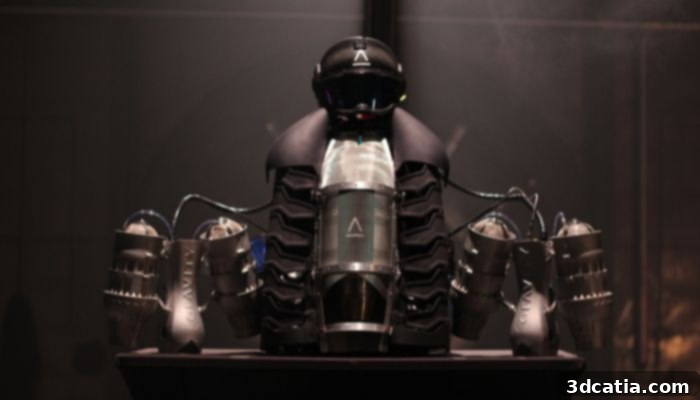
A closer look at the advanced 3D printed components of the Jet Suit.
3DN: What can we expect in terms of future developments from Gravity Industries?
“Ah, the future – that’s where a lot of the magic is still under wraps!” Sam chuckled. “While I can’t reveal all our secrets, I can share our overarching vision. We’ve made incredible strides in transforming the Jet Suit from an experimental marvel into a highly capable and reliable tool. Our focus moving forward is on making it even more robust, rugged, and significantly easier to use. This ‘toolification’ is absolutely essential for any device intended for real-life applications, whether it’s for emergency services, industrial inspection, or even advanced entertainment. Imagine a future where flying is as intuitive as riding a bicycle. We are diligently working on enhancing the suit’s durability, ensuring it can withstand demanding environments and prolonged use. Furthermore, user experience is paramount. We’re refining the controls and interfaces to make flight accessible and natural for a wider range of individuals. And, of course, aesthetics play a crucial role. We believe that if a product is going to be truly revolutionary and widely adopted, it also needs to look good. We’re investing in design improvements to ensure the Jet Suit is not only functionally superior but also visually striking and aesthetically pleasing. Expect continuous innovation that makes personal flight more practical, more reliable, and undeniably stylish.”
3DN: Any last words or messages for our readers who are inspired by Gravity Industries’ work?
“Absolutely. One of Gravity’s most fundamental goals extends beyond just building Jet Suits; it’s about inspiring people,” Sam emphasized. “We want to ignite imagination and demonstrate what is truly possible when you push the boundaries of technology and human potential. We believe in empowering individuals, and that’s why we’re proud to offer flight training courses for those who aspire to learn to fly for themselves. These courses provide a unique opportunity to experience the incredible freedom of flight under expert guidance. For those keen to stay updated on our journey and witness the latest advancements, you can find more information about our recent test flights, groundbreaking achievements, and exciting future plans directly on our official website HERE. We also encourage everyone to connect with us and follow our progress on social media. Join our community and be a part of this incredible journey into the future of human mobility.”
What are your thoughts on Gravity Industries’ revolutionary approach to personal flight and the pivotal role of additive manufacturing? Share your opinions in a comment below or join the conversation on our vibrant Facebook and Twitter pages. And don’t miss out on the latest advancements in the world of 3D printing – be sure to sign up for our free weekly newsletter, delivering all the essential news straight to your inbox!
*All photo credits: Gravity Industries