
Unlocking Large-Format 3D Printing: Ginger Additive Makes Pellet Technology Accessible
The landscape of additive manufacturing is continually evolving, and within this dynamic field, the utilization of pellets as a primary material for extrusion 3D printing is rapidly emerging as a profoundly viable and increasingly important technology. Already embraced by a growing number of market players, particularly within the realm of large-format 3D printing, this method offers a myriad of compelling benefits. From facilitating the use of an expansive variety of plastics and enhancing sustainability through the potential for recycled materials, to enabling massive robotic arms to produce previously unfeasible works, pellet-based 3D printing is pushing the boundaries of what’s possible. We recently had the opportunity to delve deeper into these advancements and more with Ginger Additive, an innovative young Italian startup dedicated to making this transformative technology more accessible to a wider audience.
The Genesis of Ginger Additive and Their Vision for 3D Printing
Ginger Additive was founded by Umberto Bisotti and Davide Malnati, two engineers under the age of 30 who shared a common academic journey at Politecnico di Milano. Their journey into the world of pellet 3D printing began nearly three years ago with a pivotal prototype. This initial venture quickly unveiled the immense, untapped potential of pellet-based additive manufacturing, sparking the inspiration that would lead to the creation of Ginger Additive. Their flagship product, Ginger.one, stands today as the first low-cost FDM technology printer utilizing pellets, manufactured and sold directly by the company. Beyond machine production, Ginger Additive also operates a dedicated production department, collaborating closely with designers and design studios to manufacture bespoke parts, showcasing the practical applications of their innovative technology.
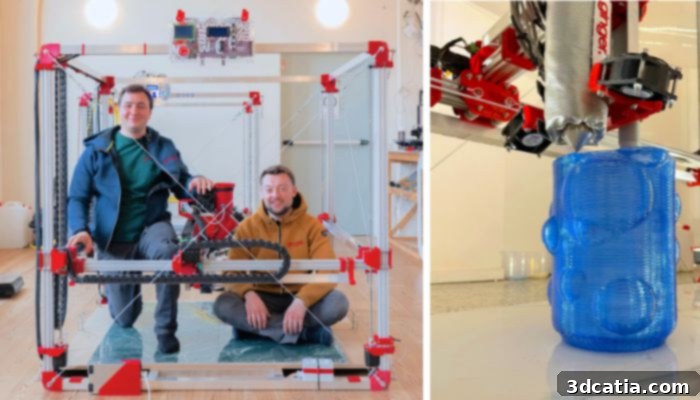
Umberto Bisotti and Davide Malnati with their solution, Ginger.one
Ginger Additive’s Mission: Democratizing Pellet 3D Printing
Based in Milan, Ginger Additive is steadfastly focused on the development and promotion of large-format pellet 3D printing. The founders firmly believe that 3D printing, in its myriad forms and applications, is destined to become an indispensable component of global manufacturing. However, despite its inherent advantages, pellet printing has historically faced barriers to widespread adoption. While the technology itself is well-developed and continues to advance, its integration into diverse sectors has been hampered by the high fixed costs associated with existing machinery. The current market offerings often reflect this prohibitive cost structure, limiting access for many potential users. Recognizing this critical gap, Ginger Additive has articulated a clear and simple mission: **accessibility**. The company is committed to developing innovative technology that can seamlessly integrate into everyday life and, crucially, open the doors of this powerful manufacturing world to Small and Medium-sized Enterprises (SMEs) and independent professionals who have traditionally found such advanced tools out of reach.
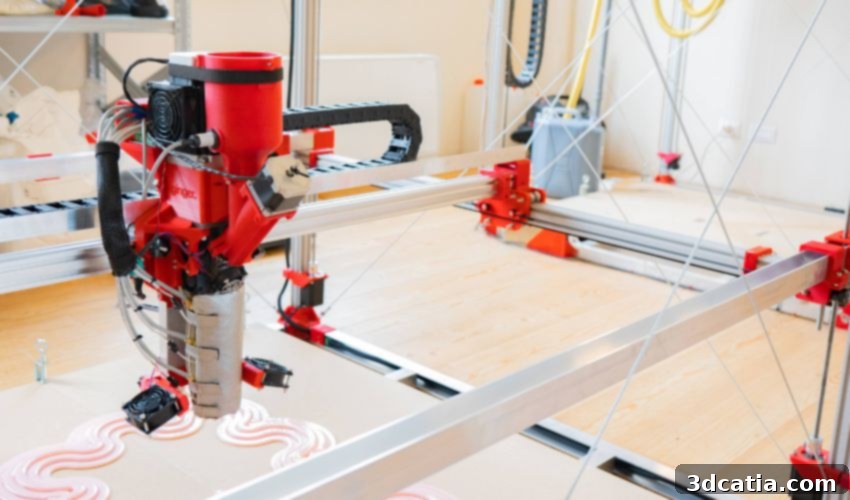
Ginger Additive’s answer to this challenge is Ginger.one, a pioneering pellet 3D printer engineered specifically to be a robust and cost-effective solution for low to medium complexity projects. This Cartesian-based machine leverages granule extrusion technology, capable of extruding industrial pellets at an impressive rate of up to 2 kg/h. Designed with practicality in mind, Ginger.one boasts a generous print volume of 1 m x 1 m x 1 m, while maintaining remarkably low energy consumption. Perhaps its most significant attribute is its unparalleled low cost relative to other solutions currently available in the market. Furthermore, its optimized footprint means it can be comfortably housed in a variety of spaces, from a living room to a small studio, making it truly accessible. A testament to their innovative approach, a substantial portion of Ginger.one’s components are themselves 3D printed. All necessary design files are supplied with the machine, empowering users with the ability for self-maintenance and even modifications, fostering a truly open and user-centric ecosystem.
The Unrivaled Benefits of Pellets Over Filaments in FDM 3D Printing
The advantages of employing pellets, as opposed to traditional filament, as the material feedstock for FDM 3D printing are profound and multifaceted, particularly in terms of cost-efficiency, material versatility, and print scale. Pellet extrusion fundamentally enables the direct use of industrial plastic formats. This eliminates the costly and energy-intensive intermediate step of converting raw plastic granules into specialized filaments, leading to significant reductions in both material cost and overall consumption. This economic benefit alone represents a paradigm shift for many manufacturing operations.
Beyond cost savings, pellets unlock an extensive palette of materials. They make it possible to process uncommon, highly loaded materials, or composites that simply cannot be extruded into a stable filament. This broadens the creative and functional applications of 3D printing dramatically. Moreover, and critically for sustainable practices, pellet extruders can directly utilize shredded and recycled plastic, transforming waste into valuable products and promoting a circular economy. This capability positions pellet 3D printing as a frontrunner in environmentally conscious manufacturing.
Another critical limitation of filament-based systems lies in nozzle size. Filaments typically restrict users to nozzles no larger than a couple of millimeters, which in turn limits extrusion flow and print speed. Ginger Additive’s machines, utilizing pellet extrusion, overcome this bottleneck by employing nozzles up to 8 mm. This allows for line thicknesses of up to 2 cm, facilitating exceptionally high extrusion flows. The ability to deposit material much faster dramatically cuts down the variable cost associated with printing time, making large and complex projects economically feasible. For projects requiring significant scale, printing with filament quickly becomes an impractical choice due to prohibitively high material costs and excessively long print durations. Pellets are, therefore, the quintessential key to unlocking truly large-format additive manufacturing. The primary hurdle to the widespread adoption of this superior technology has been the high fixed costs of the necessary equipment – precisely the challenge Ginger Additive was founded to address and overcome.

A part made with pellet 3D printing on the Ginger.one from Ginger Additive
Target Markets and Pioneering Applications for Ginger Additive
Ginger Additive is strategically targeting markets where the benefits of large-format, accessible pellet 3D printing can create the most significant impact. Foremost among these is the world of design, with a particular emphasis on furniture. This sector has already begun to embrace additive manufacturing over the past few years, recognizing its potential for customization, rapid prototyping, and the creation of complex geometries. Ginger Additive actively engages with this sector both as a manufacturer of cutting-edge machines and as a robust manufacturing service provider. Evidence of their success lies in the fact that almost all of their machinery sold to date has been acquired by design and architecture firms. The inherent flexibility of 3D printing, combined with the extensive material options available through pellet extrusion, opens up vast possibilities that span from pure aesthetics to total functionality, making it ideal for the diverse demands of modern design.
Working in close collaboration with a diverse array of artists and designers, Ginger Additive has had the distinct privilege of bringing many truly incredible projects to fruition. They proudly highlight some of their impactful contributions, particularly those showcased at the most recent Milan Design Week, a global benchmark for innovation in design. These projects include: the impressive production of beautiful and striking Buoy lamps, reaching monumental heights of up to 5 meters, envisioned by the talented Parisian designer Lucas Zito; a synergistic collaboration with Lyla Design studio, which develops intuitive online software for the modeling of furniture objects, demonstrating how Ginger.one seamlessly integrates into digital design workflows; and a fascinating project involving the printing of a special natural lacquer, a unique material deposited by an insect, executed in partnership with designer Ori Orisun. These diverse applications underscore the versatility and transformative power of Ginger Additive’s technology in pushing creative boundaries.
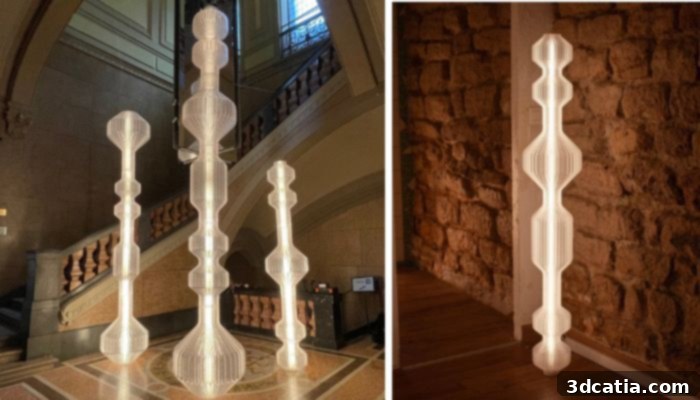
Photo Credits: Ginger Additive/Lucas Zito
A Future Vision: 3D Printing in Every Home
As Ginger Additive continues its journey, the founders extend their gratitude to 3Dnatives and its dedicated readership. Their ultimate hope is that in the very near future, the sight of a 3D printed chair, lamp, or any custom-designed object in a home, office, or public space will become an absolutely common and unremarkable occurrence. This vision encapsulates their mission of making advanced manufacturing not just accessible, but ubiquitous. To learn more about Ginger Additive’s innovative solutions and their groundbreaking work, interested readers are encouraged to visit their official website HERE.
We invite you to share your thoughts on Ginger Additive’s pioneering work in the comments section below, or engage with us on our various social media platforms, including LinkedIn, Facebook, and Twitter. Don’t miss out on the latest advancements and news in the 3D printing industry; be sure to sign up for our free weekly Newsletter here, delivering the most current information straight to your inbox! Additionally, you can explore all our engaging videos and content on our YouTube channel.
*All Photo Credits: Ginger Additive