

Gil Lavi: Pioneering the Future of Additive Manufacturing and Driving Global Adoption
Continuing our insightful series on the most influential personalities in additive manufacturing, following interviews with Avi Reichental and Hanan Gothait, we now turn our attention to Gil Lavi. As a true pioneer in the industry, Gil embarked on his journey in the early 2000s, initially contributing his expertise to the renowned manufacturer Objet Geometries, which later merged with Stratasys. His tenure there laid the groundwork for a profound understanding of the nascent 3D printing market before he ventured into his own entrepreneurial endeavors.
In an industry characterized by relentless innovation and rapid transformation, Gil Lavi has navigated significant shifts and spearheaded key developments. This interview aims to explore his experiences and perspectives: How has Gil adapted to the dynamic changes within the additive manufacturing landscape over recent years? What enduring opportunities and persistent challenges does he perceive within this evolving market? 3Dnatives had the privilege of sitting down with him to gain deeper insights into his journey and vision for the future of 3D printing.
3DN: Could you tell our readers about your previous experience in Additive Manufacturing (AM)?
My involvement with the additive manufacturing industry began 13 years ago when I joined Objet Geometries. At that time, it was a truly unique and groundbreaking startup in an industry still in its infancy. The landscape was vastly different, with no more than a dozen significant 3D printing companies globally. It was a period defined by an unwavering belief in a transformative vision for how products would be designed and manufactured. I dedicated a decade of my career to the company, including three years post-merger with Stratasys. During this time, I was instrumental in establishing and managing the company’s robust network of sales partners across Europe, and subsequently took on the responsibility for the company’s strategic accounts in the entire EMEA region. My role involved not just sales, but building foundational relationships and market presence. In 2015, I transitioned from the company with a clear objective: to identify and assist innovative startup companies in the AM space. My goal was to leverage my extensive experience to help them formulate effective go-to-market strategies and successfully deploy their global channel networks, bringing their cutting-edge technologies to a wider audience.
3DN: What about your current work in the AM industry?
Throughout my years in the industry, I continually observed a significant disconnect within the market. On one hand, I met numerous 3D printing resellers who were actively seeking promising new products to add to their portfolios but often had limited resources or expertise to thoroughly vet and choose the most suitable technologies from a burgeoning market. They needed guidance in navigating the flood of new solutions. Conversely, I encountered dozens of ambitious 3D printing startup companies that possessed incredible innovation but lacked the necessary experience, established networks, and direct access to professional sales partners required to build and scale their global channel networks effectively. This dual challenge presented a clear opportunity to create a bridge between these two vital segments of the industry.
It was precisely to address this critical gap that I founded 3D Alliances at Formnext 2018. 3D Alliances operates as a specialized consulting firm dedicated to forging strategic business alliances with leading hardware and software 3D printing companies. Our core mission is to empower these innovative companies to successfully deploy, manage, and optimize their global channel networks, ensuring their technologies reach the right markets and customers. Currently, our carefully curated portfolio features three exceptional companies, each bringing unique and disruptive solutions to the additive manufacturing landscape. This includes XJET3D from Israel, renowned for its incredible NanoParticle Jetting™ technology, which is revolutionizing Metal and Ceramic 3D printing with unparalleled precision and material density. We also partner with Essentium3D from Texas, USA, the developer of some of the world’s fastest and most robust extrusion platforms, enabling high-volume, industrial-grade production. The third jewel in our crown is ParaMatters from California, USA, a key part of XponentialWorks Innovation Lab, which has developed one of the most powerful and intuitive topology optimization software solutions in the industry, enabling engineers to design highly optimized, lightweight, and performant parts. All these companies are not only promising but also well-funded, offering truly unique and impactful solutions. We are actively engaged in discussions and look forward to signing new business alliance agreements in the coming months, further expanding our portfolio with other groundbreaking technologies.
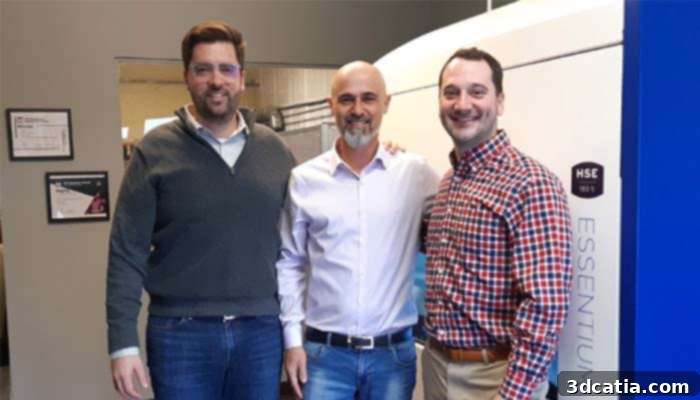
Gil Lavi with the team behind Essentium, one of 3D Alliances’ portfolio companies.
To date, we have meticulously built and nurtured an extensive network comprising over 1,200 active 3D printing and additive manufacturing resellers spanning 72 countries. This formidable network is, in fact, the largest of its kind in the industry, providing an unparalleled reach. We strategically leverage this vast network to meticulously identify, recruit, and onboard the most suitable and professional sales partners for each specific company we collaborate with, ensuring optimal market penetration and sales performance.
Beyond this core activity, we have recently innovated by launching a new, highly valuable service specifically for 3D printing resellers: **comprehensive overview reports on interesting startup companies** within the industry. These meticulously compiled reports provide in-depth information and critical insights that empower resellers to efficiently discover new companies, thoroughly evaluate their products, and make informed decisions about potential partnerships, thereby saving them significant time and resources in their product discovery process.
3DN: How has the industry changed over the years?
The additive manufacturing industry has undergone a profound transformation over the past 13 years, with countless developments shaping its current landscape. However, I believe three overarching changes stand out as the most significant and impactful:
(1) Firstly, there has been an explosive growth in the sheer number of 3D printing companies entering the market. This proliferation was largely catalyzed by the expiration of key foundational patents, such as those related to Fused Deposition Modeling (FDM) and Stereolithography (SLA). These expirations democratized access to previously proprietary technologies, significantly lowering barriers to entry. This, coupled with substantial new investments from venture capitalists and established industrial players, alongside the arrival of a new, highly innovative generation of entrepreneurs, created fertile ground for an unprecedented wave of startups and technology advancements.
(2) Secondly, the overarching vision for the industry has fundamentally shifted. The initial perception of 3D printing primarily as a rapid prototyping tool has evolved dramatically. Today, the new paradigm is squarely focused on implementing 3D printing technologies directly into large-scale, functional manufacturing processes. This transition from prototyping to industrial production is driven by the realization of additive manufacturing’s potential for producing end-use parts, enabling mass customization, fostering on-demand manufacturing, and streamlining complex supply chains, thereby offering significant economic and logistical advantages.
(3) And perhaps one of the most important changes – 3D printing has finally achieved widespread recognition as a revolutionary force that is fundamentally reshaping the way products are conceived, designed, and manufactured across all sectors. It is no longer a niche technology but a mainstream driver of industrial innovation, acknowledged for its capacity to disrupt traditional production methods and create entirely new possibilities.
This profound recognition explains why we are witnessing an incredible diversity of industries actively developing groundbreaking solutions using additive manufacturing. We see its application in printing complex food structures, fabricating patient-specific body parts for medical applications, rapidly constructing houses and architectural elements, manufacturing intricate circuit boards, customizing furniture designs, producing unique fashion items, and countless other applications. This acceleration of specialized developments, driven by tailored material science and process innovations, is set to intensify. I have absolutely no doubt that in the coming years, we will see an even more rapid acceleration of these special developments, pushing the boundaries of what is possible with additive manufacturing.
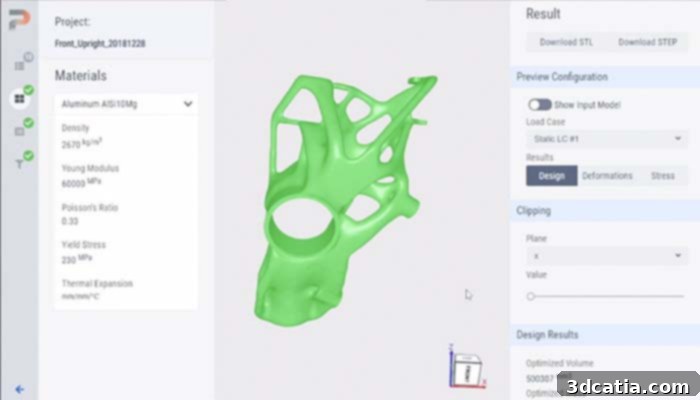
Gil Lavi has been working closely with ParaMatters, a 3D software company based in the U.S. focused on topology optimization.
3DN: What has caught your eye in the last few months?
What has particularly captured my attention recently isn’t a single company or a specific technology, but rather a more fundamental understanding of the critical synergy required between the diverse range of industrial hardware and software solutions available today. It’s become increasingly clear why it is absolutely essential to tailor and integrate them together under one cohesive ecosystem in the future to unlock the full potential of additive manufacturing. I envision three primary types of complementary solutions that must seamlessly interoperate:
Firstly, **Software** solutions are paramount. This includes advanced capabilities like generative design, which uses AI to optimize part geometries for performance and material efficiency; robust data security protocols to protect intellectual property and ensure secure digital manufacturing workflows; and sophisticated workflow management systems that streamline the entire additive manufacturing process from design to production. These software tools are the brains of the operation.
Secondly, the output itself, which refers to the myriad different types of **3D printing technologies**. These technologies are continuously breaking traditional barriers in terms of printing speed, expanding the variety and performance of printable materials (including advanced polymers, metals, ceramics, and composites), and significantly enhancing part strength and reliability. These advancements in hardware are crucial for enabling industrial-scale production.
The last, but by no means least, is **post-processing**. This stage will become increasingly essential as printing speeds continue to rise and, with it, the overall volume of printed parts – particularly for functional, end-use components. Automated and integrated post-processing solutions are critical for achieving desired surface finishes, ensuring mechanical properties, and ultimately meeting the stringent quality requirements for production parts. From heat treatment and surface finishing to support removal and inspection, efficient post-processing is as vital as the printing itself.
When viewed from the perspective of heavy industrial users, their primary objective is to implement a complete, robust, and reliable end-to-end solution. Such a solution must encompass all necessary elements of the entire additive manufacturing workflow, from the initial design phase through to the creation of the final end-use parts, critically, with no major bottlenecks or interruptions in the process. This holistic approach is what will drive widespread industrial adoption and transform manufacturing paradigms.
3DN: What are the remaining challenges to the global adoption of Additive Manufacturing?
At this juncture, it is evident that the additive manufacturing industry boasts a wealth of innovative 3D printing technologies and solutions, many of which hold immense potential to truly revolutionize manufacturing. However, despite these advancements, there often remain significant gaps between what these cutting-edge technologies are theoretically capable of achieving and their seamless, practical implementation within complete, standardized manufacturing processes. Bridging these gaps is crucial for widespread global adoption.
Beyond specific performance gaps, which still include areas like maximizing printing speed, ensuring consistent material strength and mechanical properties, and further diversifying the range of printable, production-grade materials, I believe one of the most critical and overarching challenges that must be addressed is **automation**. To genuinely revolutionize manufacturing and enable lights-out production, we require smooth, highly automated solutions that demand minimal human intervention at every stage of the workflow. This automation must span from the initial design phase, integrating seamlessly through the entire printing process, and extending robustly into the post-processing stages, with the ultimate goal of producing a final, certified end-use part without manual bottlenecks. While the industry has made impressive strides and you can certainly find great individual solutions for various steps today, most of these systems currently operate in isolation, as disparate entities. The key to significantly increasing the adoption of additive manufacturing across a multitude of industries will be the successful integration and tailoring of all these individual solutions under one comprehensive, intelligent, and interconnected ecosystem. This unified approach will enable predictable, scalable, and cost-effective additive manufacturing, ultimately accelerating its industrialization.
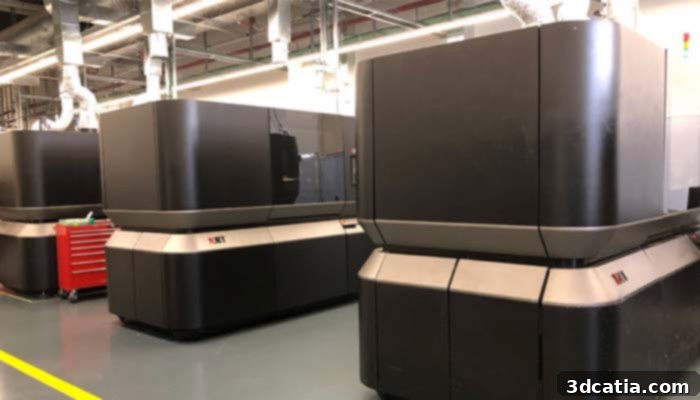
XJET3D, based in Israel, is one of the innovative companies working with 3D Alliances, showcasing advanced metal and ceramic 3D printing.
What are your thoughts on Gil Lavi’s extensive career and insightful perspectives on the additive manufacturing industry? We invite you to share your comments below or engage with us on our Facebook and Twitter pages! Don’t forget to sign up for our free weekly Newsletter, ensuring you receive all the latest news, analyses, and exclusive insights in the world of 3D printing delivered straight to your inbox every week!