
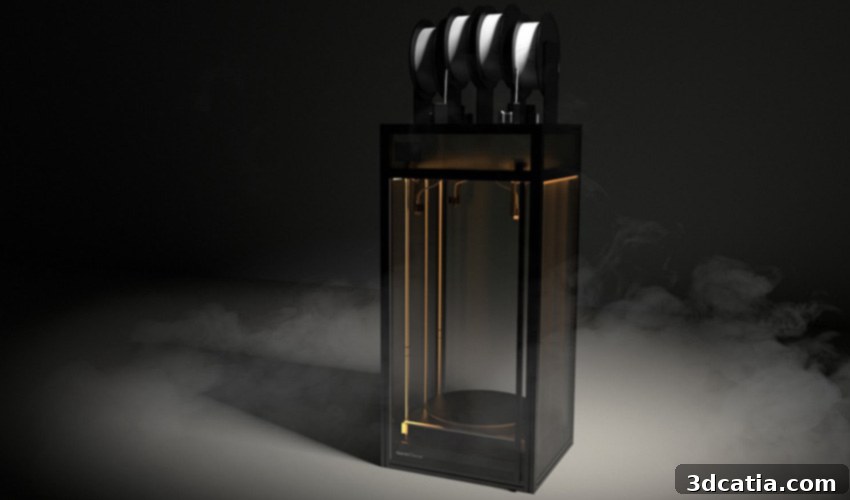
Gantri’s Dancer: Pioneering On-Demand Design Manufacturing with Proprietary 3D Printing Innovation
Great design ideas are abundant, yet they frequently encounter a significant roadblock: the high costs and lengthy timelines associated with traditional industrial manufacturing. This formidable barrier often stifles creativity and prevents innovative concepts from ever reaching production. Recognizing this critical challenge, Gantri has emerged with a revolutionary alternative, aiming to disrupt the conventional manufacturing model. They argue that the existing system demands excessive time and financial investment, particularly for creating the initial prototypes or test runs of a design idea. In response, Gantri has developed a sophisticated digital platform, empowering designers to conceptualize and develop fully-functional products from any location in the world. These unique products are then showcased on Gantri’s curated online marketplace. Once a product is purchased, it is brought to life in real-time at their state-of-the-art 3D printing factory located in California, effectively bridging the gap between design inception and tangible creation.
In a significant stride forward, the company recently made an exciting announcement: the development of its own proprietary 3D printer, specifically engineered to optimize these unique manufacturing operations. This groundbreaking machine has been christened “The Dancer.” On their official blog, Gantri offers a compelling narrative, detailing the extensive journey and the innovative spirit that culminated in the creation of this remarkable device. They articulate their vision, stating: “We’ve quietly moved away from the idea of a printer in every home to what the technology was supposed to be all along — a revolution in manufacturing. The benefits of 3D printing are clear. Traditional manufacturing requires scale to be efficient, while 3D printing can meet or exceed quality/efficiency goals with the first unit.” This statement underscores Gantri’s profound belief in the transformative potential of additive manufacturing, positioning it not merely as a consumer gadget, but as a pivotal force reshaping industrial production.
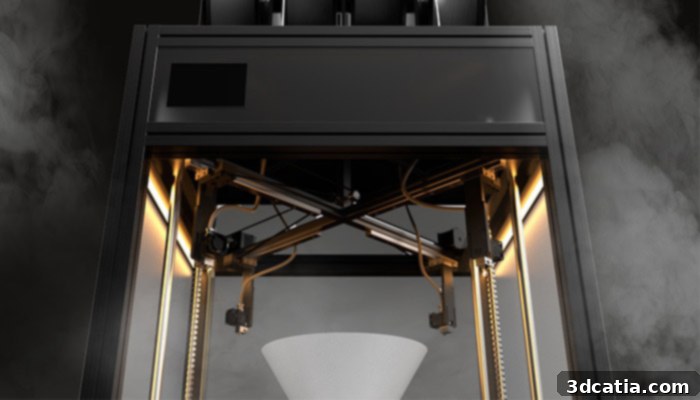
Image via Gantri
Gantri’s Vision for On-Demand 3D Printing in the Home Design Sector
So, how does the concept of 3D printing for the home design and decor sector translate into a viable business model and a sustainable future? The innovators behind Gantri are unequivocally convinced that this approach represents the next frontier for the entire industry. They highlight the intrinsic adaptability of 3D printing technology, which can effortlessly pivot to accommodate rapidly evolving customer tastes, emerging trends, and dynamic market demands. This agility stands in stark contrast to the rigid and slow-moving processes of traditional manufacturing, where retooling for new designs is both time-consuming and prohibitively expensive.
Despite this immense potential, the sector still grapples with a notable scarcity of tailored solutions. While the market has been inundated with desktop 3D printers, making the technology seemingly accessible to the masses, these consumer-grade machines often fall short of the rigorous quality standards required for commercially viable, aesthetically pleasing home goods. Their limitations in terms of resolution, material properties, repeatability, and overall build quality render them unsuitable for professional manufacturing operations. On the other end of the spectrum, industrial-grade 3D printers certainly offer the requisite quality and precision. However, their exorbitant price tags, substantial operational complexities, and intensive labor requirements place them far beyond the reach of most independent designers and smaller design-focused manufacturers. This significant gap in the market presented a clear opportunity and a compelling necessity for Gantri.
Building the Bridge: The Birth of the Dancer FDM 3D Printer
It was precisely this unaddressed need that spurred Gantri to embark on the ambitious journey of developing its own hardware. As a company dedicated to design manufacturing, they understood that relying on existing solutions simply wouldn’t suffice to achieve their vision. The leadership at Gantri recognized that the only feasible path to leveraging 3D printing for their specific manufacturing requirements was to engineer a machine from the ground up – one that could deliver industrial-level quality and efficiency while simultaneously preserving the inherent flexibility and customization benefits of 3D printing. This realization marked the genesis of “The Dancer Project.”
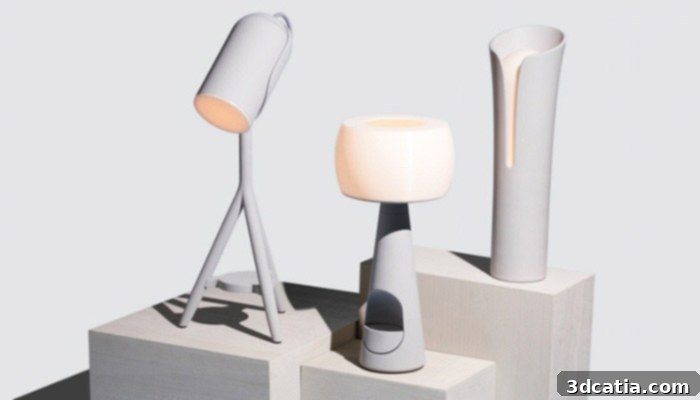
Some pieces from Gantri’s collection
The Technical Prowess of the Dancer: Speed, Precision, and Material Choice
At its core, Dancer is an FDM (Fused Deposition Modeling) 3D printer, a deliberate choice by Gantri. This specific technology is crucial for the company’s commitment to continuing to offer high-quality products predominantly made from PLA (Polylactic Acid). PLA is a thermoplastic polymer derived from renewable resources, making it an attractive choice for its environmental profile, ease of printing, and suitability for interior design objects, particularly lighting and home decor. It offers a smooth finish and excellent aesthetic qualities, which are paramount for Gantri’s design-centric offerings.
To address one of the primary limitations of FDM technology – print speed – Gantri’s engineers focused intensely on innovative solutions. Their breakthrough came by dramatically increasing the rate of material flow within the printer. This isn’t just a minor tweak; it represents a fundamental re-engineering of the extrusion system. Furthermore, Dancer is equipped with not one, but four independent nozzles, all working in synchronized harmony to print each individual part. This multi-nozzle configuration allows for parallel processing, significantly boosting throughput and drastically reducing overall print times per product. The combination of increased material flow and multiple nozzles is a game-changer, enabling Gantri to produce designer pieces with unprecedented speed without compromising on the intricate details and smooth finishes their customers expect.
The strategic implications of this technological advancement for Gantri are profound. The company envisions a systematic replacement of its existing fleet of 3D printers in its California factory with numerous Dancer units. This ambitious migration to their proprietary machines is expected to unlock a myriad of new possibilities for their network of talented designers. With the enhanced capabilities of the Dancer, designers will gain the freedom to conceptualize and create larger, more complex products that require fewer individual components, simplifying assembly and potentially reducing material waste. Simultaneously, for Gantri’s valued customers, this transition promises a significant reduction in lead times, meaning that unique, custom-designed products will reach their homes faster than ever before. This operational shift represents a clear commitment to scalability, efficiency, and continued innovation in the on-demand manufacturing space.
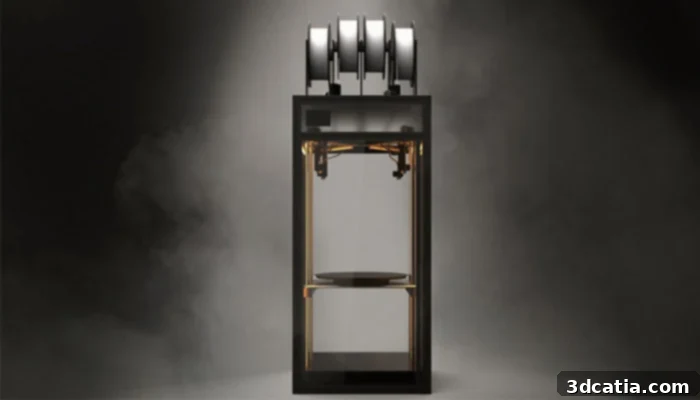
Image via Gantri: showcasing the intricate details possible with their technology
The Future of On-Demand Manufacturing with Gantri and The Dancer
Gantri’s commitment to building its own specialized 3D printer, The Dancer, signifies a pivotal moment in the evolution of manufacturing. It highlights a growing trend among innovative companies to take greater control over their production processes, moving away from off-the-shelf solutions that might not perfectly align with their unique business models and quality standards. This bespoke approach allows for unparalleled optimization, ensuring that every aspect of the printing process is tailored to meet the specific demands of their design-centric products. By investing in proprietary hardware, Gantri is not just improving its internal operations; it is actively shaping the future of how custom, high-quality goods can be produced on an industrial scale, yet with the flexibility of a boutique operation.
The implications of Gantri’s strategy extend far beyond their California factory. Their model demonstrates the viability of a decentralized, agile manufacturing ecosystem that can respond to market shifts with unprecedented speed. This approach offers significant advantages in terms of sustainability, as on-demand production inherently reduces waste associated with overproduction and warehousing. It also minimizes the environmental footprint often linked with global supply chains, favoring localized manufacturing. For independent designers, Gantri’s platform, powered by The Dancer, offers an accessible entry point into manufacturing, democratizing product creation and empowering a new generation of creative entrepreneurs. This ecosystem fosters innovation, allowing designers to experiment with forms, textures, and functions that might be impossible or too expensive to realize with traditional methods.
Ultimately, Gantri is championing a paradigm shift in how we perceive manufacturing – transforming it from a rigid, capital-intensive process into a flexible, designer-friendly, and consumer-responsive service. The Dancer is more than just a machine; it is a testament to Gantri’s vision of a future where creativity is unbound by industrial limitations, and where beautiful, functional designs can be brought to life efficiently and sustainably. This fusion of cutting-edge technology, innovative business models, and a passion for design positions Gantri at the forefront of the next industrial revolution, making custom design accessible to a broader audience and empowering creators worldwide.
What are your thoughts on companies developing unique 3D printers specifically tailored for their own distinct 3D printing needs? Do you believe this trend will become more widespread in specialized manufacturing sectors? Share your insights and opinions in a comment below, or join the conversation on our Facebook and Twitter pages! Don’t miss out on the latest advancements and breaking news in the additive manufacturing world. Remember to sign up for our free weekly Newsletter, delivering all the essential updates in 3D printing directly to your inbox!