
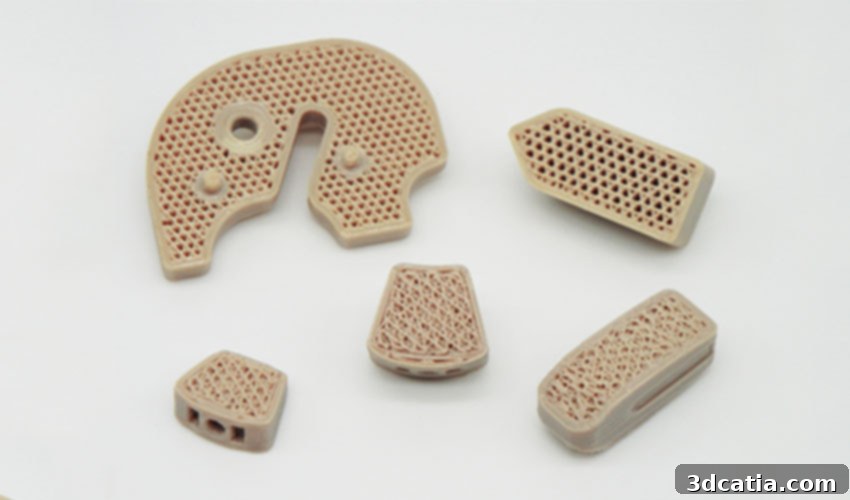
FossiLabs Revolutionizes Medical Implants with Fully Porous PEEK 3D Printing for Superior Osseointegration
FossiLabs, an innovative startup proudly based in the US, is at the forefront of medical technology, specializing in the development of advanced FDM 3D printers specifically engineered to produce sophisticated PEEK medical implant devices. In recent years, high-performance thermoplastics like PEEK (Polyether Ether Ketone) have garnered significant attention within the additive manufacturing landscape. These cutting-edge materials offer a suite of crucial benefits to highly demanding sectors such as aerospace and automotive, including exceptional temperature stability, robust chemical resistance, and superior mechanical properties. Beyond these advantages, PEEK is also proving to be a more cost-effective solution compared to many traditional alternatives. However, in the realm of medical applications, it is PEEK’s inherent biocompatible properties that are of paramount interest, making it an ideal choice for long-term implantable devices. This remarkable polymer stands out for its inertness, strength-to-weight ratio, and crucial radiolucency, which allows for clearer post-operative imaging compared to metallic implants, significantly enhancing patient monitoring and comfort.
Driven by a singular vision to promote accelerated and effective bone growth in patients, FossiLabs has engineered a proprietary and groundbreaking process. This innovation enables the creation of a first-of-its-kind 3D printed PEEK porous medical implant. What sets this apart is its design featuring defined areas of full porosity coupled with advanced hydrophilicity – properties meticulously optimized to promote osseointegration. Osseointegration is the critical process where the implant directly integrates with the patient’s bone, creating a stable and lasting connection. Unlike many other 3D printed PEEK implants that typically feature only surface porosity or limited porous windows within specific layers, FossiLabs’ technology ensures that the *entire* implant structure boasts extensive porous networks. This full, interconnected porosity provides an optimal scaffold for host bone cells to penetrate, colonize, and grow deep into the implant, establishing a stronger and more biologically sound anchorage. The enhanced hydrophilicity further aids this process by attracting biological fluids and cells to the implant surface, fostering a more conducive environment for initial cell adhesion and subsequent bone formation. This holistic approach significantly improves the potential for long-term implant success and patient recovery.
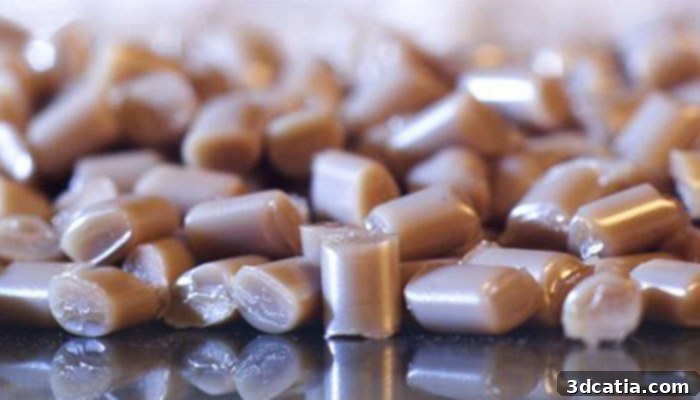
VESTAKEEP PEEK pellets | Credits: Evonik
Todd Reith, the visionary Founder of FossiLabs, further illuminates the transformative power of their approach: “Using 3D printing technology makes it possible to create a porous structure that would not be possible using traditional methods. The increased surface area and the full porosity encourage new bone on-growth and in-growth of the implant, leading to greater integration strength. Add hydroxyapatite (HA) nanocoating, now you have something unmatched in the industry.” This statement underscores the limitations of conventional manufacturing, which struggles to create the intricate, customizable, and fully interconnected porous architectures that 3D printing readily facilitates. The extensive surface area provided by FossiLabs’ full porosity design is crucial for maximizing the interface between the implant and living bone tissue. This leads to superior biological fixation through both ‘on-growth’ (bone growing onto the implant surface) and ‘in-growth’ (bone growing into the internal pores of the implant), resulting in significantly enhanced mechanical stability and long-term integration strength. Moreover, the strategic application of a hydroxyapatite (HA) nanocoating further elevates the implant’s bioactivity. Hydroxyapatite, a natural mineral component of bone, actively promotes osteoconduction, guiding new bone formation and accelerating the healing process. This powerful combination of advanced full porosity and HA nanocoating creates a synergistic effect, offering an implant solution that is truly unparalleled in its capacity for robust and rapid osseointegration.
The foundation of FossiLabs’ advanced implants lies in Evonik’s renowned VESTAKEEP PEEK material, specifically formulated as a polymer monofilament for the FDM (Fused Deposition Modeling) process. Evonik, a leading German chemical group, highlights that VESTAKEEP PEEK is so robust that it can effectively serve as a metal substitute in components subjected to severe environmental conditions, demonstrating its exceptional durability and performance. More precisely, the VESTAKEEP i4G grade chosen by FossiLabs is distinguished by its outstanding biocompatibility, ensuring it is safe for direct and prolonged contact with human tissue. Its biostability guarantees that the material maintains its integrity and properties within the harsh physiological environment over extended periods, resisting degradation. Furthermore, its inherent x-ray transparency is a critical advantage in medical imaging, allowing clinicians to clearly visualize the surrounding bone and soft tissues without artifact interference from the implant itself, facilitating precise post-operative assessment and patient monitoring. This combination of mechanical strength, chemical inertness, sterilizability, and imaging compatibility makes VESTAKEEP i4G an ideal, high-performance polymer for the most demanding medical implant applications. Its fatigue resistance and ability to withstand repeated sterilization cycles are also crucial for ensuring the long-term safety and efficacy of FossiLabs’ PEEK implants.
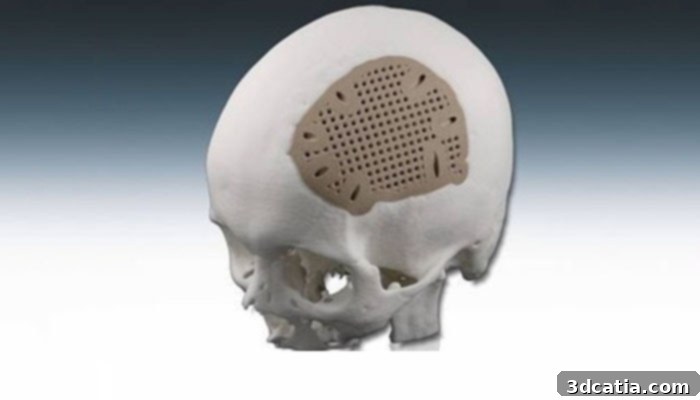
Example cranial implant made from PEEK
Beyond its innovative hardware, FossiLabs has also developed sophisticated proprietary software that works synergistically to maximize the potential of its 3D printing technology. This software empowers medical professionals to easily identify, customize, and precisely define solid and controlled bone-like macroporosity regions within existing client models. This capability is particularly invaluable for applications such as spacers and cages for the spine, where exact control over bone growth areas is paramount. Surgeons can now specify optimal locations for bone integration, and these precise designs are then seamlessly 3D printed in PEEK, resulting in patient-specific implants that offer superior fit and functional outcomes. The ability to customize porosity for each patient can lead to reduced surgical complications, improved post-operative stability, and faster recovery times. Currently, FossiLabs is actively seeking partnerships with established medical device companies to license its cutting-edge technology. This strategic approach aims to enable these companies to significantly enhance their existing static product lines and collaboratively develop exclusive new high-performance medical products that leverage the unique benefits of FossiLabs’ porous PEEK technology. This move is poised to accelerate the adoption of these transformative implants across the industry, addressing critical needs in the multi-billion dollar spinal implant market and potentially expanding to other orthopedic and reconstructive areas. You can delve deeper into FossiLabs’ pioneering work and explore their technological advancements by visiting their official website HERE.
FossiLabs’ commitment to advancing medical implant technology through innovative PEEK 3D printing truly represents a significant leap forward in patient care. By offering implants with full porosity and enhanced osseointegration capabilities, the company is set to transform surgical outcomes and improve the quality of life for countless individuals. This blend of advanced material science, proprietary hardware, and intelligent software highlights the immense potential of additive manufacturing in precision medicine.
What are your thoughts on FossiLabs’ groundbreaking solution and its potential impact on the future of medical implants? We encourage you to share your insights in a comment below or join the conversation on our Facebook and Twitter pages! Don’t miss out on the latest advancements in 3D printing – sign up for our free weekly Newsletter and get all the news delivered straight to your inbox!