
Formnext Connect 2020: Unveiling the Future of Additive Manufacturing Virtually
Formnext has long been recognized as the undisputed global leader in the additive manufacturing industry, a pivotal annual gathering that unites innovators, industry leaders, and users from every corner of the world. It serves as an essential platform for profound exchanges, collaborative discussions, and the showcasing of the latest breakthroughs and innovations driving the market forward. However, the unprecedented global context of recent times necessitated a radical reimagining of this prestigious event. In response, the organizers brilliantly pivoted, crafting an innovative virtual alternative: Formnext Connect. This digital platform successfully opened its virtual doors, offering an immersive experience that ran until November 12th. Participants were able to seamlessly connect, entirely free of charge, to engage with insightful conferences, interact directly with representatives from a diverse array of companies, and explore the meticulously designed virtual stands of 203 exhibitors. The sheer breadth of representation was remarkable, encompassing machine manufacturers, material developers, printing service providers, software developers, and resellers, thereby showcasing the entire intricate additive manufacturing value chain. Each exhibitor seized this unique digital opportunity to present their most recent innovations and groundbreaking products, reaffirming Formnext’s commitment to spearheading progress. But what specific advancements were highlighted at Formnext Connect? We have meticulously curated a selection of the most significant announcements that no enthusiast or professional should have missed.
Groundbreaking Product Launches at Formnext Connect: Redefining Additive Manufacturing
Trade shows, whether physical or virtual, consistently provide an unparalleled stage for companies to unveil their latest advancements. Formnext Connect was no exception, serving as the launchpad for a plethora of new products spanning 3D printers, advanced materials, sophisticated software, and transformative post-processing solutions. Despite the shift to a virtual format, the spirit of innovation remained vibrant, with numerous exhibitors seizing this digital opportunity to introduce their market-defining offerings.
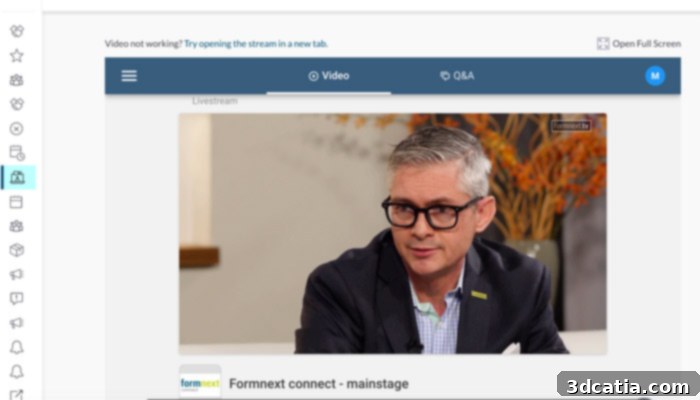
The Formnext Connect platform allowed attendees to follow live round tables and conferences, fostering global engagement.
Revolutionary 3D Printers Leading the Way
The segment of new 3D printers saw significant announcements, pushing the boundaries of what’s possible in additive manufacturing.
Ultimaker 2+ Connect: Enhanced Accessibility and Connectivity
Dutch manufacturer Ultimaker, a household name in accessible professional 3D printing, introduced the Ultimaker 2+ Connect. This new machine builds upon the proven reliability and performance of its predecessor, the Ultimaker 2+, while integrating crucial modern enhancements designed to streamline workflows and improve user experience. Key features include seamless Wifi or Ethernet connectivity, enabling remote monitoring and print management – a significant step towards networked 3D printing environments. The addition of a responsive touch screen interface simplifies operation, making it more intuitive for users of all skill levels. Furthermore, a stiffer build plate contributes to enhanced print accuracy and stability, while a wide range of pre-saved print profiles significantly reduces setup time and optimizes results for various materials. This printer is ideally suited for educational institutions, small businesses, and professionals seeking a dependable and connected FDM solution for prototyping and functional part production.
Smart3D Macro HT: Industrial High-Temperature FDM for Advanced Materials
Also within the FDM domain, manufacturer Smart3D leveraged Formnext Connect to showcase its industrial-grade Macro HT 3D printer. This machine is engineered for high-performance applications, specifically designed to process demanding high-temperature polymers. Its capability to design robust parts using advanced engineering plastics such as ULTEM, PEEK, or PEKK is a game-changer for industries requiring exceptional mechanical strength, chemical resistance, and thermal stability. The Macro HT boasts an impressive extrusion temperature reaching up to 500°C and a heated printing chamber capable of maintaining temperatures up to 200°C. This precise thermal control is critical for successfully printing these challenging materials, minimizing warping and ensuring optimal layer adhesion. The Macro HT positions itself as a vital tool for aerospace, automotive, medical, and industrial sectors looking to produce end-use parts, tooling, and functional prototypes with unparalleled material properties.
Prodways ProMaker P1000X: Expanding SLS Accessibility and Material Versatility
Shifting focus to powder bed technologies, Prodways announced the widespread availability of its SLS ProMaker P1000X 3D printer. This move signifies Prodways’ commitment to making advanced selective laser sintering technology accessible to a broader range of industrial players, from established manufacturers to innovative startups. A key highlight of this announcement was the machine’s enhanced compatibility with Prodways’ extensive catalogue of materials. This includes flexible TPU, known for its elasticity and durability; robust PA12; classic PA11; and glass fiber reinforced PA11, which offers increased stiffness and strength. Additionally, the ProMaker P1000X now supports the innovative new polypropylene PP1200, expanding its application possibilities into areas requiring chemical resistance and lightweight properties. This broad material compatibility makes the ProMaker P1000X an incredibly versatile solution for industries such as consumer goods, prosthetics, and industrial tooling, enabling the production of diverse parts with tailored mechanical properties.
SLM Solutions: Ushering in the Next Generation of Metal Additive Manufacturing
On the metal additive manufacturing front, the venerable manufacturer SLM Solutions made a highly anticipated announcement: the introduction of its next generation of metallic 3D printers. Billed as “the most productive selective laser fusion system on the market,” this new offering promises to significantly elevate the speed, efficiency, and quality of metal part production. While specific details were revealed during their scheduled presentation, the emphasis on productivity suggests advancements in multi-laser technology, improved build rates, and enhanced process control. Such innovations are crucial for driving the adoption of metal additive manufacturing in high-volume production environments, particularly within aerospace, medical, and energy sectors where complex geometries and high-performance alloys are critical.
Mimaki: Advancing Color 3D Printing with Material Jetting
Finally, Mimaki, a manufacturer renowned for its expertise in graphic arts and industrial inkjet printing, utilized Formnext Connect to announce the launch of a new machine. Specializing in the development of sophisticated color printing solutions based on Material Jetting technology, Mimaki’s entry into the 3D printing space is particularly exciting for applications requiring intricate details and a full spectrum of colors. Material Jetting works by jetting tiny droplets of photopolymer resin onto a build tray and then curing them with UV light. This process allows for precise control over material placement and the blending of different colored resins, enabling the creation of highly realistic prototypes, models, and artistic designs. This new machine from Mimaki is expected to further democratize high-fidelity color 3D printing, opening new avenues for product design, medical modeling, and creative industries.

SLM Solutions unveiled a new metal additive manufacturing machine, promising enhanced productivity.
Innovations in Software and Post-Processing: Optimizing the AM Workflow
Beyond hardware, Formnext Connect also highlighted critical advancements in the software and post-processing stages of the additive manufacturing workflow, addressing common challenges and enhancing efficiency.
CoreTechnologie’s 4D_Additive with Advanced Lattice: Lightweighting and Structural Optimization
The Franco-German company CoreTechnologie unveiled the latest iteration of its powerful 4D_Additive software, now featuring an innovative new module called Advanced Lattice. This module is designed to empower engineers and designers to effortlessly generate complex internal lattice patterns within components. Users can choose from a wide array of structures, including intricate honeycomb, gyroid, star, and many other customizable lattice geometries. The primary benefit of this technology is the ability to significantly reduce the weight of components without compromising their critical mechanical properties. By strategically removing material from non-load-bearing areas and replacing it with optimized lattice structures, parts become lighter, require less material, and can even exhibit improved performance characteristics like energy absorption or thermal dissipation. This is invaluable for industries such as aerospace, automotive, and medical where lightweighting and performance optimization are paramount. The Advanced Lattice module integrates seamlessly, providing powerful tools for designing highly efficient and structurally sound additive manufacturing parts.
Solukon SFP 770: Streamlining Powder Removal for Plastic Parts
In post-processing, Solukon introduced the SFP 770, a specialized machine designed to efficiently remove residual powder from plastic parts and thoroughly clean them. The challenges of post-processing, especially powder removal from complex internal geometries, can be time-consuming and labor-intensive. The SFP 770 addresses this by providing a quick and easy solution, crucial for increasing throughput and reducing manual labor in additive manufacturing operations. Its precise operation ensures that even delicate plastic components are cleaned effectively without damage, making it an essential tool for manufacturers working with powder bed fusion processes for polymers, where cleanliness and surface finish are critical for final part quality and performance.
AM-Flow AM-BAGGING: Automating Post-Processing and Logistics
The Dutch company AM-Flow, a leader in post-processing automation, seized the virtual event to formally announce the launch of its AM-BAGGING service. This automated process represents a significant step forward in streamlining the final stages of additive manufacturing production. AM-BAGGING efficiently prints customized text, graphics, and high-resolution barcodes directly onto bags, ready for immediate shipment. This eliminates the need for manual labeling and packaging, which are often bottlenecks in additive manufacturing workflows. By automating this crucial step, AM-BAGGING accelerates existing processes, transitioning them from costly, error-prone manual post-processing to highly efficient, automated production lines. This solution directly impacts supply chain efficiency, reduces operational costs, and ensures consistent quality in packaging and labeling, facilitating faster delivery of additive manufactured parts to customers.
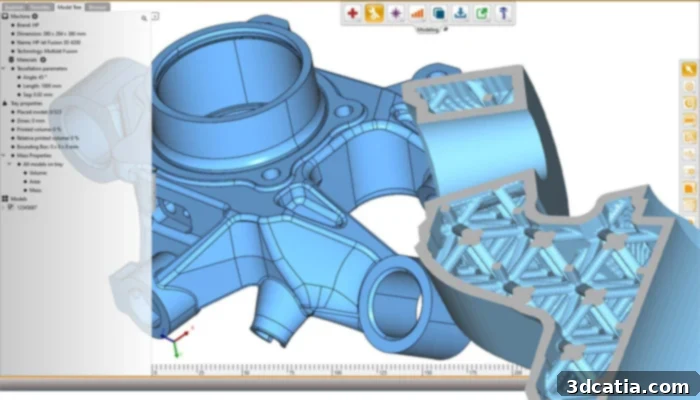
The Advanced Lattice module of 4D_Additive offers new capabilities for lightweight component design.
Advanced Materials for Diverse Additive Manufacturing Applications
The success of additive manufacturing is inherently tied to the availability of advanced materials. Formnext Connect showcased a vibrant landscape of new material innovations.
Evonik & HP’s High-Performance Flexible TPA Elastomer
Evonik & HP officially unveiled their revolutionary new elastomer, a high-performance flexible powder specifically engineered for additive manufacturing. This innovative material is based on a thermoplastic amide (TPA) grade, offering a unique combination of flexibility, durability, and lightweight characteristics. It is distinguished by its remarkably low density and a Shore A hardness of 91, making it ideal for applications requiring pliability without sacrificing resilience. Compatibility with HP’s 4200 range of 3D printers ensures seamless integration into existing workflows. This TPA elastomer is poised to open new possibilities for applications in consumer goods (e.g., footwear, sports equipment), automotive (e.g., seals, flexible components), and medical devices (e.g., prosthetics, orthotics), where flexible, yet strong and lightweight parts are essential.
Covestro’s Sustainable Addigy® Filaments
Staying within the realm of plastics, the German chemical company Covestro presented new filaments for its Addigy® range, firmly aligning with the principles of a circular economy. These materials represent a significant step towards more sustainable additive manufacturing. Specifically, these new filaments are either partially made from recycled plastics, reducing reliance on virgin resources, or manufactured with a maximum of 20% CO2, minimizing their carbon footprint. This initiative by Covestro underscores a growing industry trend towards environmental responsibility, offering manufacturers and designers more eco-conscious choices for their 3D printing projects. Such materials are crucial for industries striving to meet sustainability targets while leveraging the design freedom and functional benefits of additive manufacturing.
Photocentric and BASF’s Ultracur3D EPD Resin Range: Rigidity and Flexibility Combined
On the resin front, manufacturer Photocentric and chemist BASF collaborated to introduce their new Ultracur3D EPD range – Powered by Photocentric. This partnership leverages Photocentric’s expertise in LCD-based 3D printing and BASF’s advanced chemical formulations. The two new resins, Ultracur3D EPD 1006 and Ultracur3D EPD 2006, offer a compelling combination of high rigidity and flexibility. This unique dual characteristic allows for the production of parts that are both structurally sound and capable of withstanding deformation without breaking, addressing a significant challenge in resin-based additive manufacturing. These resins are particularly suited for applications requiring durable yet pliant components, such as grippers, seals, or certain consumer products, offering a new level of design freedom and material performance.
Fehrmann Alloy’s AlMgty-90: A Corrosion-Resistant Aluminum Alloy
Finally, in the metal category, manufacturer Fehrmann Alloy utilized Formnext Connect to provide detailed insights into its novel aluminum alloy, AlMgty-90. This advanced alloy boasts an impressive array of properties making it highly attractive for various industrial applications. Key advantages include superior corrosion resistance, crucial for parts exposed to harsh environments. Furthermore, AlMgty-90 is anodizable, even in color, offering aesthetic and protective surface finishes, and is remarkably easy to polish, enhancing surface quality and reducing post-processing efforts. This alloy is ideal for aerospace components, marine applications, and high-end consumer products where lightweight, durable, and visually appealing metal parts are desired.
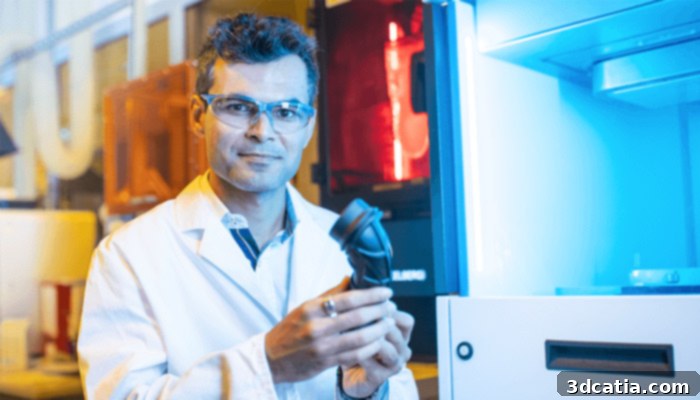
Photocentric and BASF’s collaboration brings forth a new range of resins for advanced additive manufacturing, highlighted by Forward AM.
Strategic New Partnerships: Driving Collaborative Innovation
Formnext Connect also served as a prime venue for leading industry players to announce new strategic collaborations, underscoring the growing importance of ecosystems and partnerships in accelerating additive manufacturing adoption.
Stratasys and nTopology: Streamlining Design for Additive Manufacturing (DfAM)
A significant partnership was unveiled between Stratasys, a pioneer in 3D printing, and nTopology, known for its powerful generative design software. Together, they are launching a series of accessible and customizable workflows centered around Design for Additive Manufacturing (DfAM). DfAM is critical for maximizing the benefits of 3D printing, but often requires specialized knowledge. Their first collaborative tool, the FDM Assembly Fixture Generator, aims to simplify this. This innovative solution automates the design of templates and tools, allowing engineers to quickly transform a 3D file into a print-ready tool with a simple “drag and drop” action. This dramatically reduces the time and expertise required to design custom fixtures, jigs, and tooling, which are essential for many manufacturing operations. Available immediately via the nTop platform, this tool empowers engineers to rapidly iterate and deploy custom manufacturing aids, enhancing efficiency and reducing production lead times.
DyeMansion and Siemens/EOS: Pioneering the Digital Factory for Shoe Production
Finally, post-processing specialist DyeMansion announced a pivotal new partnership with Siemens, the industrial leader in automation systems. This collaboration highlights the increasing need for integrated, automated solutions across the entire additive manufacturing workflow, not just printing. DyeMansion’s latest solution, the Powerfuse S, for instance, is already equipped with Siemens’ cutting-edge automation technology, enabling seamless integration with various digital services and enhancing traceability and process control. Furthermore, in conjunction with manufacturer EOS, a leader in industrial 3D printing solutions, DyeMansion and Siemens are presenting the blueprint for the first fully digital factory specifically optimized for shoe production. This ambitious project combines EOS’s advanced SLS machines for printing complex shoe components with DyeMansion’s industrial post-processing solutions for finishing and coloring. This holistic approach aims to demonstrate a highly efficient, automated production line for customizable and series-produced footwear, illustrating the immense potential of integrating additive manufacturing with Industry 4.0 principles to create highly efficient and flexible manufacturing environments.
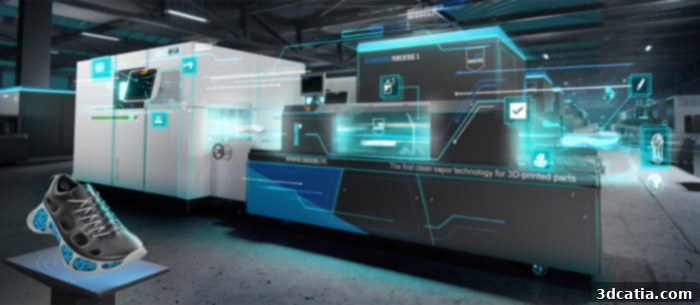
A glimpse into the future production plant, showcasing integrated additive manufacturing workflows.
Formnext Connect demonstrated that even in a virtual format, the additive manufacturing industry continues to push the boundaries of innovation, offering a compelling vision for the future of production. The event successfully connected thousands of industry professionals, facilitating knowledge exchange and showcasing critical advancements in hardware, software, materials, and partnerships. These innovations collectively contribute to making additive manufacturing more efficient, sustainable, and capable of addressing increasingly complex industrial challenges.
You can still explore highlights and past sessions from the event for free HERE, to catch up on the conferences and discover the myriad novelties unveiled by international exhibitors. Formnext Connect concluded on Thursday, November 12th, but its impact on the additive manufacturing landscape resonates long after. Did you participate in this pioneering virtual edition? We’d love to hear your insights and experiences! Share your thoughts in a comment down below or join the conversation on our Facebook and Twitter pages! Don’t forget to sign up for our free weekly Newsletter to stay informed about the latest developments in the exciting world of 3D printing and additive manufacturing.