
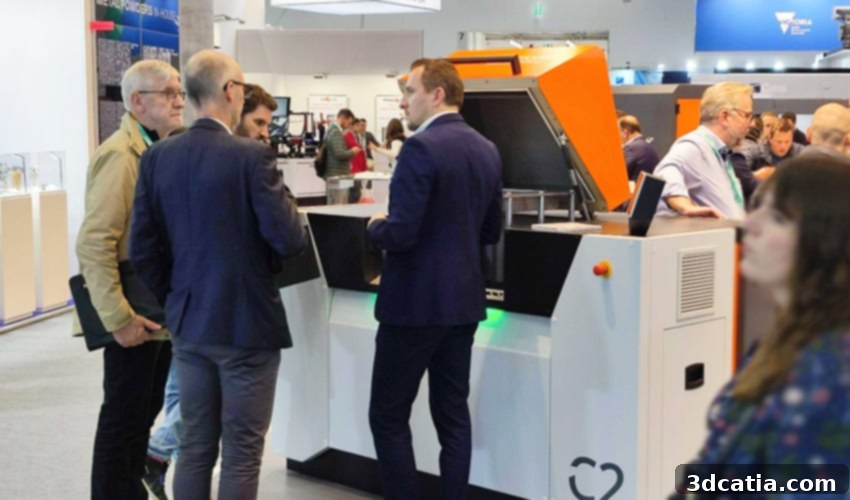
Revolutionizing 3D Printing: Advanced Post-Processing Solutions from Formnext 2023
The journey of a 3D-printed part doesn’t end when it comes off the build plate. In fact, what happens next – known as post-processing – is often as critical as the printing itself. This vital stage refines the aesthetics, improves mechanical properties, and ensures the part meets final application requirements. Historically, post-processing has been a significant bottleneck in additive manufacturing, involving labor-intensive, time-consuming, and often costly manual steps. However, the industry is rapidly evolving, driven by an urgent need for automation and efficiency to scale production and reduce overall manufacturing costs. The good news is that specialized solutions and innovative players in this market segment are emerging at an impressive pace.
Formnext, the premier global exhibition for additive manufacturing, consistently serves as a launchpad for groundbreaking technologies. Formnext 2023 was no exception, showcasing a plethora of novelties and innovations in post-processing. From established industry leaders to agile startups, new solutions were introduced that promise to transform how 3D-printed parts are finished. These advancements are not merely incremental improvements; they represent fundamental shifts towards smarter, faster, and more sustainable production cycles. We meticulously explored the exhibition floors to identify the most impactful and interesting post-processing solutions, highlighting their unique benefits and potential to streamline your 3D printing workflow. These innovations are designed to tackle various challenges, from support removal and depowdering to surface finishing, strengthening, and even ensuring operator safety. Below, we’ve compiled a list of these remarkable solutions, presented in alphabetical order for your convenience, offering a glimpse into the future of additive manufacturing finishing processes.
Addiblast Mars: Automated Depowdering for Metal 3D Printing
For powder-based 3D printing technologies, particularly in metal additive manufacturing, depowdering is undeniably one of the most crucial and often challenging post-processing steps. It involves the meticulous removal of excess powder that surrounds the printed part within the build chamber, akin to support removal in FDM. Incomplete depowdering can compromise part functionality, aesthetics, and even lead to material contamination, necessitating a precise and thorough cleaning process. Slovenian company Addiblast has stepped up to address this challenge with its MARS (Metal Additive Removal System) line. At Formnext, they showcased both polymer and metal depowdering solutions, with the MARS03 particularly standing out for its advanced capabilities in metal applications.
The MARS series is specifically engineered and optimized for the thorough and efficient removal of fine metal powders, even from incredibly complex geometries, including parts featuring intricate internal channels that are notoriously difficult to clean manually. The precision and consistency offered by this automated system are critical for producing high-quality metal components. The MARS03 boasts an entirely automated process, significantly reducing labor time and ensuring consistent quality across batches. However, recognizing the need for flexibility and the potential for delicate work, it also incorporates heavy-duty gloves for manual intervention when necessary, offering a versatile solution that combines the best of both worlds. The generous full workspace measures 850 mm x 900 mm x 1000 mm, accommodating a variety of part sizes, though its dedicated build plate volume is 400 mm x 400 mm x 400 mm. This blend of automation and operator control makes the Addiblast Mars a powerful tool for efficient and safe metal part depowdering, crucial for delivering high-performance final components ready for demanding applications.
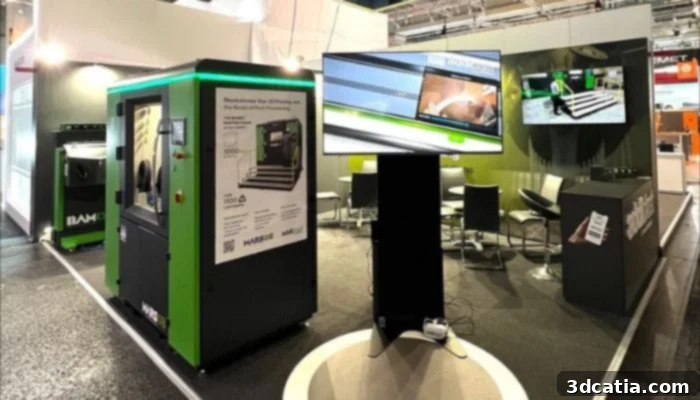
Photo credits: Addiblast
AM Efficiency and its All-In-One Solution for Polymer Powder 3D Printing
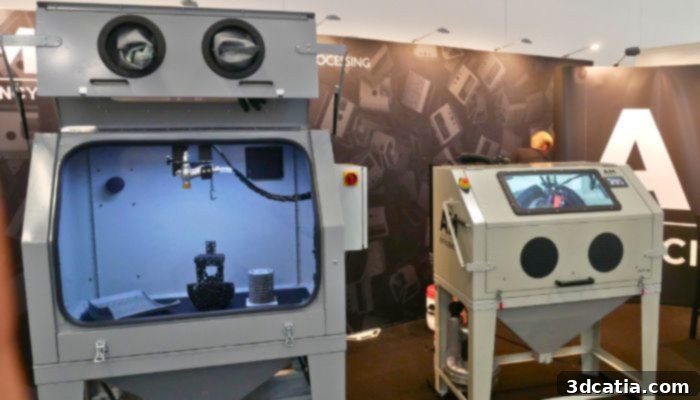
Swedish company AM Efficiency is rapidly gaining recognition for its innovative contributions to post-processing, particularly for polymer powder bed fusion technologies. They introduced two automated and highly scalable solutions designed to clean, color, and polish 3D printed parts, offering a comprehensive finish in a single unit. These machines are a game-changer for businesses looking to streamline their finishing processes while maintaining high quality and efficiency, significantly reducing the manual labor traditionally associated with these steps.
The first of these solutions, the CCP-10, is ideally suited for parts produced using desktop or small-scale Selective Laser Sintering (SLS) machines, such as those from Sinterit, Formlabs, and Wematter. Its compatibility extends seamlessly to any polymer powder bed technology, including MJF (Multi Jet Fusion), SAF (Selective Absorption Fusion), and HSS (High Speed Sintering). The CCP-10 is notably office-friendly, featuring a compact cabinet volume of 440 liters and a drum with a diameter of 55cm and a depth of 30cm. Its standout feature is the ability to perform cleaning, coloring, and polishing all within the same unit, significantly saving valuable workspace and simplifying the workflow for users. This integration not only boosts productivity but also ensures remarkable consistency in the final product’s appearance and feel, critical for aesthetic and functional parts alike.
Complementing the CCP-10 is the CCP2, which offers the same powerful benefits and capabilities but on a much larger, industrial scale. With a cabinet volume of 990 liters and a drum volume of 65 liters, the CCP2 is designed for higher throughput and larger batch processing, catering to more demanding manufacturing environments. Both machines are engineered for exceptional efficiency and sustainability. They operate without the use of toxic chemicals, ensuring no negative environmental impact and promoting a safer working environment for operators. This commitment to eco-friendly operations, combined with their automated multi-functional capabilities, positions AM Efficiency as a leader in sustainable and advanced polymer post-processing, offering solutions that are both powerful and responsible. You can find out more about their machines HERE.
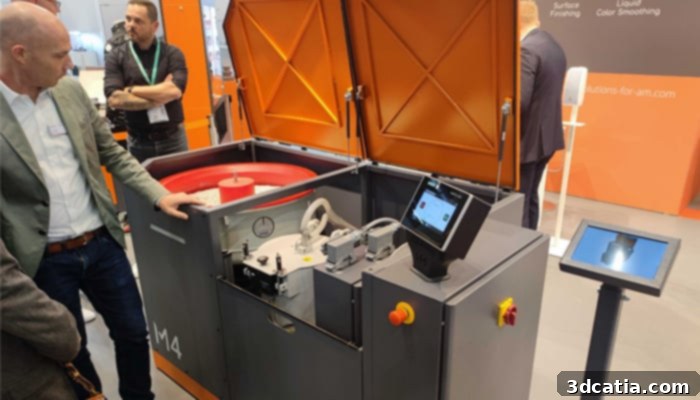
AM Solutions – M4: Integrated Mass Finishing for Diverse Materials
AM Solutions continues to push the boundaries of surface finishing, and at Formnext, they unveiled two impressive 2-in-1 solutions. While the C2 machine handles sanding and chemical staining, it was their M4 machine for mass finishing that truly caught our attention due to its innovative integration and versatility. The M4 uniquely combines a rotary vibrator and a cleaning centrifuge into a single, compact system, offering unparalleled efficiency and precision in post-processing operations. This integration is particularly valuable for small to medium-sized parts, providing an ideal, comprehensive solution for surface finishing both metal and plastic components with high precision and repeatability.
The M4’s capabilities span a wide array of critical surface finishing processes, making it a highly adaptable machine for various industrial needs. Users can effectively perform initial cleaning, precise deburring (removing sharp edges and burrs), controlled grinding (material removal for shaping and dimensioning), fine honing (improving surface texture and geometric accuracy), consistent matting (creating a dull, non-reflective finish), and achieving a high-quality polishing (producing a smooth, reflective surface). This comprehensive range ensures that parts can be finished to the exact specifications required for their application, from functional prototypes to end-use components. Furthermore, a key highlight of the M4 is its integrated water recycling system. This feature not only provides significant independence regarding the machine’s placement, as it reduces the need for constant external water supply, but also contributes to remarkable cost and process optimization. By minimizing water consumption and waste, the M4 embodies both economic efficiency and environmental responsibility, setting a new standard for intelligent mass finishing solutions in additive manufacturing.
AMT – PostPro SFX: Compact and Sustainable Vapor Smoothing
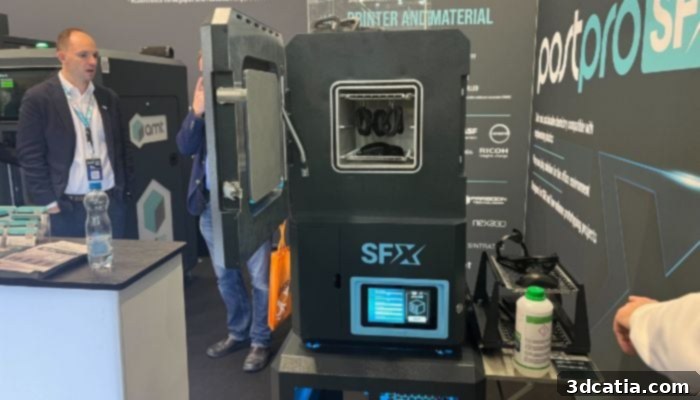
Among the noteworthy post-processing launches at Formnext 2023 was AMT’s latest innovation: the PostPro SFX. This compact, desktop-sized machine is specifically designed for vapor smoothing, a critical process that significantly enhances the surface quality and mechanical performance of 3D printed parts. Vapor smoothing works by using a controlled chemical vapor to gently melt and reflow the outer surface of the part, effectively closing pores, reducing roughness, and improving aesthetic appeal. The PostPro SFX caters primarily to users of small-scale 3D printers, but its industrial-grade capabilities also make it suitable for a range of professional applications requiring precise surface refinement.
AMT has focused heavily on both compactness and sustainability in the design of the PostPro SFX, making it a standout solution. Its efficient 11-liter process chamber ensures a minimal footprint, making it ideal for laboratories, workshops, or even office environments where space is a premium. This compact design does not compromise its powerful performance. On the sustainability front, the machine is compatible with a wide array of materials, including all nylons and flexible materials like TPE and TPU. Crucially, it exclusively processes these materials with AMT’s proprietary PostPro Pure solvent. This solvent is not only considered significantly more environmentally friendly than traditional alternatives but is also FDA approved, offering a safer and more responsible approach to post-processing. Vapor smoothing dramatically improves the aesthetic appeal of parts, eliminates porosity, enhances mechanical properties such as fatigue resistance, and facilitates easier cleaning, making the PostPro SFX an invaluable tool for producing high-quality, end-use components across various industries.
DLyte – 100PROCarbide: A Breakthrough in Carbide Surface Finishing
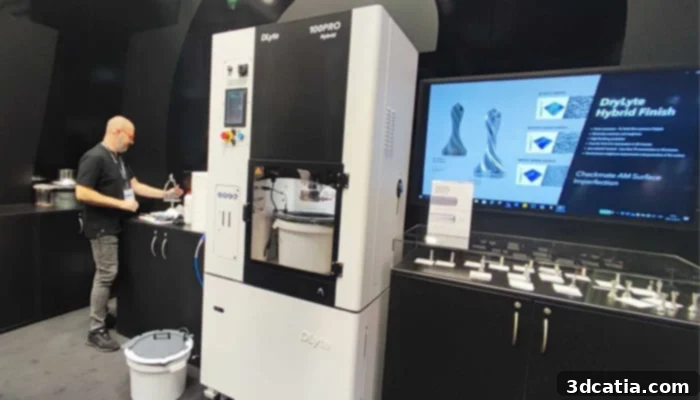
DLyte, a leading manufacturer of advanced surface finishing equipment, made a significant impact at Formnext 2023 by introducing several new solutions designed to push the boundaries of part quality. The most revolutionary among them was undoubtedly the 100PROCarbide machine (also referred to as 100PROHybrid in the source, indicating a versatile hybrid solution), specifically engineered for the post-processing of carbide parts. This marks a monumental first for DLyte and a significant breakthrough for the wider additive manufacturing and traditional machining markets. Carbide materials, known for their extreme hardness, exceptional wear resistance, and high strength, are notoriously challenging to finish, often requiring abrasive, time-consuming, and labor-intensive manual processes that can compromise material integrity.
The 100PROCarbide is designed to handle the intricate surface finishing requirements of cemented carbide parts with unprecedented precision and control. A critical aspect of working with carbide, especially in precision applications, is managing cobalt leaching, which can compromise the material’s integrity, hardness, and overall performance. DLyte’s innovative solution provides precise control over this electrochemical process, ensuring that the finished parts retain their desired properties and structural integrity without undesirable surface alterations. By offering an automated and highly controlled method for carbide surface finishing, DLyte is enabling manufacturers to achieve superior part quality, extend tool life, and open up new possibilities for high-performance applications requiring the exceptional properties of carbide components. This technology addresses a long-standing challenge in the industry, promising enhanced efficiency and higher quality for complex carbide geometries in sectors such as tool manufacturing, aerospace, and medical implants.
Formlabs – Fuse Blast: Automated Cleaning and Polishing for SLS
Formlabs, a company synonymous with accessible and high-performance 3D printing solutions, unveiled another essential post-processing innovation for its Selective Laser Sintering (SLS) ecosystem: the new Fuse Blast. This industrial-grade system is engineered to automate and significantly enhance the cleaning and polishing of SLS 3D printed parts, complementing the manufacturer’s existing Fuse series to create a fully integrated, efficient post-processing workflow. The Fuse Blast aims to address the common bottleneck of powder removal and surface finishing in SLS production, making it faster, more consistent, and less labor-intensive than ever before.
The automated system operates by performing blasting inside a tumbler, where residual and semi-sintered dust is effectively and uniformly removed from the part’s surface. This gentle yet powerful action ensures that parts emerge completely smooth and clean, ready for their next stage, whether it’s direct use or further treatment. For applications requiring an even finer finish, an optional polishing system is available. This feature provides end-use parts with a desirable smooth, semi-glossy surface that is not only aesthetically pleasing but also ideal for direct use or for subsequent dyeing processes, ensuring excellent color absorption and uniformity. When combined with the integrated Fuse Sift dust management station, Formlabs asserts that the new Fuse Blast can reduce overall cleaning time to a mere 15 minutes, representing an impressive 80 percent reduction in manual labor time. This level of automation and efficiency is critical for scaling SLS production, enabling businesses to produce high-quality parts with significantly lower operational costs and faster turnaround times, ultimately expanding the reach and applications of SLS technology.
Reinforce3D – Delta: Strengthening 3D Printed Parts Post-Production
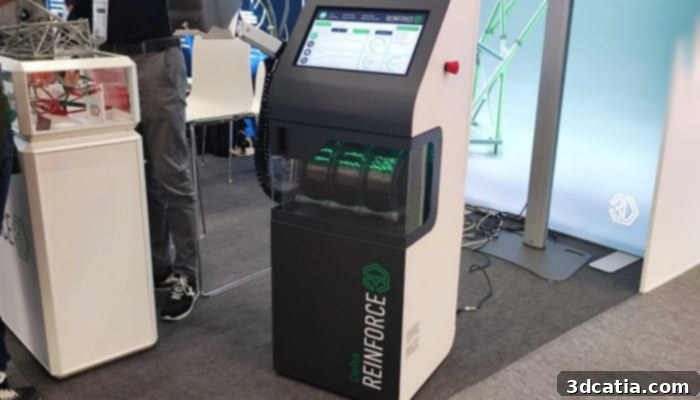
Reinforce3D, an innovative startup, introduced an undoubtedly game-changing post-processing solution at Formnext: the Delta machine. Unlike traditional reinforcement methods that typically integrate fibers or other strengthening agents during the initial printing process, Delta employs a unique approach to strengthen 3D printed parts *after* they have been manufactured. This novel method directly addresses the need for enhanced part strength, stiffness, and overall performance, particularly for prototypes and functional components that require superior mechanical properties beyond what standard materials can offer.
The Delta machine utilizes a patented Continuous Fibre Injection Process (CFIP) technology. This advanced technique involves precisely injecting continuous fibers into the 3D printed structure, significantly improving the part’s tensile strength, impact resistance, and overall structural integrity. The ability to add reinforcement as a post-processing step offers immense flexibility, allowing users to optimize mechanical properties without modifying the initial printing parameters, material composition, or redesigning the part for fiber integration. Reinforce3D’s primary goal with Delta is to automate this innovative process for industrial scale, enabling the efficient production of ready-to-use prototypes and high-performance end-use parts with vastly improved structural integrity. This solution opens up new possibilities for applications where lightweight yet exceptionally strong 3D printed components are essential, providing a significant advantage in industries like automotive, aerospace, defense, and medical devices, where structural reliability is paramount.
Rivelin Robotics: Automated Robotic Finishing for Metal AM
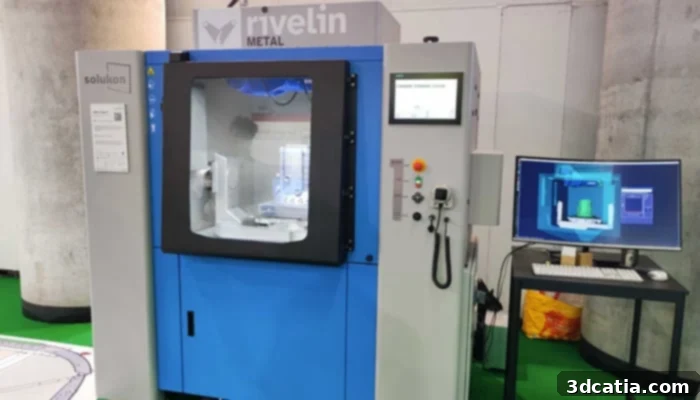
Rivelin Robotics is a name that has become increasingly prominent in the additive manufacturing space, particularly after their victory at the Formnext Startup Challenge last year. They returned to Formnext with an expanded presence and new solutions, building on the success of their NetShape robotic solution. Rivelin’s core innovation lies in automating the often complex, hazardous, and labor-intensive post-processing of metal additive manufacturing (AM) parts. Their focus is specifically on support removal and surface finishing – tasks that, when performed manually, are highly prone to human error, inconsistencies, and pose significant safety risks to operators handling sharp edges and toxic materials.
At Formnext 2023, Rivelin showcased several advanced AM post-processing cells for metal components, including the NS0, NS1, and NS2, each tailored for different part sizes and production volumes. Each of these cells integrates high-precision industrial robots from their partner Yaskawa Europe, all meticulously controlled by Rivelin’s sophisticated Netshape software. This proprietary software is the brains behind the operation, intelligently guiding the robots to accurately identify, remove supports from complex internal and external geometries, and refine the surface of metal parts to exacting specifications. The result is a truly automated solution that dramatically reduces defects in parts by up to 90 percent, leading to superior quality, unprecedented consistency, and significantly reduced scrap rates. Furthermore, this automation translates into a significant reduction in operational costs by minimizing manual labor and completely eliminating human risk and variability from the post-processing workflow. Rivelin Robotics is setting a new benchmark for efficiency, safety, and quality in metal AM, making high-volume production more feasible and reliable for critical applications in aerospace, medical, and defense sectors.
Schmitt Ultraschalltechnik – SLA Clean: Eco-Friendly Resin Part Cleaning
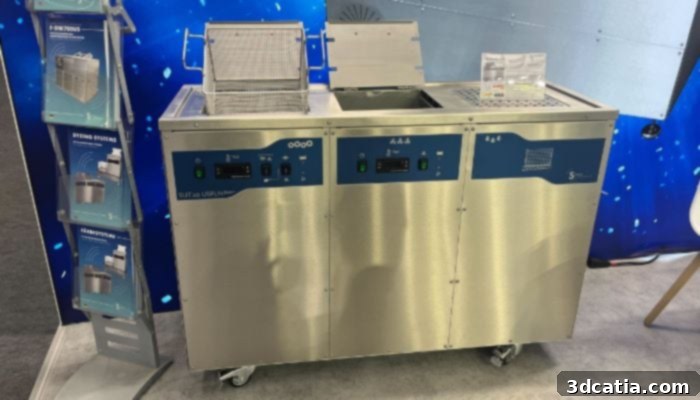
German manufacturer Schmitt Ultraschalltechnik presented a series of innovative solutions at Formnext, specifically dedicated to the meticulous cleaning of parts produced with Stereolithography (SLA) technology. Traditionally, isopropanol alcohol (IPA) has been the go-to product for cleaning resin-based parts, but its flammability, strong fumes, disposal challenges, and environmental impact present considerable operational and safety challenges. Schmitt Ultraschalltechnik’s solutions offer a refreshing and much-needed alternative by completely eliminating the use of isopropanol, focusing instead on a safer approach for operators and a more environmentally friendly process without compromising on cleaning efficacy.
The core of the SLA Cleaning solutions lies in a sophisticated rotating ultrasonic cavitation system, which they describe as an “electronic brushing” method. Parts are securely placed in a metal basket within the unit, where an innovative, isopropanol-free liquid is agitated by precisely controlled ultrasonic waves. This cavitation process generates microscopic bubbles that effectively dislodge and dissolve uncured resin residues, even from hard-to-access internal channels, intricate lattice structures, and delicate geometries, without causing any damage to the material surface or fine details. This gentle yet powerful cleaning ensures that intricate details are preserved while thoroughly removing all uncured resin, resulting in perfectly clean and functional parts. By prioritizing operator safety, environmental responsibility, and maintaining high cleaning quality, Schmitt Ultraschalltechnik is providing an advanced, non-toxic, and highly efficient solution for SLA post-processing, making it an attractive option for companies looking to enhance their sustainability practices and streamline their workflow.
Xioneer – Vortex XP: Modular and Automated Post-Processing System
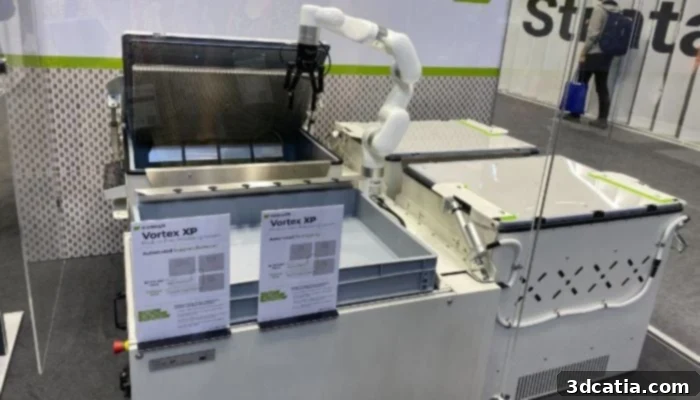
Xioneer introduced its highly anticipated modular and automated post-processing solution, the Vortex XP, at Formnext, showcasing a vision for a fully integrated and flexible finishing workflow. The Vortex XP system is cleverly designed around three distinct units, each dedicated to a specific crucial process: media removal (e.g., support or powder), rinsing, and drying or dyeing. This inherent modularity is a key advantage, as it allows users to purchase units individually based on their specific needs, providing a scalable and customizable solution for various production volumes and part types, adapting to evolving manufacturing requirements.
What makes the Vortex XP truly innovative is the possibility of combining these individual units into a seamlessly integrated, fully automated system by incorporating a robotic module. This approach minimizes manual handling and maximizes efficiency. At their Formnext booth, Xioneer demonstrated this capability by linking two XP190G units (presumably configured for media removal and subsequent rinsing) with an XP190D unit (for drying or dyeing) into a single, cohesive post-processing station. This integrated setup further included an additional tray or staging area where the robot efficiently places the finished and thoroughly post-processed parts, completing a fully automated and continuous cycle from raw print to ready-to-use component. This level of automation not only drastically reduces manual labor and associated costs but also ensures unparalleled consistency, repeatability, and throughput in the final part quality. The Vortex XP represents a significant step towards fully autonomous additive manufacturing production lines, offering superior efficiency, precision, and scalability for diverse industrial applications across many sectors.
Powder-Ex: Essential Skin Cleansing for Powder-Based 3D Printing
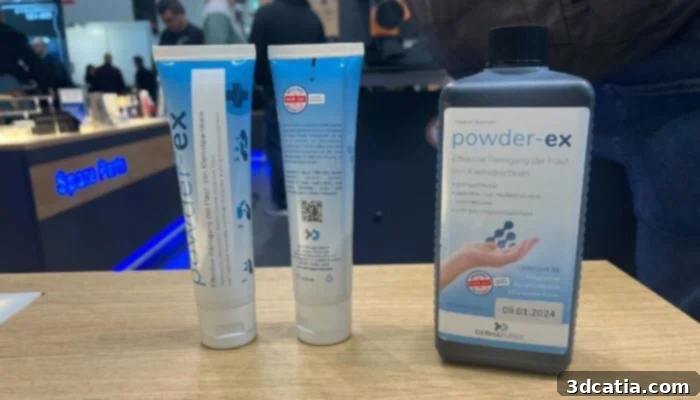
Our final entry on this list of cutting-edge post-processing solutions takes a slightly different, yet equally vital, turn. While all the preceding innovations focus on optimizing and finishing the 3D-printed parts themselves, Powder-Ex is uniquely designed with human well-being and safety in mind. It’s an open secret in the additive manufacturing community that the fine powders used in technologies like Selective Laser Sintering (SLS), Direct Metal Laser Sintering (DMLS), and other powder bed fusion processes can pose significant health risks to operators if not handled correctly. Strict safety protocols, personal protective equipment (PPE), and specialized ventilation systems are routinely employed to mitigate these dangers. However, despite all precautions, it’s always possible for these microscopic particles to come into contact with the skin, potentially leading to irritation, allergic reactions, or other systemic health issues over time.
This is where Powder-Ex steps in as an indispensable part of the overall “post-processing” routine for personnel. While it might seem more aligned with dermatology than industrial post-processing, its function is critically important for anyone working regularly with powder-based additive manufacturing. Powder-Ex is an advanced cleansing solution specifically formulated to effectively remove all types of powders and fine particles from the skin, targeting contaminants as small as approximately 2 nanometers. Crucially, its formulation is entirely soap-free, ensuring reliable skin cleansing without stripping the skin’s natural protective barrier. This gentle yet thorough action prevents dryness, irritation, and maintains skin health, which is vital for sustained work in these environments. For professionals involved in handling raw powders, depowdering operations, or recently printed parts from SLS or DMLS processes, Powder-Ex is not just a convenience; it’s a necessity. It represents an essential “post-processing” step for the human element of 3D printing, significantly enhancing safety and well-being in the workspace by minimizing direct exposure risks.
Formnext 2023 clearly demonstrated that post-processing is no longer an afterthought but a central pillar of efficient and high-quality additive manufacturing. The innovations showcased, from automated depowdering and versatile surface finishing to sustainable vapor smoothing and critical operator safety solutions, underscore a collective industry drive towards greater automation, sustainability, and human-centric design. These advancements are not just refining parts; they are refining the entire 3D printing workflow, making it more scalable, cost-effective, environmentally responsible, and safer for the workforce. As additive manufacturing continues its trajectory towards mainstream industrial adoption, these post-processing solutions will undoubtedly play a pivotal role in unlocking its full potential, transforming the way we design, produce, and finish components.
What groundbreaking post-processing solutions impressed you most at Formnext 2023? We invite you to share your thoughts in the comments below or connect with us on our LinkedIn, Facebook, and Twitter pages! Don’t forget to sign up for our free weekly Newsletter here to receive the latest 3D printing news straight to your inbox! You can also find all our videos on our YouTube channel.
*All image credits: 3Dnatives