

Revolutionizing Modern Warfare: Additive Manufacturing’s Impact on Global Defense
In the dynamic landscape of modern military operations, flexibility, innovation, and rapid response are not merely advantageous – they are critical for success across diverse global theaters. Military personnel constantly operate under pressure, where the ability to adapt swiftly and change course in real-time can fundamentally distinguish between operational triumph and failure. Recognizing this imperative, the defense sector is relentlessly pursuing advanced solutions to enhance what it terms “field readiness.” Among these solutions, additive manufacturing (AM), commonly known as 3D printing, stands out as a transformative technology.
This relentless pursuit of innovation has fueled a remarkable expansion within the sector. The global additive manufacturing market for aerospace and defense, valued at approximately $2.76 billion in 2022, is projected to surge to an impressive $17.9 billion by 2032, demonstrating a robust Compound Annual Growth Rate (CAGR) of about 20.48%, according to Inkwood Research. Such explosive growth begs a closer examination: What is the current landscape of additive manufacturing in defense? How has its adoption evolved, and what significant challenges still need to be overcome to fully unleash its potential?
Government Policies Driving 3D Printing in the Military
The increasing integration of 3D printing into military operations worldwide is significantly propelled by strategic government policies at both national and international levels. The United States Department of Defense (DoD) provides some of the most prominent examples, having been an early and enthusiastic adopter of additive manufacturing in its defense strategies.
The United States: A Pioneer in Military Additive Manufacturing
The American armed forces, encompassing the Army, Navy, Air Force, Marine Corps, and Space Force, represent the world’s third-largest military, with approximately 1,328,000 active personnel in 2024. Given that the People’s Republic of China and India, the two largest militaries, possess significantly larger populations, the U.S. military constitutes a substantial proportion of the nation’s population and budget. With ongoing global commitments and conflicts, maintaining a powerful and adaptable military remains a paramount national priority.
Recognizing the inherent flexibility and innovative potential of additive manufacturing, the Department of Defense launched its comprehensive Additive Manufacturing Strategy in January 2021. This strategic imperative was further reinforced by the Biden Administration’s “AM Forward Initiative,” announced in May 2022, which champions the widespread adoption of AM. These policy directives have visibly translated into a growing use of AM across all military branches, with technologies being rigorously tested in various training exercises to assess their real-world efficacy.
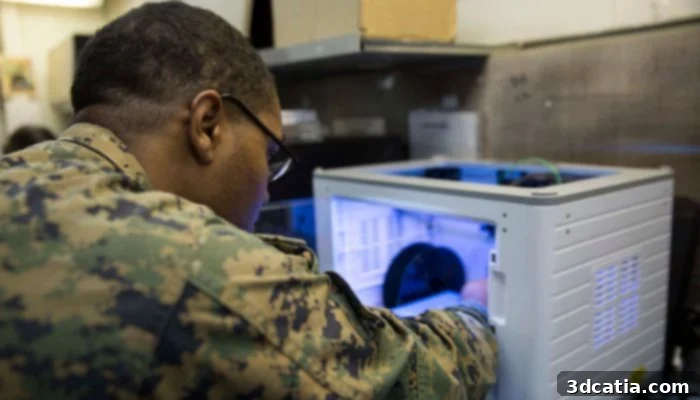
An American solider working with a 3D printer (photo credits: Cpl. Bernadette Wildes/31st Marine Expeditionary Unit)
The DoD’s Additive Manufacturing Strategy is an extensive document, too broad to fully detail here. However, its core objective is to outline the rationale and methodology for integrating additive manufacturing throughout the American defense ecosystem. Critically, the strategy highlights three primary ways in which 3D printing supports the DoD’s overarching mission: first, by modernizing national defense systems through advanced manufacturing capabilities; second, by enhancing material readiness via rapid prototyping and the direct production of critical parts, thereby mitigating the risk of hardware obsolescence; and third, by empowering warfighters on the battlefield with innovative, rapidly deployable solutions that leverage AM’s vast potential.
To achieve these ambitious goals, the DoD has articulated five strategic pillars: integrating AM into both the DoD and the wider Defense Industrial Base; ensuring consistent alignment of AM activities across DoD components and with external partners; promoting agile and efficient use of AM technologies; expanding expertise and proficiency in AM throughout the workforce; and finally, securing the entire AM workflow, particularly concerning data integrity and supply chain resilience. Through these concerted efforts, the DoD aims to harness the multifaceted benefits of 3D printing not only for its own operations but also for its allies. This includes improving accessibility to AM training and resolving complex issues surrounding data securitization for manufactured parts.
Robert Gold, former Director of the Technology Manufacturing Industrial Base (TMBID) office in STP&E, OUSD (R&D), underscored the profound significance of this strategy in official DoD correspondence. He stated, “Additive manufacturing offers DoD unprecedented supply chain agility while enabling our developers to sustain technological dominance for our Warfighters. This Strategy ensures that DOD will realize the most benefits from AM technology by structuring our AM activities, aligning funding opportunities, and improving AM implementation efforts – all with the objective of enhancing our Warfighters’ mission readiness.” This statement powerfully encapsulates the vision for AM’s role in future military readiness.
The tangible results of this strategic commitment have been evident since 2012, with direct DoD spending on AM escalating from $300 million in 2023 to $800 million in 2024. This trend is expected to continue its upward trajectory, reaching an estimated $2.6 billion by 2030. Projects span all military branches, including the production of critical submarine components, 3D printed rockets for the US Air Force, parts for Apache helicopters, the deployment of metal 3D printers aboard US Navy ships, advanced weapon systems, battlefield aid drones, and even specialized barrack components, showcasing the breadth of AM’s applicability.
During a 2023 panel at the Air and Space Forces Association’s Air, Space and Cyber event, William LaPlante, former Undersecretary of Defense for Acquisition and Sustainment, elaborated on the transformative nature of AM. He highlighted, “Additive manufacturing is being used to produce parts in aircraft engines; car companies are using them for mission-critical parts. What’s interesting about it is not just that you can do things faster, you can produce things that we could not have produced otherwise. And what’s happening — and we’re seeing it in Ukraine — is it’s also changing how sustainment is done. Going back and forth with additive manufacturing, and going back and iterating with [digital engineering,] magic can happen. It’s happening right now in the commercial space, where [space development agencies] are going from the design phase to production and going up to orbit in three years.” This illustrates how AM not only accelerates existing processes but also unlocks entirely new possibilities for innovation and logistical efficiency.
The United Kingdom: Advancing Defense Through AdM
The United Kingdom’s Ministry of Defence (MoD) has similarly articulated its intent to leverage the benefits of additive manufacturing. This commitment is formalized through various initiatives, most notably its comprehensive framework for additive manufacturing (AdM). Much like the U.S. DoD’s strategy, the UK’s AdM framework aims not only to integrate 3D printing for military applications but also to proactively identify and address potential barriers to its adoption within government and among industry partners. As part of this effort, the MoD’s Defense Equipment & Support (DE & S) organization awarded contracts to five companies in April 2023 to further develop these capabilities.
While the AdM framework was formally unveiled recently, the UK military has been actively engaged with AM for some time. In 2022, the government launched Project TAMPA, a targeted initiative designed to promote metal additive manufacturing. This project actively sought partnerships with companies to accelerate the maturity of AM technology, specifically emphasizing the need to reduce excessive lead times and improve the end-to-end supply chain, particularly for producing obsolete parts crucial to maintaining legacy equipment.
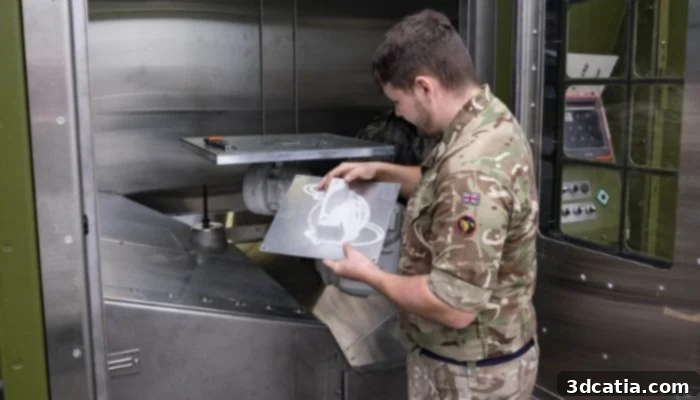
A British soldier taking a part out of a printer (photo credits: MOD Crown)
Alexander Champion, an Additive Manufacturing Engineer at the MoD, highlights the longer history of AM within the British Military: “The Ministry of Defence has been running multiple AM trials over the past ten years. They are currently looking at the adoption of Additive Manufacturing, as part of a wider advanced manufacturing toolkit. For the British Army, Youtube will show videos of the Royal Engineers in the British Army 3D printing plumbing fittings for hospitals in South Sudan back in 2019. As a result of that success, the REME are moving forward with the adoption of metal AM. More recently, in the RAF, 71 Inspection and Repair Squadron, have also built a powder bed metal facility.” This demonstrates a gradual, successful integration from basic field applications to more sophisticated industrial deployments.
Champion further notes that Project TAMPA is a direct evolution stemming from these prior successes in additive manufacturing. He explains, “This project is working with Thales, RBSL, Babcock, and NP Aerospace to accelerate the manufacture and installation of 3D printed parts by Defence manufacturers. The project has seen industry printing and fitting increasingly complex metal parts to in-service vehicles. This has helped inform future decision makers in the MOD on how to create an environment whereby additively manufacturing parts becomes ‘business as usual.’” The project not only validates AM’s capabilities but also establishes a roadmap for its routine integration into defense logistics and sustainment.
Building on the momentum of Project TAMPA’s success, the United Kingdom is further intensifying its investment in additive manufacturing through “Spiral 3.” This ambitious project aims to accelerate AM adoption across the entire defense supply chain by improving the availability of AM equipment throughout the MoD and fostering a deeper understanding and collaboration on AM between U.S. DoD and UK MoD suppliers. This cross-Atlantic partnership underscores the strategic importance of AM for allied defense capabilities.
Global Expansion: Other Examples Around the World
While the United States and the United Kingdom have established explicit, detailed policies, numerous other governments are actively implementing projects to enhance the use of additive manufacturing in defense. A notable example comes from Australia, particularly through its collaboration with SPEE3D. SPEE3D is distinguished for its pioneering use of cold spray additive manufacturing, a metal technology lauded for its remarkable speed, versatility in material choice, and robust performance. These attributes have made it an attractive solution for both the Australian and American militaries. Indeed, both nations have engaged in joint projects, including testing the rapid printing of replacement parts for armored vehicles and developing dedicated additive manufacturing teams within the Australian army, showcasing practical applications of this advanced technology.
Europe is also witnessing an increasing role for additive manufacturing in defense. The European Defence Agency (EDA) conducted a comprehensive feasibility study to evaluate how AM could bolster defense capabilities across member states. The report specifically highlighted critical applications such as “mobility, sustainability, ensuring platform availability, effect and protection through e.g. on-site and on-demand field repair & maintenance, reduced logistic burden of deployments and improved sustainability in warfighting and peacekeeping missions.” These areas underscore AM’s potential to enhance operational efficiency and logistical resilience for European forces.

The EDA has been working to integrate additive manufacturing (photo credits: EDA)
The EDA’s findings further revealed that the technical capabilities across various additive manufacturing technologies are remarkably broad and diverse, indicating significant untapped potential within the defense sector. Alexander Champion from the UK MoD acknowledged this global trend, commenting, “Outside of UK MOD, it is also clear that our NATO allies have a significant appetite to increase their Additive Manufacturing capabilities. The UK MOD have therefore already taken part in multiple military training exercises looking to better cohere and align exploitation of the technology with countries such as France, the Netherlands, the USA and Australia. In future this could help unlock a new global supply web, whereby parts can be printed at or near the point of need by industry, UK Military or a NATO neighbor.” This vision points towards a future of distributed, on-demand manufacturing for enhanced logistical agility.
China is also actively embracing 3D technologies for military applications. Following reports that Taiwan was utilizing 3D printing for drone production, news emerged that China’s People’s Liberation Army (PLA) is similarly deploying AM. Specifically, the PLA has been using additive manufacturing to test remote weapons maintenance, leveraging Unmanned Aerial Vehicles (UAVs) to deliver 3D printed parts. This trend suggests a strategic focus on distributed logistics and maintenance capabilities, which is likely to continue and expand.
Key Applications: How Is Additive Manufacturing Being Used in Defense?
As additive manufacturing solidifies its critical role in the defense sector, understanding the most prominent technologies and materials in use becomes essential. Due to the vast array of potential applications, a diverse range of materials—including metals, composites, and plastics—are being utilized. Let’s delve into the specific types of 3D printing and their unique contributions to military operations.
Composite 3D Printing: Lightness and Strength for Critical Components
Composites, defined as materials constructed from two or more constituent materials, are highly valued across numerous industries for their exceptional combination of lightness and strength. They have seen rapid adoption in sectors like aerospace and aeronautics, where weight reduction is paramount for flight performance and fuel efficiency. Consequently, their applicability in defense is similarly significant and growing.
For instance, composite materials are instrumental in creating lighter yet robust components such as protective helmets, specialized weapon parts, intricate electrical enclosures, and various spare parts. The inherent light-weighting properties of composites allow for increased operational range, reduced soldier burden, and improved maneuverability. In the air force, composites are employed much as they are in civil aviation: to produce essential spare parts and to recreate obsolete components for legacy fighter jets like the iconic B-52s, the colossal C-5M Super Galaxy, and the stealthy B-2 Stealth Bomber. Both ground and air forces view composite 3D printing as a crucial method to lighten equipment and significantly reduce logistical loads.
Metal 3D Printing: Enabling Robust Solutions and Supply Chain Resilience
Metal 3D printing is arguably the area experiencing the most substantial growth and innovation within the defense sector, particularly within the army and navy. The U.S. Navy, for example, has strategically partnered with companies like SPEE3D and AML3D to address persistent supply chain vulnerabilities, especially concerning the manufacturing of critical submarine parts. Beyond these partnerships, the Navy extensively collaborated with Xerox before the company divested its 3D printing division. A landmark achievement of this collaboration was the deployment of a metal 3D printer aboard the USS Essex in 2022, marking a significant step towards on-demand, at-sea manufacturing capabilities.

A metal 3D printed part made on the USS Essex (photo credits: Mass Communication Specialist 3rd Class Isaak Martinez/U.S. Navy)
Alexander Champion further elaborates on the UK’s focus: “Metal AM is also being investigated within the MOD, however this is slower due to the cost and complexity of equipment. We are already seeing Defence suppliers such as Lockheed Martin, Rolls Royce, Airbus Defence and Boeing printing critical metal parts for flight. This includes metal powder bed but also larger technologies such as DED and cold spray for use in both Additive Manufacturing as well as Additive Repair.” This indicates a broad adoption of metal AM technologies, ranging from precision powder bed fusion for new components to large-scale Directed Energy Deposition (DED) and cold spray for both manufacturing and on-site repair, significantly extending the lifespan and readiness of vital equipment.
Polymer 3D Printing: Versatility from Training to High-Performance Parts
While metals and composites offer extensive applications, the critical role of polymers in military additive manufacturing should not be overlooked. Simple polymers, particularly those used with Fused Deposition Modeling (FDM) technology, often serve as the entry point for soldiers and engineers to learn about AM. This accessibility has been crucial for initial adoption and widespread familiarization within military contexts.
Champion elaborates on this progression: “Deployed Military users such as soldiers in the Army started with FDM printing, this is a very fast and affordable way to learn how additive manufacturing can support. Very quickly we learnt that AM will not replace the supply-chain, or the other tools which MOD engineers use, such as welding. AM is, however, a very powerful tool when used for the correct applications. Several organizations both in Defense and Industry are now upgraded to using additional polymer printing technologies such as SLS printing and continuous carbon fiber reinforced. These technologies are perfect for larger volume, higher-strength, end use parts.” This highlights the progression from basic FDM for rapid prototyping and learning to more advanced polymer techniques like Selective Laser Sintering (SLS) and continuous fiber composites, enabling the production of robust, high-performance end-use components.
High-performance polymers also hold a significant position within defense applications. Materials like PEEK (Polyetheretherketone) and PEKK (Polyetherketoneketone) offer an unparalleled strength-to-weight ratio, often surpassing metals while being considerably lighter. These advanced polymers are already widely used in demanding aerospace operations and are consequently finding similar critical applications in defense, ranging from durable enclosures to lightweight structural components for various platforms.
Addressing the Obstacles to Greater AM Adoption in Defense
Despite the increasingly widespread adoption and demonstrated benefits, significant challenges persist in fully integrating additive manufacturing into defense operations. These obstacles often mirror those encountered by other industries in their 3D printing journeys, including inadequate training, complex certification processes, and paramount security concerns related to data breaches. However, given the inherently sensitive nature of defense work, these issues become even more pronounced and critical.
To truly expand the propagation of additive manufacturing beyond its current reach and into a greater number of national militaries, these fundamental obstacles must be systematically addressed. The European Defence Agency (EDA) acknowledged this in its previously mentioned report, stating, “non-technical factors (IPR, training, standardization and certification, health and safety, etc.) represent solid limitations for AM implementation, stronger in fact than technical ones.” This insight suggests that the primary barriers are often not technological capability but rather the surrounding ecosystem and human factors.
It can be argued that the difficulty lies not in finding applications for the technologies themselves, but rather in establishing comprehensive standardization, achieving rigorous certification, and effectively training personnel to operate and integrate these advanced machines. The additive manufacturing industry has long been aware of these weaknesses. In recent years, there has been a noticeable increase in the presence and influence of certification and qualification organizations at major industry events like RAPID + TCT and Formnext, indicating a growing interest from 3D printer and material manufacturers in these vital services.
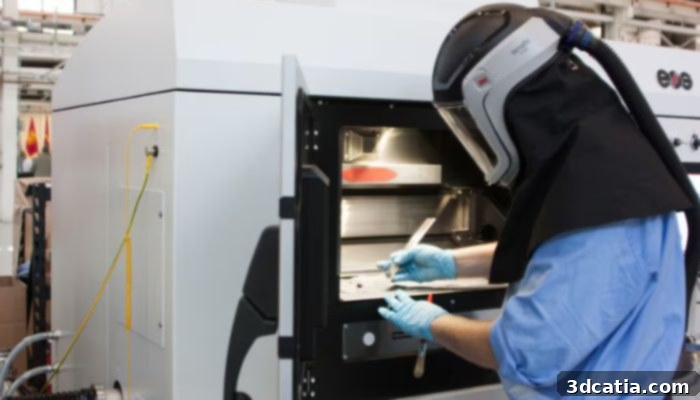
At the Rock Island Arsenal, engineers are working on using additive manufacturing for many defense applications (photo Credits: Debralee Best/U.S. Army)
The U.S. Army, at least, is actively tackling these challenges, as evidenced by recent calls for white papers. For instance, in its pursuit of adopting AM for flight-critical parts, the military has issued requests for qualified 3D printing vendors to submit proposals. These vendors, with their extensive knowledge and specialized skills across various 3D printing processes, are often best positioned to produce such highly technical parts. This approach—leveraging external industry expertise—could serve as a viable model for other countries, particularly as military corps of engineers continue to develop and expand their in-house additive manufacturing capabilities.
Champion illuminates additional, profound obstacles, stating, “The most critical obstacle to the widespread adoption is the availability of CAD and design information, large numbers of our unavailable spare parts stopped being manufactured in the 1970s, there are therefore no technical drawings or digital CAD to build a ‘thingiverse’ style library from. The task of assessing and reverse engineering the +1million different items in our supply chain will not be a fast or easy problem to solve. Once we have some digital files which are suitable for manufacture, the MOD can then begin to mature all the other key topics, called Defence Lines of Development (DLOD’s). These will include, proportional certification, access to Intellectual Property Rights, improving user training and understanding maintenance in a deployed environment will all be challenges to overcome, as well as understanding demand signal issue from the MOD to make this possible and worthwhile.” This highlights the monumental task of digitizing legacy information for millions of components, which is foundational for effective AM integration.
Addressing the challenge of establishing a comprehensive digital database for legacy parts is inherently complex, especially given the confidential nature of defense work. However, drawing parallels from other industries, notably the railroad sector, demonstrates that creating such digital repositories is entirely feasible and offers significant benefits in terms of efficiency and supply chain resilience. The overarching concern, however, will always revolve around enhancing data security. This suggests that the development of such critical databases should primarily be a government-led initiative, even if the industrial sector possesses greater resources, to ensure the highest levels of protection against cyber threats and sabotage.
Security itself remains a paramount concern. 3D printers and their associated digital workflows are susceptible to vulnerabilities, and past controversies have highlighted the risks of using them for sensitive information. Protecting digital files from hacking or sabotage is absolutely critical in military applications. Fortunately, given the sheer number of additive manufacturing companies and research institutions working within the defense sector, substantial efforts are being directed towards bolstering the security of AM processes. These ongoing advancements are progressively making it safer and more feasible for militaries worldwide to adopt various 3D printing technologies with greater confidence.
The Future Role of Additive Manufacturing in Defense
Considering the relentless advancements and growing strategic integration of additive manufacturing within the defense sector, it is unequivocally clear that its role will continue to expand significantly. While the United States, closely followed by the United Kingdom, pioneered the creation of dedicated national policies for additive manufacturing in defense, they are unlikely to be the last. Given the existing strong interest in 3D printing among NATO countries and the extensive work being undertaken by two of the world’s largest militaries, it is highly probable that more nations, especially within the alliance, will develop their own comprehensive AM strategies.
Furthermore, the utilization of AM is poised for continued robust growth within the United States. One of the foundational tenets of former President Trump’s intended policies for a potential second term centers on fortifying the military. A proven pathway to achieving this objective lies in accelerating technological advances, including the broad adoption of additive manufacturing. While the precise trajectory of future investments is subject to political and economic factors, the potential for significant, sustained investment in AM for military applications remains strong.
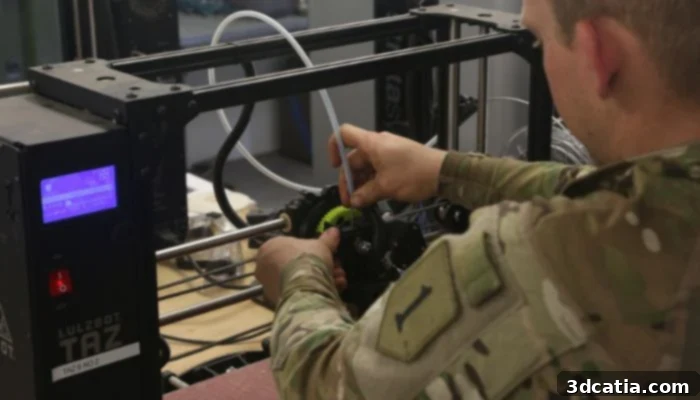
A U.S. soldier working with a 3D printer back in 2019 (photo credits: U.S. Army)
Collaboration will also play an indispensable role in further establishing additive manufacturing as a cornerstone tool within the defense sector. Alexander Champion concludes with an insightful perspective: “The MOD have not undertaken this journey alone, they are already collaborating with some of the biggest names in the industry to guide us along the way, such as the National Centre for Additive Manufacturing based in the MTC in Coventry. Likewise, we have a close working relationship with our NATO allies. Finally, the MOD is not just interested in 3D printing, it is just the first new tool to be considered for the toolbox. There is a growing appetite to understand other Advanced Manufacturing processes such as laser cutting. Additive Manufacturing will hopefully be the first step in helping the MOD realize the benefits of digital manufacturing.” This emphasizes that AM is part of a broader shift towards digital manufacturing, with immense potential for future innovation and efficiency in defense.
What are your thoughts on the expanding use of additive manufacturing in the defense sector? Are you aware of other countries where 3D printing is making significant strides in military applications? Share your insights in the comments below or join the conversation on our LinkedIn, Facebook, and Twitter pages! Don’t forget to subscribe to our free weekly Newsletter here to receive the latest 3D printing news directly in your inbox. You can also explore all our video content on our YouTube channel.