
Serendipitous Breakthrough: Fluorescent 3D Printed Implants Revolutionize Biomedical Tracking and Monitoring
The history of scientific discovery is replete with instances where groundbreaking innovations emerged from unexpected places. The term “serendipity” perfectly encapsulates these chance encounters that lead to profound advancements. Iconic examples like the discovery of radioactivity by Henri Becquerel, X-rays by Wilhelm Röntgen, and penicillin by Alexander Fleming underscore the power of accidental observation combined with keen scientific insight. Recently, this very spirit of serendipity paved the way for a remarkable new breakthrough in the field of additive manufacturing. Through an informal conversation, two pioneering researchers from the University of Oregon envisioned a novel fusion of their distinct expertise: the creation of fluorescent 3D printed rings specifically designed for critical medical applications. These innovative rings possess the potential to fundamentally transform medical technology by enabling a new generation of luminous implants. Such implants could significantly enhance post-insertion tracking, monitoring, and even diagnosis within the human body, opening up unprecedented possibilities for patient care and advanced biomedical research.
The Power of Collaboration: University of Oregon’s Breakthrough in Smart Materials
At the heart of this exciting development are Dr. Paul Dalton, affiliated with the Phil and Penny Knight Campus for Accelerating Scientific Impact, and Dr. Ramesh Jasti, from the Department of Chemistry and Biochemistry at the University of Oregon. Their collaboration exemplifies how interdisciplinary approaches can unlock solutions to complex challenges in material science and biomedicine. Dr. Paul Dalton’s laboratory has long been at the forefront of exploring “Melt Electrowriting,” a sophisticated 3D printing technique renowned for its ability to fabricate intricate, highly precise three-dimensional structures. This method is particularly well-suited for medical applications due to its fine resolution and capability to create scaffold-like materials that mimic biological tissues. Researchers in Dr. Dalton’s lab have consistently pushed the boundaries of this technique, developing customized 3D parts vital for various biomedical engineering challenges.
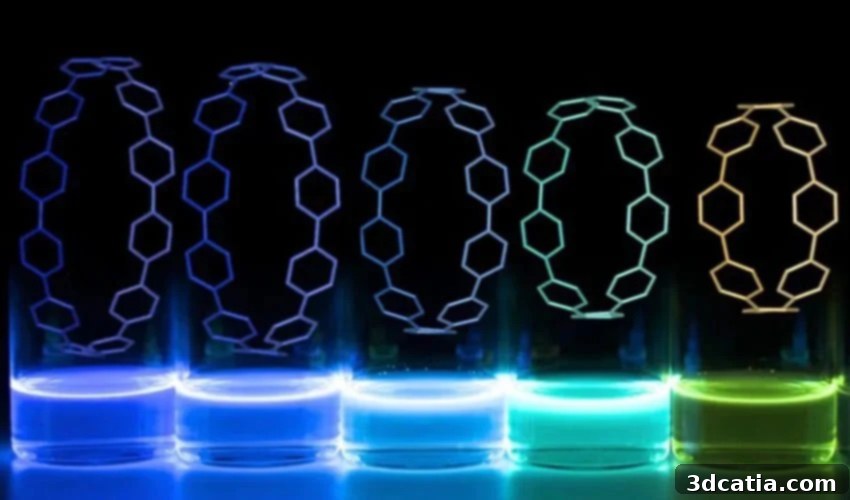
Concurrently, Dr. Ramesh Jasti’s laboratory has garnered international recognition for its pioneering work on “nanohoops.” These fascinating molecules are precisely engineered carbon cylinders that possess a unique property: they emit light when exposed to ultraviolet (UV) light. Unlike many conventional fluorescent molecules, nanohoops exhibit exceptional stability, even under harsh conditions. This inherent robustness makes them ideal candidates for integration into new materials. The convergence of these two distinct research trajectories—Dr. Dalton’s advanced 3D printing capabilities and Dr. Jasti’s innovative nanohoops—proved to be the catalyst for this breakthrough. Together, the researchers embarked on a mission to integrate the ideal concentration of these fluorescent nanohoops into a biocompatible 3D printing material. Their success led to the production of durable, long-lasting luminous structures that retain their integrity and functionality, paving the way for revolutionary medical implants.
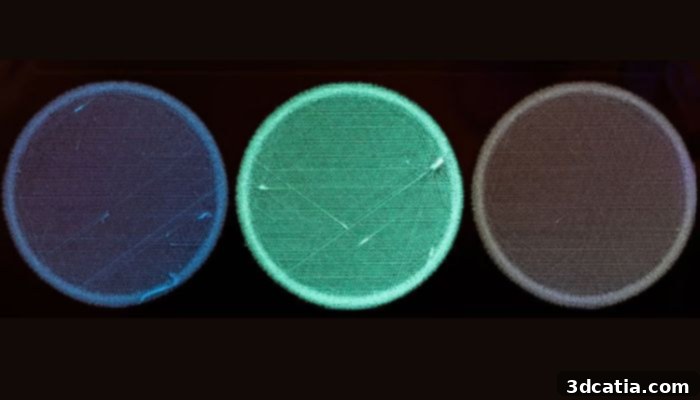
The rings glow in ultraviolet light, emitting different colors depending on their size and structure.
Unpacking the Science: The Game-Changing Properties of Fluorescent 3D Printed Rings
The development of these fluorescent 3D printed rings represents a significant leap forward, primarily because it addresses a long-standing challenge in material science: creating luminescent structures that can withstand the rigors of manufacturing and biological environments. Previous attempts to incorporate luminescent properties into materials for biomedical applications often faced insurmountable obstacles. Most traditional fluorescent molecules are highly susceptible to decomposition when exposed to prolonged heat, a common occurrence during many 3D printing processes. This thermal instability severely limited their practical applicability, especially for implants requiring sterilization or operating at body temperature over extended periods.
This is precisely where Dr. Jasti’s groundbreaking work with nanohoops truly differentiates this new material. Unlike their fragile counterparts, these specialized carbon cylinders boast remarkable thermal and chemical stability. They maintain their structural integrity and luminescent properties even at elevated temperatures, making them perfectly suited for integration via Melt Electrowriting. To validate their hypothesis, the researchers conducted extensive tests, meticulously verifying that the nanohoops retained their crucial properties—including their fluorescence, strength, and stability—when embedded within the 3D printing material. The results were unequivocally positive: the composite material exhibited no compromise in its mechanical strength or overall stability, a critical factor for any load-bearing or long-term implantable device.
Perhaps even more vitally for biomedical applications, the team rigorously confirmed that the addition of these fluorescent nanohoops did not induce any adverse cellular toxicity. Biocompatibility is the cornerstone of any material destined for implantation within the human body. Through comprehensive cytotoxicity assays, the researchers demonstrated that the composite material remained benign to cells, ensuring it would not provoke inflammatory responses, tissue damage, or other harmful biological reactions. This non-toxic nature, combined with exceptional stability and inherent fluorescence, positions these 3D printed rings as an incredibly promising platform for a new generation of smart, trackable, and safe medical implants. This innovative approach overcomes previous limitations, offering robust and reliable luminescent features for enhanced medical diagnostics and intervention.
Transformative Biomedical Applications: A Future Illuminated by Smart Implants
The innovative design of these fluorescent 3D printed rings holds the potential to unlock a myriad of transformative applications across the biomedical landscape. The researchers envision these luminous structures not just as components, but as foundational elements for an entirely new paradigm in healthcare. Primarily, these rings could revolutionize the development of next-generation medical implants, offering unparalleled capabilities for in-situ tracking and monitoring once inserted into the body. Imagine a surgical implant that, when exposed to a specific UV light source (perhaps externally applied or via endoscopic tools), glows visibly, allowing clinicians to precisely assess its position, integrity, and interaction with surrounding tissues without invasive procedures or harmful radiation like X-rays. This could dramatically improve post-operative care, enable early detection of complications such as implant migration or infection, and facilitate personalized adjustments to treatment plans.
Beyond general tracking, the researchers highlight several specific, high-impact applications. One promising area is the development of a new wound-healing technology. Luminous scaffolds could be engineered and 3D printed to fit the exact contours of a wound. By monitoring the fluorescence intensity or patterns, clinicians could non-invasively track the progress of tissue regeneration, assess the efficacy of drug delivery from the scaffold, or even detect early signs of bacterial infection. This real-time visual feedback would be invaluable for optimizing treatment protocols and accelerating patient recovery. Another critical application lies in the creation of advanced artificial blood vessels. Current prosthetic vessels often suffer from issues like clotting, inflammation, or poor integration with host tissues. Implants incorporating nanohoops could provide a luminescent signal to indicate patency (openness), detect early thrombosis, or monitor endothelial cell growth along the vessel walls, leading to more durable and safer vascular grafts.
Furthermore, these fluorescent materials hold immense promise for scaffolding to promote nerve regeneration. Repairing damaged nerves is one of the most challenging areas in medicine. By creating luminescent 3D printed scaffolds that guide nerve growth, researchers could potentially visualize the extent of regeneration, ensure proper alignment, and even monitor the health of newly formed neural connections. The ability to visually confirm nerve regrowth in complex anatomical structures could revolutionize therapies for spinal cord injuries, peripheral nerve damage, and neurodegenerative diseases. The adaptable nature of the material also suggests potential for a wide range of other biomedical devices, from drug delivery systems that release active compounds visibly, to bio-sensors that change fluorescence in response to specific biomarkers, offering a new dimension to diagnostic capabilities.
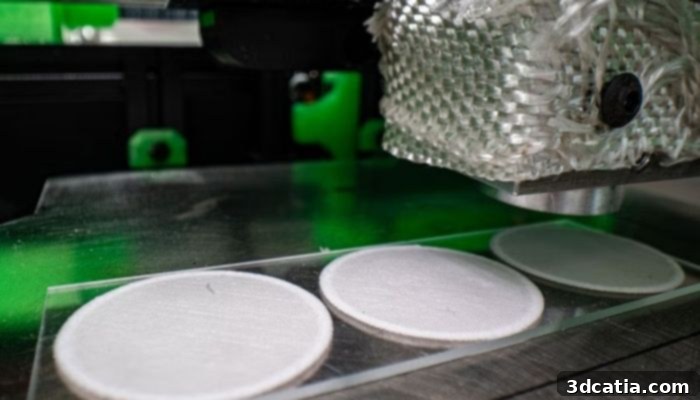
Normal appearance of printed structures. Fluorescence is only activated by ultraviolet light.
Beyond Biomedicine: Security Applications and the Road Ahead
While the immediate focus of this research is on the biomedical field, the potential applications of these fluorescent 3D printed materials extend far beyond healthcare. The team also envisions their material being adapted for crucial security applications. Imagine high-value components or secure documents marked with invisible, fluorescent 3D printed tags that are only detectable under specific UV light frequencies, offering a robust anti-counterfeiting measure. This could be applied to brand protection, intellectual property, or even tracking sensitive materials in logistics. The unique and stable luminescent signature provided by the nanohoops makes them ideal for creating covert identification markers that are incredibly difficult to replicate or tamper with, opening new avenues in secure manufacturing and supply chain integrity.
However, before these innovative fluorescent 3D printed rings become commonplace in clinics or security systems, there is a necessary period of development and commercialization. The team has proactively taken a crucial step by filing a patent application to protect their intellectual property. This patent filing is a vital milestone, safeguarding their discovery and paving the way for eventual commercialization. The journey from laboratory breakthrough to widespread application in medical devices is often long and complex, involving rigorous regulatory approvals, extensive clinical trials, and scaling up manufacturing processes. The next phase of research will likely focus on optimizing material formulations, exploring different geometries and functionalities of the rings, and demonstrating their efficacy and safety in more complex biological systems. While patience will be required, the foundational science has been laid, promising a future where smart, trackable, and safe implants become a standard in advanced medical care.
This serendipitous discovery at the University of Oregon highlights the profound impact of interdisciplinary collaboration and innovative material science. The development of biocompatible, fluorescent 3D printed structures represents a significant advancement in additive manufacturing, poised to revolutionize various sectors. From enhancing the precision and safety of medical implants to securing sensitive materials, the future of these luminous materials shines brightly. We eagerly anticipate the concrete applications that will emerge from this groundbreaking work.
What are your thoughts on these innovative fluorescent 3D printed rings and their potential? Let us know in a comment below or on our LinkedIn, Facebook, and Twitter pages! Don’t forget to sign up for our free weekly newsletter here for the latest 3D printing news straight to your inbox! You can also find all our videos on our YouTube channel.
*All Photo Credits: Dusty Whitaker/University of Oregon