

Soaring to New Heights: Richard Browning’s 3D Printed Jet Suit and the Dawn of Personal Flight
For centuries, humanity has harbored an enduring dream: the ability to fly. This aspiration, once relegated to the realms of mythology, science fiction, and superhero narratives like Iron Man, has now become an astonishing reality. Thanks to the groundbreaking work of inventor Richard Browning and his company, Gravity Industries, individuals can now experience unassisted human flight with their revolutionary 3D printed jet suit. This monumental development isn’t just a technological marvel; it marks the thrilling commencement of personal flight commercialization, with the suit making its astonishing debut on the Selfridges website at a price tag of £340,000 (€380,000). The question is no longer “if” we can fly, but “would you pay this amount for the ultimate freedom of the skies?”
The Visionary Behind the Velocity: Richard Browning and Gravity Industries
Richard Browning, the innovative CEO and founder of Gravity Industries, openly acknowledges the indelible influence of pop culture on his pioneering project. He explains, “It started as an exploration alongside daily work.” What began as a personal quest soon converged with a widely imagined concept: the iconic character of Iron Man. Browning humorously points out, “What people find amusing is that I am not a formally trained engineer. However, I have always possessed an insatiable curiosity, a drive to dismantle objects to understand their inner workings, and then to reconstruct or create new things.” This hands-on, iterative approach, coupled with a visionary mindset, proved to be the fertile ground from which the jet suit would eventually take flight, transforming a fantastical idea into a tangible, awe-inspiring machine.

Engineering Personal Flight: The Power of 3D Printing and Advanced Propulsion
From Concept to Reality: Development and Investment
Bringing such a complex and ambitious idea to fruition required significant backing. Gravity Industries secured an initial investment of $650,000 from astute Silicon Valley entrepreneurs, providing the crucial capital to fuel years of intensive research and development. This dedicated effort culminated in last year’s momentous announcement: the 3D printed jet suit was officially ready for takeoff. This isn’t just a gimmick; it’s a high-performance machine. The suit boasts an astounding 1,000 horsepower, enabling it to reach exhilarating speeds of up to 90 km/h. For practical and safety reasons, the suits are typically recommended for operation at a limit of 50 km/h, but their sheer capability is undeniable. Furthermore, the technology allows for impressive vertical ascent, with the suit capable of reaching heights of up to 3,650 meters, pushing the boundaries of what was previously considered possible for individual human flight.
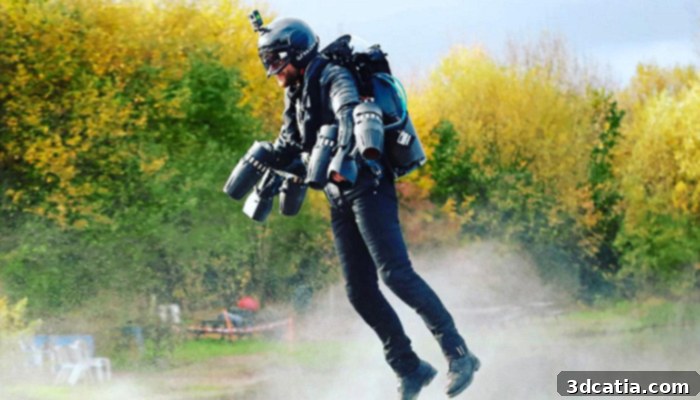
A critical innovation underlying the jet suit’s design is the strategic use of 3D printed metal components. Additive manufacturing, particularly with metals, allows for the creation of incredibly complex, lightweight, and robust parts that are essential for the suit’s performance and safety. These custom-designed components contribute to the suit’s manageable weight of 27 kg. Powering this marvel are five strategically placed turbines: two on each arm and one on the back. These turbines operate on kerosene, providing the immense thrust necessary for vertical lift and propulsion. What makes the suit truly intuitive is its control mechanism; unlike complex cockpits, flight is achieved through subtle body movements. By shifting weight and adjusting arm positions, the pilot can effortlessly steer and maneuver in the desired direction, creating an experience that feels like an extension of the human body.
Taking Flight: Commercialization and Future Horizons
The suit’s inaugural public demonstration in 2017 sent shockwaves through the tech and luxury markets, immediately attracting significant attention. Within a short period, nine eager buyers emerged, each requesting their bespoke, tailored jet suit. Among these early adopters, one name stood out: actor Tom Cruise, reportedly keen to commence his training with the cutting-edge 3D printed suit. While the current price point undeniably places this incredible technology far beyond the reach of the average consumer, Browning and Gravity Industries are not resting on their laurels. They are actively pursuing various collaborations to further develop and refine the suit, including intriguing discussions with military organizations. This raises compelling questions: will we soon witness this groundbreaking 3D printed jet suit in action on future battlefields, revolutionizing reconnaissance, logistics, or even combat scenarios?
According to its creators, an innovation of this magnitude transcends mere technological advancement; it’s a historical moment akin to witnessing the flight of one of the world’s very first aircraft. Bosse Myhr, director of men’s clothing and technology at Selfridges, eloquently articulated this sentiment: “The suit is the equivalent of launching the first plane. We are truly on the cusp of a new era where aeronautical technology can finally transition into the hands of the consumer, and we are immensely proud to be the first to offer such an unparalleled experience.” This partnership with Selfridges underscores the unique position of the jet suit—a fusion of extreme engineering, aspirational luxury, and a bold vision for the future of personal mobility.

Beyond the Horizon: The Broader Impact of Personal Flight
The rapid advancements in personal mobility aren’t limited to the skies. Just recently, we marveled at the CUDA aquatic propeller, a “jet pack for the sea” designed to revolutionize underwater movement. Now, with the dramatic arrival of Richard Browning’s jet suit, we are propelled into a future brimming with exhilarating possibilities. It paints a vivid picture where, in perhaps just a few years, anyone could realistically fulfill their childhood dream of becoming a superhero, or at the very least, enjoying an unprecedented level of personal freedom. Imagine the transformative impact on daily life: commuting to work effortlessly in your very own 3D printed jet suit, bypassing traffic and embracing the serene expanse of the open air. This isn’t just about entertainment or luxury; it’s about redefining transportation, emergency services, and even the very fabric of how we interact with our environment.
The potential applications extend far beyond personal enjoyment. For search and rescue operations, a jet suit could enable rapid access to difficult terrains, drastically cutting response times in emergencies. In military contexts, it offers unprecedented agility and strategic advantage. For entertainment, it opens up entirely new sports and performance spectacles. While the journey from exclusive luxury item to widespread adoption is undoubtedly long and complex, requiring advancements in fuel efficiency, safety regulations, and manufacturing scalability, the initial leap has been made. The dream is real, and the sky is no longer the limit.
To witness this incredible technology in action, observe one of the pioneering flight tests in the video below. For further detailed information and to explore the commercial offerings, be sure to visit the official Selfridges website here.
What are your thoughts on this groundbreaking “Iron Man” 3D printed jet suit? Do you envision a future where personal flight becomes commonplace? Share your insights and predictions in a comment below, or join the conversation on our Facebook and Twitter pages! Don’t miss out on the latest advancements in additive manufacturing—remember to sign up for our free weekly Newsletter to have all the breaking news in 3D printing delivered straight to your inbox!