
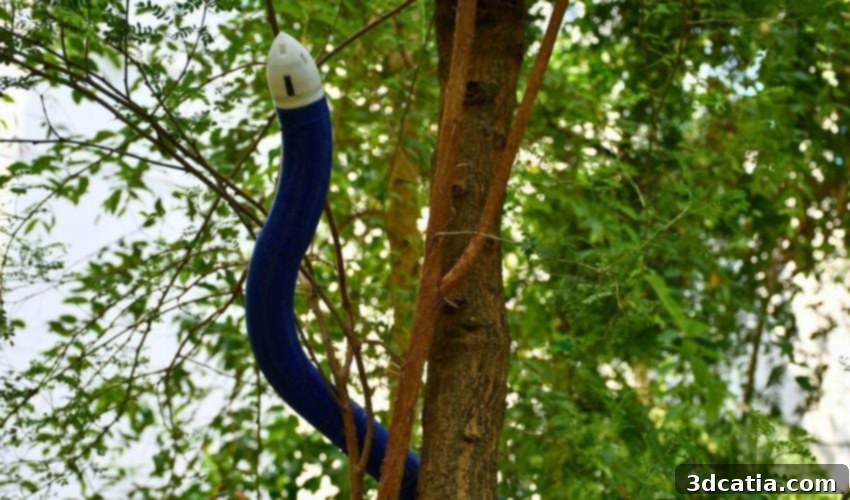
FiloBot: Revolutionizing Robotics with 3D Printed Self-Growing Plant-Inspired Machines
The convergence of additive manufacturing and soft robotics has ushered in an era of unprecedented innovation, enabling researchers to overcome traditional engineering limitations and achieve remarkable results. Among these advancements is FiloBot, a pioneering project from the Italian Institute of Technology (IIT) in Genoa, Italy. This robot represents a fascinating blend of biomimicry and advanced 3D printing techniques, drawing inspiration from the adaptive growth patterns of climbing plants. FiloBot is not merely a static machine; it’s a dynamic entity capable of “self-molding” and actively growing in three-dimensional spaces, pushing the boundaries of what robots can achieve in complex, unstructured environments.
Self-growing robots are rapidly emerging as a transformative solution within the field of soft robotics. Their inherent ability to navigate, explore, and even colonize environments that are often inaccessible or hazardous to conventional robots makes them incredibly valuable. However, the development of robots that can genuinely grow and move with high dexterity and autonomy in real-world, three-dimensional conditions has been a significant challenge. The groundbreaking study on FiloBot, which was prominently featured in the esteemed journal *Science Robotics*, addresses these challenges head-on. The research was meticulously conducted by the innovative group led by Barbara Mazzolai, who serves as the Associate Director for Robotics and heads IIT’s Bioinspired Soft Robotics lab. Their work showcases a profound understanding of natural systems translated into advanced robotic applications.
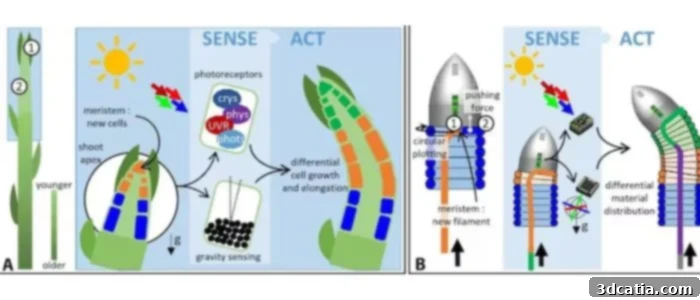
FiloBot dynamically grows its structure in response to external stimuli (photo credits: IIT)
FiloBot: A Marvel of Biomimicry and Additive Manufacturing
The Italian Institute of Technology in Genoa has a distinguished track record of pushing the envelope in robotics and biomimicry. This isn’t the first time we’ve highlighted their pioneering work. Just last year, we marveled at I-Seed, an extraordinary robot inspired by the humble seed, fabricated using innovative 4D printing technology. I-Seed was designed with the ambitious goal of exploring and monitoring subterranean environments, demonstrating IIT’s commitment to nature-inspired solutions. Today, FiloBot follows in this tradition, promising an equally wide array of viable and impactful applications. This cutting-edge robot was developed as a key component of the European GrowBot project, an initiative dedicated to exploring plant-inspired growth in robotics. While still a prototype, FiloBot has already unveiled immense potential, captivating the scientific community with its unprecedented capabilities.
The genesis of FiloBot’s design lies in the meticulous observation of nature, particularly the fascinating growth and adaptive strategies of climbing plants and vines. These plants possess an inherent ability to navigate complex, changing environments by continuously extending and reshaping their bodies to find support and light. “To move from one point to another, plants must continually grow and adapt their bodies to external environmental conditions. In light of this observation, we understood how apical growth is an important prerequisite for expressing a form of movement and adaptation in robots as in plants,” commented Barbara Mazzolai and Emanuela Del Dottore, the lead author of the study. This profound insight formed the core principle behind FiloBot: to imbue a robot with the same dynamic, adaptive growth mechanisms observed in the plant kingdom.
The Ingenious Mechanism Behind FiloBot’s Adaptive Growth
Just like a climbing plant that instinctively seeks out and wraps around supports, the IIT team envisioned FiloBot as a robot capable of not only growing but also seamlessly adapting its physical structure to the nuances of its surrounding world. The pivotal question was: how could this biological marvel be replicated robotically? The answer lies in a sophisticated combination of an embedded 3D printing mechanism directly within the robot’s structure, coupled with an array of highly sensitive motion sensors. This ingenious integration allows FiloBot to perceive its environment and react with dynamic growth.
At the heart of FiloBot’s operational prowess is its innovative rotating head. This head serves as an on-board additive manufacturing unit, employing a specialized Fused Deposition Modeling (FDM) process. It meticulously deposits a thermoplastic filament, which, upon solidification, progressively lengthens the robot’s body. What truly distinguishes FiloBot, however, is not merely its ability to print, but its capacity to grow intelligently. This growth is not pre-programmed but rather dictated by real-time external stimuli, including gravity, ambient light, and varying levels of shade. By responding directly to these environmental cues, FiloBot exhibits an adaptive behavior strikingly similar to the tropism observed in living plants – gravitropism (response to gravity) and phototropism (response to light). Witnessing FiloBot in action is a testament to this achievement; its fluid, responsive growth patterns evoke the mesmerizing sense of a living organism actively interacting with its habitat.
Unlocking New Frontiers: Applications of Self-Growing Robots
FiloBot’s complex and highly adaptive mechanism empowers it to navigate and proliferate through intricate and challenging habitats. Its ability to grow in relation to detected gaps, identify potential supports, and trace pathways means that FiloBot never adopts a fixed configuration. Instead, it assumes a unique structural form each time, precisely tailored to the specific environmental conditions it encounters. This unparalleled adaptability opens up a vast array of potential applications, with environmental monitoring standing out as one of the most immediate and impactful. Imagine a robot that can autonomously enter a hazardous area – perhaps a contaminated zone or a site with unstable structures – and measure pollution levels without risking human lives. FiloBot’s plant-inspired growth allows it to bypass obstacles and reach previously inaccessible or unknown natural environments, providing invaluable data for scientific research and ecological preservation.
Beyond environmental monitoring, the implications of FiloBot’s technology extend far and wide. Consider its potential in disaster relief and search and rescue operations, where it could penetrate rubble or confined spaces to locate survivors or assess damage. In urban settings, these robots could assist in infrastructure inspection, growing into pipelines or ventilation systems to identify faults. Furthermore, the concept of self-growing robots holds immense promise for exploration in extraterrestrial environments, where robots would need to adapt to alien topographies and limited resources. By producing its own structural components on demand, FiloBot minimizes the need for complex pre-assembly or transport of bulky parts, offering a paradigm shift in robotic deployment and operation in remote or hostile settings. This breakthrough underscores a new era where robots can not only move but also evolve their physical form to suit the demands of their mission.
The Future of Soft Robotics: Challenges and Potential
While FiloBot represents an extraordinary leap in robotics, it is important to remember that it is still a prototype. Like all pioneering technologies, it requires continued testing, refinement, and optimization before it can be deployed on a larger scale. Aspects such as the durability of the thermoplastic filament in various extreme conditions, the speed of growth, and the sophistication of its sensory inputs and decision-making algorithms will undoubtedly be areas of ongoing research. Nevertheless, this innovation signifies a major milestone at the intersection of biomimicry and robotics, marking a monumental step forward, particularly in the realm of environmental protection and exploration. The ability of robots to autonomously adapt and grow offers a sustainable approach to tasks that are currently dangerous, costly, or simply impossible for humans or traditional robots.
The future potential of FiloBot and similar self-growing robotic systems is truly exciting. It paves the way for a new generation of machines that are more resilient, autonomous, and harmoniously integrated with their operational environments. We eagerly anticipate the further developments and broader applications that this remarkable technology will unlock in the near future. For those interested in delving deeper into the technical specifics and research findings, the comprehensive study can be accessed HERE.
What are your thoughts on FiloBot and the concept of self-growing robots? Let us know in a comment below or connect with us on our LinkedIn, Facebook, and Twitter pages! Don’t forget to sign up for our free weekly newsletter here to receive the latest 3D printing news directly to your inbox! You can also find all our engaging videos on our YouTube channel.
*Cover Photo Credits: Istituto Italiano di Tecnologia (IIT), Genova