
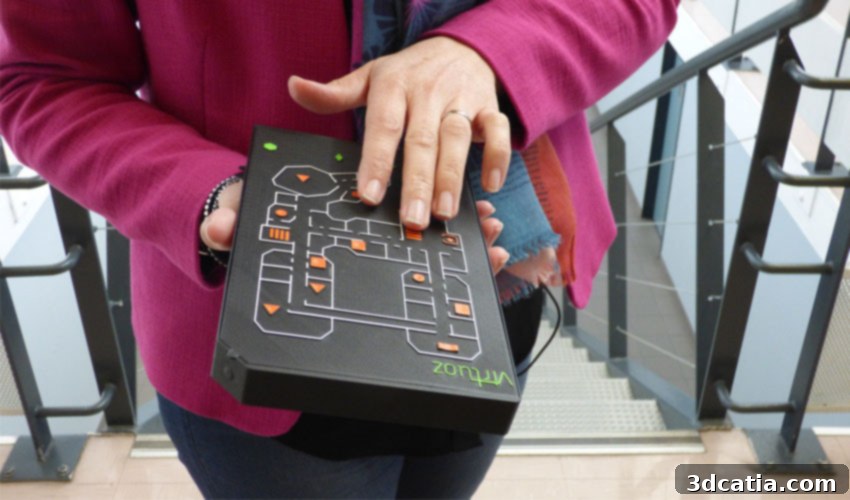
Feelobject’s Virtuoz: Revolutionizing Accessibility for the Visually Impaired with 3D Printed Tactile Maps
As 3D printing continues its remarkable development, expanding its capabilities to support individuals with disabilities through innovations such as 3D printed prosthetics, the French startup Feelobject is making significant strides with its groundbreaking Virtuoz solution. This innovative system offers a tactile and interactive 3D printed plan, meticulously designed to help people with visual impairments better understand and navigate their surroundings. Whether at home, in the workplace, or within complex transportation hubs, Virtuoz provides an unprecedented level of independence. Feelobject’s pioneering work was recently recognized when they triumphed at the first edition of the Startup Contest at the 3D Print Congress & Exhibition in Lyon. We had the opportunity to speak with Sylvain Huin, a co-founder of Feelobject, to delve deeper into the Virtuoz solution and explore how advanced 3D technologies are transforming daily life for individuals facing disabilities today.
Meet the Visionary: Sylvain Huin, Co-founder of Feelobject
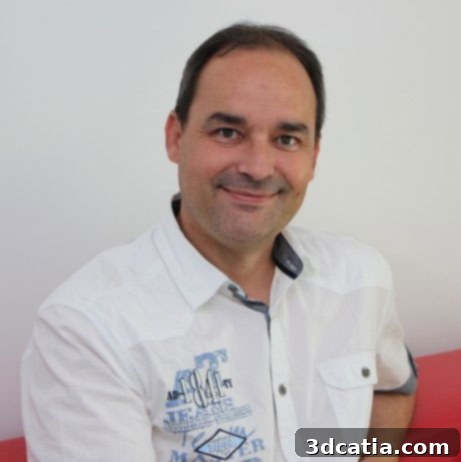
Sylvain Huin, co-founder of Feelobject
“My name is Sylvain Huin, and I am the President and co-founder of Feelobject,” begins Huin. “Our journey began in Toulouse in 2015, where I, alongside Céline FAVY-HUIN and Pascal GARRIN, established Feelobject. Our core strength lies in our dedicated Engineering Studio, where we conceptualize, design, rigorously test, and manufacture the products of tomorrow using cutting-edge professional 3D printing technology. We are driven by strong values and are deeply committed to fostering the intelligent inclusion of individuals with diverse needs and abilities within various sectors, including business and public spaces. This commitment led us, by the end of 2016, to design and bring to market high-quality, socially customizable objects—all produced through the transformative power of 3D printing. Our expertise in additive manufacturing is not just a technical capability; it’s a fundamental part of our mission to create meaningful solutions.”
Unveiling Virtuoz: The Tactile and Interactive Navigation System
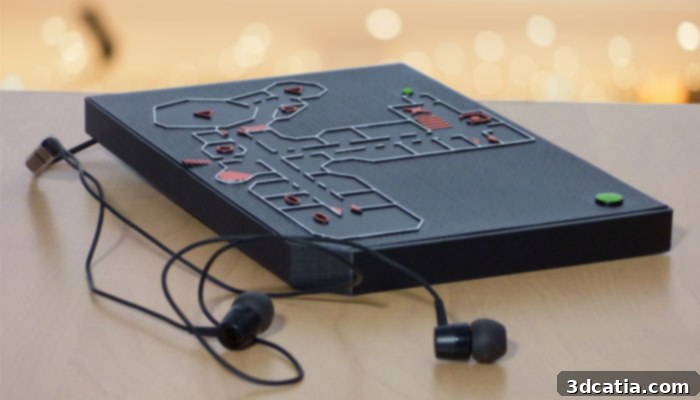
“Virtuoz stands as the world’s first tactile and interactive plan specifically engineered to empower visually impaired and blind individuals to navigate buildings with complete independence,” Huin explains. “At its heart, Virtuoz is a raised, simplified floor plan of a building, meticulously rendered with precise detail. Essential landmarks and points of interest are integrated into this tactile map in the form of unique, easily discernible symbols. Through a careful touch, users can progressively explore the space, developing a clear and accurate mental image of their environment, much like sighted individuals use visual maps. The interactive aspect comes alive when a user presses one of these symbols, triggering distinct sound information that significantly enriches their understanding of that specific location or feature. Furthermore, a patented plan change system allows users to seamlessly access information for multiple spaces or floor levels, offering unparalleled flexibility and comprehensive guidance.”
“The impact of Virtuoz on its users is profound,” Huin emphasizes. “It significantly reduces stress often associated with navigating unfamiliar environments, instilling a newfound sense of confidence and empowering them with greater autonomy. This freedom allows them to explore new places and experience spaces they might otherwise avoid. Our core belief is that it is high time visually impaired people are granted independent access to all environments. This includes their workplaces, administrative buildings, vibrant cultural venues, popular tourist sites, and crucial public transport systems. Virtuoz isn’t just a map; it’s a key to unlocking a more inclusive and accessible world, providing a personalized pathway for every individual to choose their own journey.”
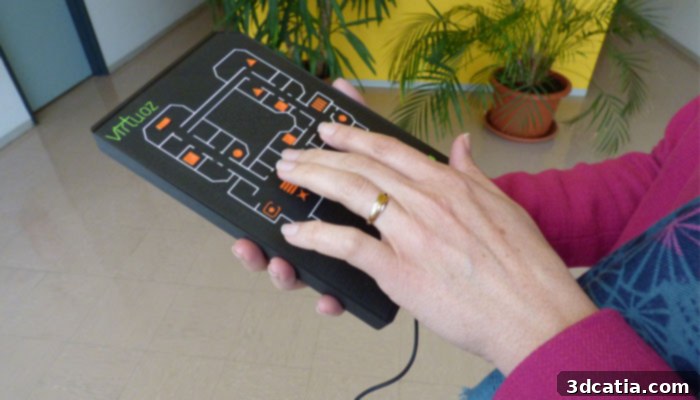
The Virtuoz tactile and interactive map in use
The Indispensable Role of 3D Printing in Virtuoz
“3D printing is not merely an option for Virtuoz; it plays an absolutely vital and indispensable role in the creation of this device,” Huin states. “The unique and highly specific design requirements of Virtuoz could only be realized through additive manufacturing technology. We collaborated closely with the Toulouse research laboratory to develop what we call ‘Seek to See’ specific symbols. These symbols are engineered with an intuitive clarity, allowing them to be readily deciphered by both visually impaired and blind individuals through touch alone. The incredible fineness, the millimeter-perfect precision of these symbols, combined with the required robustness and premium tactile quality, are paramount to the usability and effectiveness of the product. Traditional manufacturing methods simply cannot achieve this level of intricate detail and tactile fidelity. Furthermore, the ability to offer customized, on-demand, and cost-effective manufacturing of these unique plans is exclusively possible with 3D printing. Our deep expertise and extensive know-how in 3D printing, coupled with its immense potential, have been the cornerstone of creating such a user-friendly and impactful product. It’s the only technology that allows us to deliver the complex geometries and personalized solutions that Virtuoz demands, making it accessible and effective for every user.”
Technologies and Materials Driving Innovation
Regarding the specific technologies and materials employed, Huin elaborates, “Currently, our primary focus is on Fused Deposition Modeling (FDM) with Nylon printers. FDM technology allows us to create robust, durable, and highly detailed tactile surfaces crucial for the Virtuoz system. Nylon, as a material, offers an excellent balance of strength, flexibility, and a pleasant tactile feel, which is essential for products designed for continuous touch interaction. However, our development roadmap includes continuous evolution of the product. Our projections for future enhancements mean we are actively exploring and evolving our material choices to introduce even more advanced functions to Virtuoz in the coming months. This might include integrating new functionalities or improving existing ones through advanced material properties, further enhancing the user experience and expanding the system’s capabilities.”
The Transformative Future of 3D Technologies for Disability
When asked about the broader implications of 3D technologies for disability, Huin offers a hopeful perspective: “3D printing possesses an extraordinary capacity to profoundly improve the lives of people with disabilities. Its inherent ability to enable extreme personalization and on-demand manufacturing makes it a uniquely suitable technology for addressing the highly individual and often varied needs of each person. Unlike mass production, 3D printing allows for tailored solutions that cater directly to specific requirements, from customized prosthetics to highly individualized assistive devices like Virtuoz. However, it’s crucial to acknowledge that this remains a technology that requires expertise to ‘tame,’ and the design phase of these intricate parts constitutes a significant portion of the final product’s cost. The good news, and what gives us immense optimism, is the rapid acceleration of technological developments in 3D printing. These advancements are steadily driving down production costs, which in turn will translate into greater accessibility and more significant benefits for users in the near future. As the technology matures and becomes more widespread, we anticipate a democratization of these life-changing solutions, making them available to a broader population in need.”
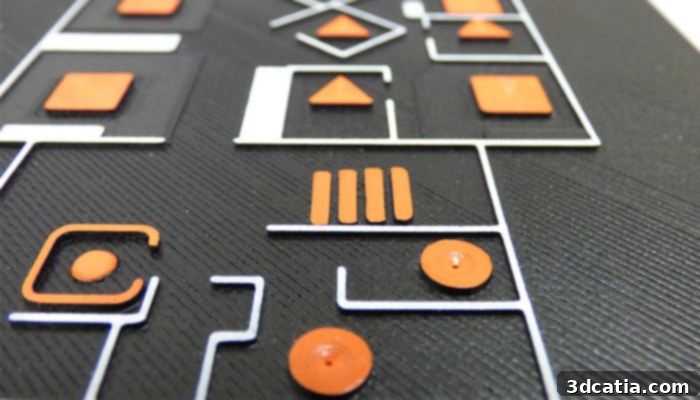
A close-up view of the Virtuoz interactive map showcasing tactile details
A Message of Hope and Collaboration
In his closing remarks, Sylvain Huin shares a powerful message for our readers: “Undoubtedly, many beautiful and impactful stories will be created with 3D printing for people with disabilities. These innovations will stem from initiatives that are genuinely rooted in understanding and addressing true user needs. It’s imperative to remember that in the realm of disability, technology serves merely as a means to an end—a tool in the service of humanity. We encourage startups and innovators who are dedicated to improving the lives of people with disabilities to federate and collaborate around initiatives such as La Handitech and FEST (France Eco-Social Tech). These platforms are crucial for fostering a collaborative ecosystem where ideas can flourish and collective impact can be maximized. What is certain is that no single product, however revolutionary, will entirely solve all the complex problems related to a specific type of disability. However, by strategically combining different tools, seamlessly connected and working in synergy, we can significantly increase the autonomy and enhance the quality of life for users. We invite everyone to learn more about our Virtuoz solution by visiting our official website.”
What are your thoughts on the groundbreaking solution developed by Feelobject? We encourage you to drop a comment below or share your insights on our Facebook and Twitter pages. Don’t miss out on the latest advancements in the 3D printing industry; be sure to sign up for our free weekly Newsletter to receive all the essential news straight to your inbox!